Lo! See how quickly the empty spaces are filled, when the Light comes to answer the darkness's wanting!
ONE of the truly wondrous qualities a really good story holds, is that it may be brought out and retold afresh in a very many variety of ways and yet bring to its new listeners ever more surprises and insights each time. Stories, really good stories, may satisfy the intellect with configurations of happening with twisty, crafty words. However the real happening of appetite occurs within the soul, which is addressed in a language it knows.
Our souls know stories, many stories, very well. Our own panoramas, our Iliad's of being, our traveled adventures, our heroic demise, our pure beginnings, vigorous at the outset, championed with petition, continued over eons.... our souls have followed the saga of self, and also of others (which they instantly know just upon greeting). The soul's senses are stories, in telling and retelling.
Perhaps it is a way in which the future may cordially come to the past. The recall of the soul's great stories is of course a repetitive force. Reliving, retelling, and the anticipation of those 'bits' we love, the best - this percussive effect of the story actually gives each and every one of us within our consciousness, that overall enjoyment of familiarity.
It is this aspect of soul consciousness which delights in what could be ordinarily placed as 'common' or even tedious. For example, when I take to myself some information about my whereabouts I do not need to intellectually or egoicly reestablish those details again and again. In the process of acquiring this knowledge we need only to establish the details the once, and then proceed to forget until such a time as we may draw upon the acquired wisdom on such occasion that it may be needed.
When we return to the once learnt knowledge, it will be (intellectually and egoicly) with the brevity that nods the head in hello, rapidly and only half consciously acknowledging the details about us. If this were not so, if we actually spent as much time and energy relearning what we have already come to know, then of course we should not have the opportunity for much advance. We would be living with the constant surprise and confusion which some poor imbeciles exhibit. Yet it is not so much a lacking of mind in relation to their abilities, and development, as one might suspect in the circumstance of imbecility, but moreover an inability of soul being made manifest in mind. Because it is the soul qualities which enable our thinking to summarize and memorize, whilst at the same time, be able to enjoy the regurgance of timely placed familiarities into the bargain - the abilities are conjoined.
Without the soul qualities in our mind's comprehending, we should come to the world greedy for knowledge, yet tired of its offerings. At times the egoic nature is so compelled with an avaricious desire to bring into it new knowledge, that it could easily exhaust itself overfilling with an eternity's sorting-through to manage! And the soul - well yes, there it is reshuffling the same old shoebox memorabilia, renovating the infinities, with that constant exclamation of 'look what I found', with such a predictably exact happiness awash with the sentimentality of it all!
The soul may appreciate the many stories with an almost impartiality for the characters within. Of course there will be the main hero, cast and perceived; and nobility of spirit is prerequisite to the telling. However the love of soul is such that in every scene of epic or episode, every other soul within its range is instantly endeared to them. They make up the story, don't they? Each character is essential to the whole.
The hearty 'boos' they applaud the villain with in a pantomime, is quite same for the soul's indifference also. Yet at the same time and having said this, the elements of tragedy are felt with far deeper incursions, and the exultation of any success won by the spirit is important and vital. The meaning is ingested. The soul's wisdom is not a fool's wisdom, nor is it an uncouth preamble to some greater thought to come. It lives before and after all other knowings for us ... cradling the ego, manifesting the spirit, giving life to the meanings of the past, the present and the futures to come.
To the soul's consciousness the stories of the gods are the stories of their own! This is another area in which differentiation is not chosen. There becomes a preferred experience of selfhood, whereupon the soul's self is juxtaposed amongst the cosmic splendor; majestic as any other, the roles are lived within.
As well as this we do also know well the stories of those of our brothers. There is something of a collective as it were, in which we are all key players, sympathetics and co-writers of the one, and this the soul can scan with all the understanding it might take for any human part to know, tragedy or comedy, heroic or romance.
You might ask: what is the difference between a 'story' experienced in the soul and the akashic recollection of memory. In explanation to this we can go a little further also in answering the question put to us earlier about Christ not being perceivable in the Akasha.
The akashic plastic is, in actual substance, the tangible memory of our beloved planet. It primarily belongs to that individuality which is incarnate within this Globe right now, and though men are privy to those parts of the memory which they signatory to (and in understanding of) they are in fact stepping into the realm of another, albeit associative to the incarnation we here experience.
Our planetary being has many systems of memory manifest concurrently, the akashic being only one. Etherically there is a living memory which perpetuates life and blueprints of forms to come. Magnetically there is a cyclic recall which perpetuates Rounds, Globes and subsequent streams. Archaically there is the physical antiquita, whilst also the evolving physical born out from the previously incised material; whilst these are distinct yet from its own soulic recall as well.
Now the difference between this form of memory and a very good story, lies in the material itself. Although remaining, the akashic substance is deceased from its origins and censored from further change (i.e. new beginnings or enhancements). Its nature and properties rely on this truth: that it holds not the means to become anything more than what it is, nor is it challenged to disintegrate and transform in that manner, in the immediate future. It is, by this standard, 'dead' material sloughed off by time as a receptacle to consequence which was made apparent.

Yes it is sophisticated as to be played with or viewed, but its condition is intransitory. Now this is an important point, because in contrast to the soulic consciousness of story retelling we find that the properties within and given from a story, actually further more life and contribute to the futures, whilst those of the plastic memory cannot. The 'who', the 'where' and the 'what' are all there, but the meaning of the 'why' has dissolved upon the ethers. This meaning evaporates out and seeks its place where it is known ... and the Akashic Chronicles in themselves are not self-conscious; they do not comprehend their own substance, unlike the stories which are born and still living in the soul.
Christ the God, Christ the God, is not defined in death. By this we mean His presence is not held in the akashic plasma because of the nature of its substance; He cannot be given (even in the smallest of parts) to that which is deceased. Let us explain further: whenever there is something of ourselves impressed or incised or remaining behind, there is an 'attachment' and a thread, and a qualifying correlation, which connects us to that very substance to which we have invested ourselves in. Our own properties of self and individuality help comprise many substances both apparent and non-apparent, and it is precisely this investiture which assists and enables us to incarnate more dominantly and create a further presence, in this manner of speaking.
If we bestow our impressions upon the physical world, consciously creating, working, making, constructing, blending, birthing or even breathing, then this conscious effort remains within the physical substance itself as well as in the higher worlds, to go on and assist with the evolution and etherisation of the physical world in the future.
We also impregnate physical matter unconsciously in the very body that we reside in, in the vapors we excite, in the impressioning of the substances we touch and govern; and this too shall rest in the memory of that material as a kernel for further properties to come, as the physical itself goes on to develop. Our investiture is part and parcel of our humanhood. We are interconnected with all future creation, to this extent and beyond, and the emanatory forces we project certainly do involve us continually within the general scheme.
Firstly we may consider what it would mean if Christ were to invest Himself preferentially in any matter and then sub-matter, as in the case of the akashic. During the Incarnation one of the paradoxes of The Event lay in the fact that our Christ did not penetrate the physical matter most fully until he had gone so far as to travel into and past the threshold of death and return. Whilst He was connected to and motivating the flesh which contained in part the mighty Consciousness, and at the same time while also His very movements created consequence in the etheric and physical worlds, it is also true to say that the matter which comprised this body (which was of the World, and so connected to the World and to all other bodies therefore) this matter which held links and keys to all other men and would determine thereafter the way of their flesh - this organic whole, the ecology and the particle, was not fully known by Christ until He met with that point of death and rebounded therefrom.
It could be said that His actual entering into matter had not fully, completely, comprehensively occurred, until that point of death and thereafter. So it is this period to which we begin to study His impact upon the physical world and understand too, that rather than the flesh He was in, being so overcome with Him during the time of His being within it, and rather than Him being therefore most partial and preferential to those particles which comprised His body during that time, we would suggest that there was moreover a cohesive separateness, rather than a rarefied condition preceding.
After His meeting with death, the conjoining of His Blood and His Waters poured into the larger body of the Earthly sphere and saturated her completely. But this Blood and this Water was not of this World; it was not of a substance so manifest as before. This was His Substance, which came leaking from His veins in Heaven. This was transfigured matter - a new property now incarnate, which had found its openings in every earthly pore, hungry, longing and now fulfilled.
When we relive this event during our break-fasted Communion we are soulicly enjoying this story. The story of a new matter upon our life here, afflicting with joy all matter now besides; the Incarnation into the World finding a completeness, but not solely by transformation within but moreover having been made catalyst in actuality rather by an import from without. This is an important part of this story. A missing page perhaps, the uncut version!
Oh! See how the world is now changed! We are different! With the Blood of Christ came the Will of God; with the Water of Christ was the flesh then transformed. Particles unite! Heaven be upon us!
So with a Love that travels out to all wanting spaces, there He was. Not particular to this one or that, but to all. Reliquary might be savored for those pieces the saints' infectious virtue have imbued, but with our Christ, our deliverer of all, there was no especial chemical knot, for His Hand is upon everything and He present therein.
What then of the akashic plastic, and His absence from this indelible record? Well, quite simply, He wasn't there. The explanation above really says it all. He wasn't really with us until afterwards, and then He was pretty difficult to find because He was everywhere at once. A bit tricky; but then He is.
But what of the consciousness you ask? What of the Christ, who appeared and spoke and conversed with real men, why cannot that appearance show through to the akasha in living color? Why not His Voice, and His Look, and His Healing and His Smile be there for us to find? Can we not know Him from this? Does not the Mother-world wish to memorize that which she can of Him? How can He be but not be, be all but be not and still be?
Have you ever known folk to shudder at photographs, voice recordings or even from their words being placed into print and copied? Such reproductions can have ghoulish qualities when experienced from the spiritual perspective, insofar as similarly to the Akashic Chronicles there becomes no living, developing reality. Though a reminder of a loving or rapturous conjunction, the creativity itself has gone from the copy; it is hollow in aspect. It is utterly representative of something former, but becomes not even that.
The recording of music cannot compare to the healing and inspiration which is provoked during a true performance, and yet there is a possibility with such a reproduction that the audience can imaginatively contribute to the piece as it is heard. When this occurs there becomes new a life each time in co-creativity. When there is this creative experience the recording has redeemed its poorness of presence and been reborn in that which it has inspired in mind or in emotion. Quite so, with any artistic imaginative reproduction - one which has departed the detail of the existence for something more.
In a painting, in creative architecture, fiction and mythology, there is the aspect of permanence, but also the spiritual bridge into the imaginative cognition that can offer a prolonged life beyond the factual representation. A painting works upon the soul very differently to a photograph. A song recorded differs profoundly to that of a mundane conversation; a diary account contrasts the dance of rhyme.
However, the Akashic Chronicle has no provision for creativity. It is not a medium for the imaginative arts where either soul or ego or angelic being can livingly correspond. It is but a sea of specters, a place of mundane fantasy, a trophy room without the heroes.
Question:
I have been guided to pause and consider the warning in our last teaching (25/10/98 'Introducing the Futures') that there is a state of ego which is both tense and contracted, and is the result of us being 'more aware of ourselves than that which we were responding to'.
It must be that self delusion plays a part in this as I have found it very difficult to contemplate. Also phrases such as 'selfhood', 'self-awareness', and even our (God forbid) Arterial Self, might all persuade us to curtail our response mechanisms to Life. Another persuasive saying that is popular, is that it is 'better to be pro-active than re-active'.
Perhaps our (my) inability to feel the Presence of the living Christ is proof of just how advanced this problem is in us.
Can you please give us some ways that we can study and practice so we can be more responsive and expansive to the 'new' and less self-absorbed?
Love,
John W.
THE term 'self-consciousness' pertains to that which is self-defining within that consciousness. Consciousness is actual, whether it is imaginative or experiential, whether it is integrated with levels beyond its physical bearings or culminating to and from the natural order ... consciousness is at all times actual, specific, determined and responsive to Life. (It is also provocative to Life, but that is yet another matter.)
The nirvanic 'blow out' of a consciousness which is saturate with an all pervading, all comprehending knowing, is but a perfect example of what you may come to when the consciousness itself has reached its furthermost points of being so completely contracted upon itself, whilst at the same time also being completely expanded beyond itself.
Similarly, if one were to lose definition of one's selfhood - become entity-non-identity, (through a number of ways, illegal or otherwise) - then we could assume that the condition of ego would be as flaccid as death, yet as stimulated overtly as well, submitting to all that besides (whether happily or not - and more likely not).
So we begin with the premise that a functioning self-consciousness requires a degree of precise limitation, without neutrality (for neutrality is soporgenic [sopor: inducing sleep; genic: producing, generating] to the awareness) and it is conceivably healthy that one's thinking and comprehending entitles the self-conscious being to set perimeters of self, even to the point of retraction.
Firstly we can acknowledge that there are two streams of thought in relation to those laws which guide a man throughout the courses of his starry travels in and out of time. As he is drawn to and from various experiences of existence, as he knows both the universal days and the universal slumbers between, when he is swept into much causality, yet effects many events upon himself; as he courses the ages depressed and diffused only to always ever be replenished anew - there are two streams of thought, in philosophical uncertainty, where it is suggested that Man is a being, at this stage of his development, more 'driven' than driving, whilst the other suggests that he is so driven that he drives.
In consideration to the Holy Spirit from which all is empowered to be driven and driving, we must firstly attribute all subsequent furtherance and universal motoring to that. In a second consideration as to whether or not men determine their own fates essentially, remarkably or determinedly - we answer thus: yes and no:
- Insofar as Father God gives us the essential life
- Insofar as Christ has characterized us to make this life remarkable
- Insofar as the Holy Spirit has empowered us to live determinedly
Yes! But without these three, no.
If you look a little further beneath the topsoil consciousness of any man you can see Christ and His Story quite animated within his being. This Life in affirmation - in repetitive monologue, the monologue of the Word - this Life is known by you and by all of those who especially ask 'But what of my inability to feel the presence of the Living Christ?'
The sweet air we inhale comes to us almost imperceptibly. We draw it in past the senses but know it not. If we smell foul or fragrance within the air, it is the foul or the fragrance we do recognize. Water is 'tasteless' and no matter what you may flavor it with, as a drink, you shall never experience the taste of the water itself. You will never arrive in the future, that at least is predetermined.
There are many impossibilities in which we begin to find that our self-consciousness has not the wherewithal to manage. But what if we could know the water or the air or the future in those very terms consciously, that they assist us with? The passage of Christ into our lives is as certain as respiration is to pure air, and thirst is to pure water. Here is one further thought: love, by itself, on its own, is also imperceptible. We know love by what it bears upon it, by that which it brings us, made active, in that which we impart. Do we know Love?
Yes our very angels are invisibly represented beside us, and the laws which contain and protect us are also quite hidden. So from this we can begin to understand that whilst we are defined within our self-consciousness we cannot be as exacting or discerning as we might choose to be theoretically. Some things at present, are not possible for us to experience or know on the levels that they most dominantly operate. Some things, though they be commonplace within our lives, needs, yearnings and existence, are not within our self-consciousness in like or in representation.
The term 'self-absorbed' relates quite wonderfully to that period in which the individual has taken a pause in order to assimilate much of what has effectually been received within him. Although this may be a preliminary effort which may go on to a contractive spasm, it is in itself a useful practice and quite necessary for one to go on and stabilize the ecology of their ego thereby. Inasmuch as it may intensify potentially the contractive condition, it may equally afford the individual a stronger position from which he may become quite expansive. To be self-absorbed, we would term as that time which we take-up that which we have taken in.
Even ideas circulate within our inner cosmic activity. They test the various magnetisms therein, they affiliate with various aligning attributes. Many present to us in dreams - fractured from their original context, we survey the various realities of insight in which we have not necessarily taken the conscious time or effort to absorb intentionally in other terms.
Meditations or spiritual exercises which require repetitive contemplations or mantric affirmations are all practices of self-absorption. Often we are required within these practices to refer to those concepts which contain the unfamiliar and the unknowable. In other words, the reality of that which we are contemplating is vague to our consciousness because it is only remotely comprehended ... and it requires the imaginative forces to help us sense the reality we are trying for.
In relation to self and the process of taking up as it were, we find that because the individual need work through the imaginative faculties in order to make progress, he is necessarily working 'within ', rather than experiencing directly that which is determinedly and tangibly, ordinarily and naturally 'without'.
There is often a caution given to students who attempt imaginative practices because of the nature of their inner work - involving the 'chaos' of such intensive traveling within. We find three considerations becoming apparent, namely:
- Reasoning
- Morality
- Physical health
Any aspirant upon the spiritual path would hopefully cherish his own reasoning to be as in accordance and enlightened by the divine reasoning which abides 'without' him. Reasoning in this context is neither rationalisation nor nonsense, but rather the ability to discern truth where truth is, and determine poorly evolved sequences for where and what they are as well.
We are required to balance our imaginative forces ideally with equal measure of reasoning, practical reasoning, and the discipline thereof. This will enable us to be strong enough to recover ourselves out from any given imagination - and this holds true for the novitiate to the initiate; for it shall be the same forces employed in the early work to that which will later become so plastic to the spiritual realities that one is transported directly into the realm. So one might say it would be inadvisable to encourage an individual who had difficulty with reasoning clearly, to practice intently that which required an imaginative practice. It would only encourage madness to do so.
Morality is very much a concern because our own personal demons may be encountered and exaggerated when inflamed with the imaginative forces. If our astral body holds a predisposition towards a certain corruptive behavior; if for example we are given to violent tempers, weakened by years of narcotic practice; given to indulgence whereupon the astral body begins to feed upon its own desires; if our thoughts are undisciplined and our criticisms are hurtful (bearing in mind that thoughts hold as much reality in the spiritual world as actions do in the physical world - for which we have impact and are accountable); if we are beset also by traumatic memory (our own or of another's imprinted upon our subtle body); if we are attempting the meditation or exercise within an environment that has formerly been corrupted .... then we are at danger of enhancing those very characteristics there within our less fortunate nature, and giving them life through our very imagination.
Of course the very best of men shall confront the many weaknesses and demons of both himself and of the world, but there are the majority of individuals who are not sufficiently prepared, and can measure this themselves by asking first of the above.
Lastly there is also the consideration of the physical condition, because interestingly enough one may be overcome in the imagination by a prevailing problem that is experienced within the body itself. This is a fascinating occurrence - we have seen many student who have experiences of a fantastic nature described, whereupon they have gone inward only to meet Mr. Colon or Mr. Lymph etc. Now this is not to be discounted because the process of such traveling can actually find its way to many places 'without' as well. However, for the beginner the problems may originate if there is an underlying malady within the physical system which is disrupting the ecology of all.
This is interesting because folk may presume it to be a corrective practice to an illness, to meditate or concentrate imaginatively so that the original health may become restored. However, once again there can be an exacerbation of the problem, if in fact the problem itself holds a spiritual causation which is ongoing and unattended to.
This is why it is recommended that students take their rising thoughts that drive them inward, to search directly for Father God or for Christ, or of the realities of the virtues themselves. If the motivation into the imaginative forces is primarily for psychic experience, if the eagerness or intention is upon unlocking the spiritual existence in general, there are many more excitable forces which may go on to stimulate a pursuing chaos therefrom. It is a serious matter when we urge our thinking into abstractions which require a relaxing of self, coupled with the self-absorption thus spoken of.
For example: if I am to meditate upon the properties of a given plant I may come to the plant informed as to whether or not it is poisonous, and I may go on to discover the properties of that plant: its aspect, its virtue, its radiance etherically and so forth, as experienced simply in its presence and through my imaginative clairvoyance. Yes, this can be done.
Moreover however, individuals begin to imaginatively project what they creatively feel the plant should or could be to them. Yes, this can also be part of the spiritual exercise to do just this. Yet depending upon the efficacy of the student in discerning the truth of it, it may also become a dangerous nonsense. If you are clear enough in head and heart to intensely come to the plant for the sake of the plant, to realize the plant and what it may bring to you, then it requires that you be relaxed imaginatively in that sense of self and what you may already be predisposed to thinking about the matter. This is something of a contradiction, because on the one hand we are emphasizing the importance of interpreting a truth when it is before you (rather than Mr. Colon rising up before your inner eye and appearing as the plant) and on the other hand we are suggesting that you must also be required to relax the preconceived ideas in order to make the imaginative and empathetic connection.
This becomes more complex again when the plant itself is but a modem for another form of spiritual life to be represented and experienced within it. However and funnily enough though, there is no guarantee that if one were to try to find Master Buddha amongst the stem and bud they would not be discussing with Mr. Colon instead! Now it may well be important to meet with Mr. Colon and it is not intended that we trivialize the miles one could go with him, but what is to be regarded is that all intent holds consequence, and when we enter into those self-conscious practices which require a repetitive employment of imaginative force we should be careful indeed, and most prudent with our intentions.
Never enter into such practice in a disturbed state of mind. If there are questions begging to be addressed, if the mind is wandering over its duties for the days or weeks ahead, if the physical body is fatigued, it is recommended that one does not try to become imaginative to correct the instabilities. But if one so desires to pursue this path of exercise (after satisfying of themselves that they are indeed reasonably, morally and physically able) always then return to the task only when the body is rested and the mind is obedient.
Question:
What is the difference between prayer and the imaginative practices you have described? Wouldn't prayer be healthy? Isn’t prayer an imaginative practice too?
The distinction between prayer and all else (in relation to this), is that in prayer, when we ask for the umbrella of grace to anneal us, we by the very prayer to God or to Christ are then given to them. It happens at the beginning, in that first inner cry, that wondering to meet with them, the solemn longing when we experience our depths within - it is what it is, and in this is far from abstract in the practice.
Although prayer may assist the self-development, and it is possible for one to pray for guidance in this self-development, one does not usually pray in the context of self in that moment, to come to experience. The certainty often felt, the peace that may follow, is because we have relaxed our egoic stronghold, not so much without our bearings, but within, in relation to the divine workings of our life.
As you may begin to see now, there are many ways we consciously and self-consciously react and adapt and address experiences which come to us, and it is no easy mean for any individual to attempt this, let alone one who wrestles also with a succession of past selves who beg addressing. Our transition into prayerful thought allows the unknowables to pass before our invisible eye and enter into our invisible taste, and be drawn in and through invisibly responsive egos. We sense quite perfectly that there are unknowables - the variety which are good and pure and perfect of substance and character - and we ask of their charity, without any effort of self.
Every man has been given prayer as remedy, as a dignifier, an ennobler and collaborator with the highest of powers. In prayer we are capable of exceeding the limits of this Globe immediately. It is true to say that the passage out is still inwardly taken, but it is not confined within this world at all (as it is with the imaginative and psychic practices).
In order for a man to interpret this world with an extrasensory psychical interpretation, there needs be a physical system he has developed which is conducive to the forces that shall go on to cause the extraordinary abilities. Some men are born with a clairvoyance which occurs naturally (i.e. they have not intentionally driven a chaos within), whilst others can come to experiences through injuring their centers of activity and perception (narcotic or spiritual practice); whilst others may find that they come to intermittent experience later in life due to the natural development which has occurred because of a wholesome inner activity, as their bodies become stronger and adaptable to 'go to the edge of reality' and perceive some localized etheric or astral vitality.

However, clairvoyance itself may be distracting or disruptive to the ill-prepared. In dream-life men have many clairvoyant experiences and know from this how 'at the mercy of' they often wake feeling. Would that you were capable of producing your dreams as self-consciously as any movie director, you would then begin to be at that level of development which could accordingly quite manage a natural clairvoyance. If not, then you are as susceptible and suggestible to the outer influences of the day and the inner pictures which present, as overwhelmingly as the bizarre and the nightmare from which you still fall influence to.
What then of channeling and mediumship? Many people have recently asked about this ... and in the light of what you are saying, how does it follow that this form of clairvoyance is for self-development when it intentionally puts self aside to effect the process? Before coming to this question, it should be added about clairvoyance in general that there are those folk who have atavistic tendencies which come from an older form of consciousness (and physical body), that they bring with them into this life. Then there are the mainstream incarnates, which during this period have forgone much of their 'chaos' in order to work their relationship with their physical body (this occurs on many levels and is no small work in the incarnating/deifying of matter); and then there are those also who begin to introduce the attributes of what will become clairvoyantly in all future men in some centuries to come. These three categories are naturally occurring conditions, which once again we reiterate, are not synthesized by externally imposed practices.
In relation to mediumship and channeling there becomes a sacrifice given to the ensuing entity whereby the individual forces themselves out from their own body's centers of activity of consciousness and willingly makes way for the submission to another being's presence and influence as well. When we depart our consciousness from our body during sleep, prayer or meditation, the connecting auric fibers are apparent and relating, and our body, which does love us faithfully, is still the living representative of our being. However, when it is temporarily ensouled or enspirited or endeva-ed or enshrouded, when this body is haunted by what is a disincarnate being, there are two conflicts taking place:
- the body itself is becoming imbued and incised with a completely different characteristic of indwelling entity
- any entity which has not the living keys into incarnation into matter does not negotiate matter, but rather imposes upon it and disturbs its processes. (Viruses can be viewed in this manner also.)
Some might maintain that there is no harm in one receiving into their body a 'higher' being and subsequently becoming imbued with their emanations and so forth. But here is the catch: we maintain that there is no possibility of a greatly advanced being ever entering into a human body of another or being attracted to do so, unless the nature and development of the owner of that body was also so advanced as to meet with its needs in every way. Even then (and this would be rare indeed), there would still become unbearable searing tensions within both the habitable frame and the purity of the passing spirit, and they could not coincide for very long at all.

At present the physical condition within the substance of matter, being what it is today, is so difficult that even advanced souls whose bodies belong to them, are worn prematurely and must be rested and properly restored in order that they can keep up with the forces within the etheric. The very properties of the etheric vitalities which enable life its continuance in matter, do also very quickly tire the matter as well. It might make for a great looking corpse, but it still has its operational and functional problems!
Returning to the question of channeling and mediumship, we find that in most cases the individuals concerned are rather 'overshadowed' by certain entities instead of being actually possessed temporarily by them. This overshadowing holds to it a safer proximity of action whereby the body itself is not interfered with, although the subtle exchange still requires that the psychic is given in self-consciousness to the then overruling 'other'.
This negation of self brings about an interesting question, namely: to what point do we trust another's thinking or being to be preferable to our own? What makes a man then another? In channeling one surrenders their right and responsibility to self-conscious discernment. Conversely, when one is overshadowed there is still yet a portion of that self-consciousness present which can at any time enter back and take charge once again. In the submission to channeling the individual is disincarnating. He is discharging himself of his obligations in the world. With the case of an individual being overshadowed by an entity, yet not overcome, there is a coherence which remains - indicated also in the fact that the voice will not change, the breathing etc. is not interrupted in the exchange.
As to the question of our self giving preference to another self with opinion, with ideal, or even with a consuming affection, the reality is that no man or woman can become for another in the long run, although with mutuality there can be great assistance offered both equally.
It is natural to for men to seek out higher company, and to a degree the influence of any who holds a greater ability will 'rub off' to the point of introducing the way into the signature of the virtue or ability that is admired. But this cannot but lead the way to such laziness, as with those who believe it is enough to simply keep company with the great and yet not do the work that it also entails. False pride is very dangerous because it dissuades folk from their true potential. So it must be said that each and every one must become great souls within their own right; whilst at the same time exerting both patience with their own attempts in timing and patience with the progress of others as well.
That we may choose to take into ourselves the advice or opinion of another, displays that we hold them in such high regard to begin with. Whether it be the advice of a person or a disincarnate being, it is important that we are mindful that the responsibility of our own thoughts, whether borrowed or not, always returns to ourselves; this, you cannot give away. It is precisely this attitude of responsibility which will further the aspirant into a heightened sense of self-consciousness as he progresses along his way into spiritual insights.
There was the issue raised about returning from that sense of Arterial Selfhood and reconnecting with the world in a way that is not separate, but expansive. When men become more awake in the world they commonly feel as though they are distanced from all that they were once a part of. They gradually find that the consciousness that once was taken up in the moment reservedly looks on, with the watching aspect of a guardian soul; and this sense of separateness comes from the yearning to empathize more. This indicates that the man is actually embracing so much the greater than he did in the past, because he begins to deservedly try for something better.
When folk are given to a group mentality (in the context of camaraderie or tribal consciousness) they find comfort in dissolving themselves within that greater group consciousness. But this does not mean that they are actually contributing much of their best or truly empathizing in an expansive way. If anything, one can see in looking on within such groups, that it is as if the participants agree to extinguish each other's selfhood into the bargain of foregoing their own. You see this may appear to be a condition of great love and affiliation, whereas if the folk concerned are not being true to their egoic tendencies and needs of the working self-consciousness, then it is but an elaborate stage-play, albeit with a chorus that we all know so well.
It is no wonder that men come to the prospect of real connectings being possible, and then fret for such in every situation, even that which did not, in truth, hold so before. Yes you can contribute and encourage, but one also comes to realize that this may also be a willfulness, a single-mindedness, which will be frustrated because the correspondents are not ready to meet your consciousness as you would have them.
We are often disappointed at the sore contrast between the dynamics from soul to soul, in inequality, in unresponsiveness; and so the question of living an expansive consciousness amongst these difficulties is well put, and important to the consideration. We find that it is not, however, the development of the Arterial Self which incurs a contractive selfishness, but moreover the ashamedly low opinion one might hold of love and the importance of laughter.
If there becomes a difficulty in reconnecting it may well be the case that you are not asked to be connecting. The time may not be right, the place, the people, wanting, wanting you. They may need to connect to something or someone quite different now. This is something you cannot manage on your own. One cannot single-handedly effect a whole connection! Rapport must be given, it can not be taken. It is a difficult thought. Why are we not required? Will the world not turn? - and so forth. We ask it all the time. Still more disappointments.
So we go where the great love is. If men invest their love wisely, and invest and invest and invest and invest - if they go where the connections are lively for them, and discern gracefully where they are not, then they begin to be worthy of their arterial connection to Father God with honoring this self-conscious actuality. By all means, one can be in many places and try always to be good company, with a cordial and sincere interest and interaction; however, if upon the trying, a situation does not discernibly feel right, then know it and decide upon it and move on.
Self-consciousness can be remarkably uncomfortable when we discern difference upon difference, but it also equips us to venture into those things which are worthy of our investment in the long run.
We have spoken so often of the needs within men to find light-heartedness, and to reconnect with the world through that which they love. This does not mean that one must find merriment where it does not exist or manufacture love where it is not sincere within you. Such falsities are disastrous, for appearances are nothing and the effect upon the soul within is debilitating. Christ does not Love us because of obligation. He actually enjoys it! He rejoices!
He delights in you!
He is confounded by your beauty!
He is absorbed with you!
He is dedicated to you!
He is excited by you!
He is cherishing of you!
He is protective to you!
He is loving the Love that he holds especially for you!
He Lives for You!
He died for You!
And He finds you are very lovable indeed.
What a profound meditation this is. That we, all of us, do make Him so very pleased - so lively and so complete.
Our next paper shall deal with anxiety and its many conjuring specters.
Good cheer to all,
XXX
- Pneu Vs New
perchance,
to dance,
the dance,
of bones.
they dance the song
of long ago.
with skin on drum,
the heart beats on;
percussive strain,
we dance again,
and again,
and again,
and again,
and again.
ALL causality must answer and respond to a higher remedy or else it would be predeterminately destined to ever make an inescapable rendition of itself. That the spiritual worlds manifestedly intermingle with all kingdoms of physical residence is proof of this very law. That nay, does the spiritual not simply merely coincide with all physical properties about, but rather that it does so with such determined coincidence that it becomes remedial to these distinguished particles with which it corresponds, one by one.
Answers to cyclical stagnation are to be discovered within the higher reference. Now what does this mean? How is this effected? All that is within the physical is vesseled with a womb-like holding. It is contained and cradled and kept separate. There are buffer spaces and fields of formative energetic and emanatory forces, dividing and detecting, remaining magnetic within their own reference. Matter pools and collects amongst its own. It may adhere and adjunct, it may comply and correlate, but essentially it is distinct and separate in its nature at present.
The physical world therefore is a compilation of much separateness. Innately the human soul collective knows this condition of the world and is distressed by it. There is ever a need to believe and sense a higher harmony that will draw together the material elements and create them, to appear as a cohesive whole. In truth however, that which participates within the material realm is self-contained, with actualities which stream back to distinct histories that argue perspective, definition and even reality amongst themselves.
This occurs from the highest representative of life into the minor aggregates with uniform prediction: beings are self-contained within their cloth of matter, and all quite capable of duplicating, replicating themselves, which in a manner of speaking, we do just in order to carry into the next day and further. We are very busy about ourselves repeating ourselves.
Life is affirmation. As a manifestive being I am establishing who I am with a constant recreation of myself, over and over, whether it be in memory or in active thought, in the unspoken dialogue between my own presence and the present I now dwell in, I am constantly reaffirming etherically who I am with a pulsing signal of beingness. This repetitive saga is maintained without a self-conscious participation and is supported on many levels by various beings who promote such laws; and much of this ongoing reaffirming of life as is known will continue on after the expiration of the physical matter also.
Now according to the boundaries of any given being's circumference, the constant as it is (or would be) on its own is not capable of variance from what it is. Neither vacuum nor addition can be brought in upon the containment. Imagine it so ... the chaos of possibility! Yet amongst the myriad of constants which cohabit this realm, there has to be somehow, somewhere, the provision for evolution, development, for change within a future as yet unknown.
It is of course the oldest joke imaginable and it relates to the introduction of new esoteric thought as much as anything - that is: if we knew ways to effect the future right now, it would already be presently with us!
Predestination is but a concept that the Past would have you believe in! It is the Past speaking (quite often the far past, which repeats back with its inclining tendencies). It does not belong in the Future! This is not said to in any way disown the benefits which are brought to us by the very laws and cycles which we can rely upon. It is not to discredit our need for such repetition which occurs throughout and upholds the structures of existence, but if you catch the concept you may begin to comprehend the spirit of the new which is yet to become in both Man and the World, which we at present may be indifferent to. It is singularly different to the operations of our historical tendencies.
Before we persist with the introduction to the Futures, cordially we may acknowledge amongst us that it is very true to say that anything which is new is not necessarily better; just as there are no outstanding claims to providence being preferred either.
What can be said is that past offers us:
- Our arterial line which connects us back to our eternal beginnings, our residence with Father God.
- The sum total of who we currently are, including also an associated and abbreviated knowledge of all beings with which we combine with accordingly.
- Reference perception - the interpretation of perceptible manifestations because of correlating past inferences with reliable findings.
- Subjective (ego) and objective (soul) memory.*
- The persistence to exist. The 'pulse' which goes back and streams from our eternal beginnings is fired with a perpetual repetitive force (as discussed) that promotes continuation.
- The knowledge of both good and evil. This is a living, resonating knowledge.
Everything which we are is reaffirming itself and lives to relive what it has known. When it comes to those darker periods of evolution that Man has passed through and gathered in, there are aspects of self that would be preferably dispensed with. It is this part of the past we should seek to exchange for future aspects. Whether we view this within the personality or elemental tendency,
- by zodiacal exaggeration;
- by determined and sclerotic egotism;
- physical determination - whereby the physical nature dominates the individual's responses in the world overwhelmingly through the dictates of carnal desire;**
- our Double and his repository of insult;
- those obstinacies which insist that new virtues are unrequired;
- and finally the demons themselves that contest our own change for the better.
This subject becomes rather involved, but is well worth purveying. The demons just mentioned belong to families of darker proportion. As men we have carried them over from ages in which we were stationed in places that were once so far removed from the Sun that we ourselves had begun to forget its existence (although carried it within our being).
We have all known incarnations of quiet splendor and periods of rest in between, however also there have been episodes of 'life' for us all when we have been amongst characters which did not exude warmth or compassion to any degree. These original beings were not offcasts of ourselves, but rather independent to our own beginnings.
When our own egos were so immature they actually experienced the worlds we were in much like a large mirror. Our loving and trusting egos took to themselves and copied faithfully the outward remonstrations taught to us by all kinds of beings around. Even to this day our astral bodies are sensitive (particularly in small children) to copy and exact much of what is offered simply by proximity; and similarly so our earlier days were filled with eager collections from far and wide.
Added to this we bear the demons of our vanities. A vanity is a point of pride which has outlived its usefulness. A vanity is self-fulfilled and its 'worth' is self-determined. They are particularly destructive when they inhibit us from recognizing the true merit in others; or in ourselves, either in possibility or actuality.
We may return now to our original thought describing the repetitive nature of the material existence and all within it. There was the thought put forth that the way to break any given cycle and introduce something new into the enclosure of being, is from the infiltration of a higher perspective. If it was not possible to effect change within any repetitive scenario then such continuum would turn into waste - it would become void. If we apply this to the particular, for example we may begin to qualify what might be a useful departure from one's expected behavior (to that which is either with yet more repetition) or purely chaotic. The question, entitled refinement was:
Question:
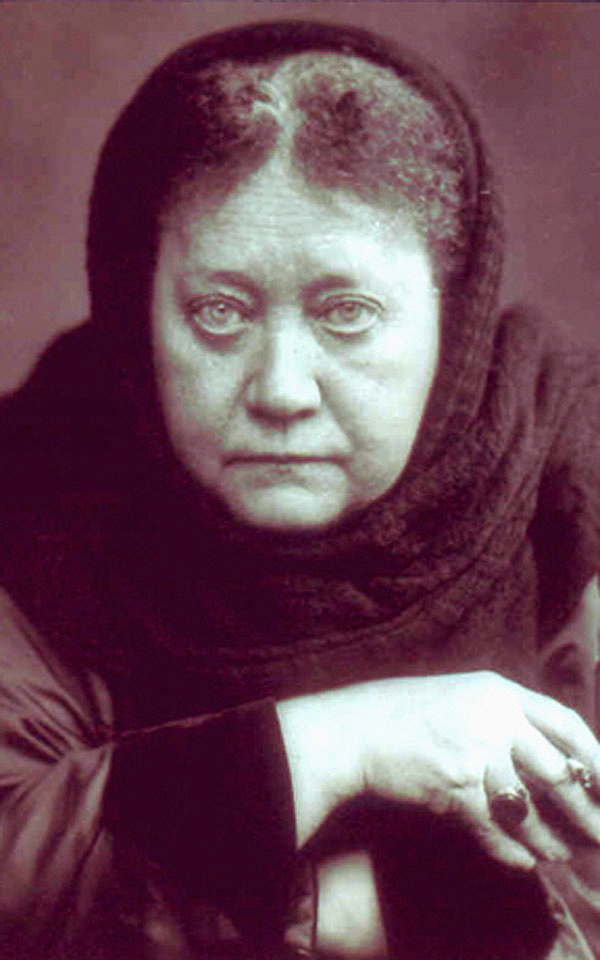
I feel that a beautiful friendship blossomed between Madame Blavatsky and her nurse/companion Countess Wachtmeister at the end of Madame's life.
The Countess was blessed with this only after she ignored all the warnings about Madame Blavatsky's rough and ready manners(and worse), to take on the carer's role.
Refinement of our spiritual nature to be purer than pure gold seems only to have ever been advised, but is there an inversion of this principle necessary in our behavior towards society as a whole in order to shake out our true selves?
Love,
-John W.
Ah! This appears to be a two-edged question, which is doubly pertinent as we may incorporate also the larger topic of the 'work' as well. Firstly, in regards to Helena herself, it is not for us to make personal remarks as to whether there was, in her relations with others in their outbursts, inspired departures from the normal circumstances, repetitions of what was expected or chaos - but it does make for a good study's speculation nonetheless. For here was an individual who was so very capable of being inspired with the very highest motivation, with caring and thought in relation to the men and women around her. If at times there was an explosion of words coming from her, one can understand that it may well have been the only way seen to help break the very repetitive nature (and confines) of the thought of the dear folk around.
The proviso for this behavior being pertinent and most useful is in its content, and in its source. If we are in company and our behavior does not fulfill their expectations, if it indeed breaks the cycle of habit socially or the usually preferred, then it will surmount to a chaotic destructfulness if our considerations are not of the very highest value. Therefore, if we act outside of our (or their) habitual nature to bring about a 'new' experience or help deliver a new thought into the environment, then it shall not begin to be effective if it rests solely on the plane of thought we are both already upon. It needs be drawn in from a source above the given and the usual. It must also be quite free of the mundane, of motivation, of self-interest and yes, to a degree, formality.
Perhaps this is why folk find sincerity refreshing, and often as a signpost to sincerity they look for the unexpected comment, the outrageous observation. Sincerity itself may well sit comfortably asleep in the lap of all habits, but as men we mark consciousness and experience with notable and outstanding events. The refreshing aspects of honesty and sincerity are not so much the honesty and sincerity themselves (dogs are atrociously honest), but rather that there is a break from the old self, the former self, the expected self, and a combining with another in an effort of consciousness that actually begins/sparks/introduces a future hitherto not known previously.
In this way we can acknowledge that our behavior to society as a whole may well determine a shaking out of theirs and our future selves, if self-consciously worked with the highest possible qualification. This does appear contradictory to the discipline of presenting oneself with a steely self-control admittedly. Yes it does, doesn't it? Respect for one another is often acknowledged through good manners and the compliance to customs, and it is important that we respect all men equally - both the shopkeeper and the king are entitled to our respectful considerations. We can respect the Christ-God within all men and love that about them - being as affable and congenial as good sense permits. But we are not required by Him in that love to live to conformity if that conformity perpetuates sorrow, hate or shame.
If custom, habit or social acceptability asks us to belittle ourselves (or another) then it is then a matter of bad manners and no respect to follow through with it. Even in the sphere of expected behaviors there must be a self-consciousness prevailing that so decides. In this we will come to a refinement, because we shall be true to merit itself; sometimes finding it in the most unexpected places!
On the subject of Helena herself: some have the talents to displace and dispel the old ghosts of disused thought. Summoned out from ancient strongholds of incorruptible truth came both the legends and their shadows, forces of wisdom and the 'unknowns' who oppose, into a materialism then so encapsulated within its own cleverness it was verily the dragon eating its own tail! Remember? In perpetual statement thereof of itself - around and around this dragon now spins - the material existence almost at that point of becoming so tight-bound that the spiritual forces were beginning to be repelled.
The question in this century to come, as to how best one helps to bring into this materialism fresh truths resplendent with life for the soul, hope for the heart, clarity for the mind, discrimination for the ego, tolerance/compassion for the being, and help Christ incarnate in the World, is still being asked in this moment. Yet the fissures are tightening ever further. The contractive forces are prevalent. There is a hardening and a sharpness, entailing each to his own, each to his own.
This paper is controversial inasmuch as we suggest that evolution does not imply merely repetition: that true development would not mean that we live out the past and go the rounds infinitely, but there needs be wisdom offered to men that brings in a new knowledge also.
We have two further points of consideration now before us, namely:
- How are we to know that the future is at all to be desired by men collectively or individually? (In the stead of the past.)
- By what means can we help to effect this, given especially that the world is ever tightening further and the physicality is becoming ever more uncompliant to the new issue.
In esotericism one fundamental law is that you will find the 'keeper of the key' at the point of its origin. This goes no less for 'newness' in relation to Man. From where and from who did this newness begin? Our original new World and all of its marvels came essentially and empirically, remarkably and quidditively from Christ – introduced to men by Him, and shall be received a'further, through Him.
The lesser gods continue to promote those retired impulses from the past (as do the de-men gods too). But in that which becomes retrogressive (compactive, contractive for Man) there becomes no provision for the futures, only perpetuation once again of former times of being.
We can look to any organized body of men who share faith/beliefs/codes to find whether or not the spirit of Christ is there in amongst them. His Name itself is to be found in living form, i.e. the term 'Christian' is no real indication of His living Presence within a given man or body of men (although a fine beginning in the asking). However, the true Son of God must be verily born in the man - made manifest in attitude and disposition of heart and consideration genuinely. Then it is that Christ's Name becomes 'Mary' or 'Joseph', 'Peter' or 'John', or whoever becomes His representative and lives as He does thereafter.
If men would commit to a work of faith collectively we ask that they appreciate that which invigorates the Futures, and that which condemns them. You see, Love by its nature is expansive. It is only by Love that we can make safe openings within our shells of physical resistance, within our spheres of ego-definitives, amongst our peoples of contrasting intelligences, even amongst the spaces of the sky which would crack and congest if it were not for the issues of Love itself.
We can examine any body of men with this qualifying power and try to interpret further in relation to the Futures and ask:
- Are these men loving? (EXPANSIVE)
- Do any of them profit from each other? (contractive)
- Does the group give charity outside of its own? (EXPANSIVE)
- Do they enforce a charter of membership with rules? (contractive)
- Do they obligate in any way? (contractive)
- Are they tolerant of the joys and loves of others? (EXPANSIVE)
- Do they condone death? (contractive)
- Do they encourage creative individual thought? (EXPANSIVE)
- Do they encourage destructive thought? (Fear, hatism, pessimism, anarchism, etc.) (contractive)
- Is there a vanity independent to their worth? (contractive)
- False ego? (Subservience to another without reasoning or proper effort to work on behalf of one's own ego) (contractive)
- Sense of self? (Ability to exercise discrimination and develop ego) (EXPANSIVE)
- Humility? (Proper perspective as to place in Cosmos - respective reverence, awe and wonder because of) (EXPANSIVE)
- Is there an exchange of money for spiritual training? (contractive)
- Is there a claim to exclusive rights or wisdom? (contractive)
- Is there an acceptance of the karmic perimeters which protect all individual beings in what they are? (EXPANSIVE)
Question:
We are taught that containment is good, that there necessarily is a 'breathing in and breathing out' motion of ego, and other things universally; what is the difference between a healthy containment and an unhealthy contraction?
There are three notable conditions of ego we can name:
Tense - This is the contracted state, similar to a muscular cramp, where the tightening implies ourselves to be more aware of ourselves than that which we were responding to. Tense is not taut. It is temporarily locked and inflexible.
Slack - Though not thoroughly relaxed, this is the condition of containment which is also inactive, whilst also deferring to a related activity elsewhere; and at the same time capable of further expansion also. It can be viewed as rest or improvisation, but it is moreover that time for taking in and up, that which the ego has contained. It is a time of assimilation, whereas in the contracted state we shut down this process.
Expansive - Although not to the point of absolute pressure, when we push out to the limits of our own perimeters, the expansive condition is only ever-stimulated by positive curiosities. Eagerness, enlightenment, enthusiasms, hope, humor, wondering, anticipation, excitement, affection, zeal, playfulness, good naturedness, appreciativeness, humility and love - these predispose the individual in his ego to come to take in NEW knowledge, experience and understandings. It does even assist in a living comprehension of all that he has formerly taken in and up as well.
So we can consider a'further more points of containment in relation to groups and group-study and what this means (as opposed to the contractive elements).
Containing pauses:
- Prayer (containing & making a being of holy thought)
- The point of desisting (yet also the springboard to inquiry)
- Receiving of the etheric vitalities (and processing them)
- Imaginatively conspiring thoughts
- Vocalization (having given form and being to words)
- Making physical spaces (giving form - for practical or creative use)
Through Christ it will be that it is for men to maketh their own futures. Dreaming, imaginatively forecasting, creating, projecting - these things are certainly enforced with past recall and imagery, yet are not merely true to the past. The difference between a new future and a mere perversion of the past is in the quality of the life which is about to become in Man.
With higher skies and deeper insights, the colors enriched, the water much sweeter, we can know the new by the enhanced properties that come with it. For the past itself (or perversions thereof) cannot of itself bring anything more than poor copies of itself. We know when Christ is there amongst our Futures when the value is greater, and the experience is better.
The Past, of course, has been gleefully responsible for such previous joys of betterment as we have known at that time when it came to us afresh. For this we thank the Past, and do honor it again with all life to come anew. However, it will only be from the new that improvements and enhancements are possible. This law alone does encourage Man to ever move forward ...and with hope in our hearts shall it only be so!
*Reply to an objection made:
Your point should be: subjective for soul and objective for ego.
This is also according to Freud.
Answer:
Objective perception and subsequent recall via the soulic consciousness is fundamental to the nature of the soul's impressioning i.e. to take to itself that which is. The faithfulness of this is angelic in quality: that the soul can love and absorb influences, events and even understandings which are true to the qualities and aspects of other souls. This faithfulness of perception is an objective overview rather than a discriminating reflective faculty as is expressed by the differentiating ego.
When the ego of a man or woman qualifies events and memory, it does so through its own criteria accepted consciously by it. These points of reference are particular and specific to its own development and understanding. They are singular and work within their own spheres of comprehension, unlike the soulic consciousness which has the ability to identify realities which do not necessarily need to be actively expressed within itself. Therefore the subjectivity noted by the egoic consciousness is one of necessary discriminatory reasonings which reflect the individual's (subjective) assessment.
**By this we mean habitual distractions by stimulants or sedatives. When the physical body is craving and given stimulants or sedatives which invoke altered conditions of mind and thought-processes, the individual is immediately thrown out from his own arterial perceptions of place and time, being given to an artificial synchronization of such.
This is not only effected through substance but by behavior as well. The nature of excessiveness itself can promote and feed stimulants within the body unhealthily too, in respect to any physical activity - eating, sport, conversation etc. Any activity which is excessive to the point of interfering with the full day's consciousness and abilities can effectively draw a man out from his relationship to proper time.
PERIODS of evolutionary characteristics are frequently recycled with habitual enterprise. As some recede, so it is that others are recalled, each with their varying additions to the former age they echo, but all needing a founding reminiscence to seed their era begun.
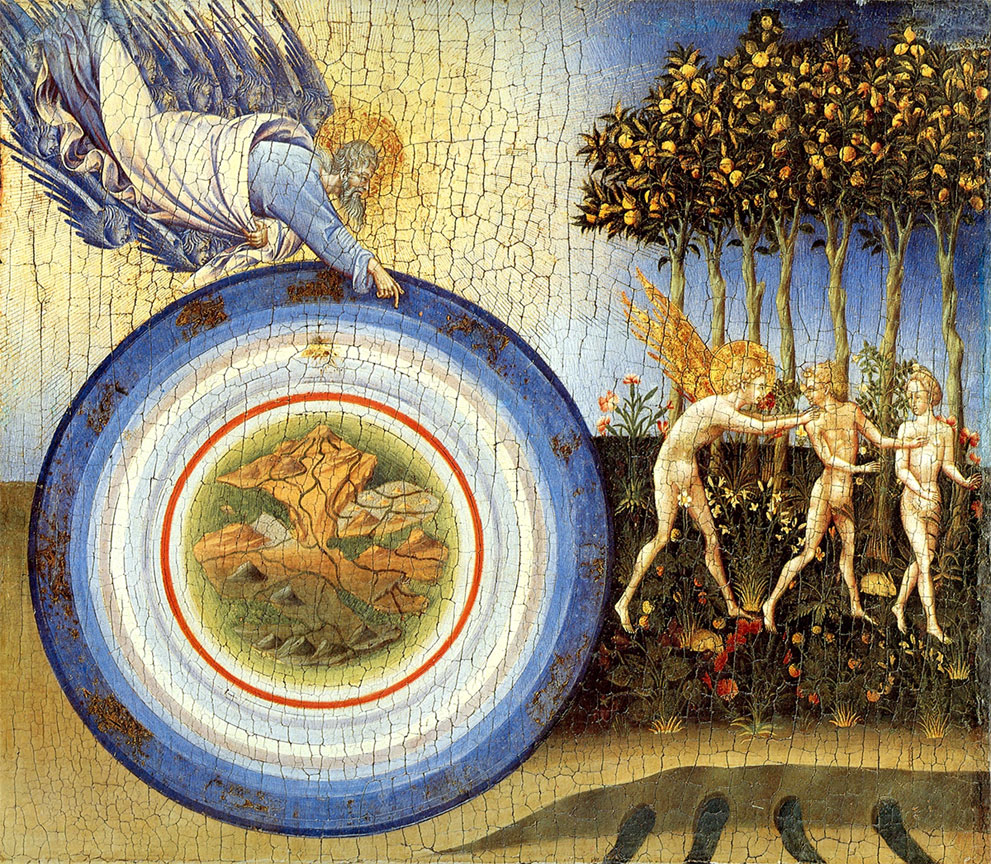
Eden's time is still amongst us, and although we have been locked out from the garden, it is all the while about us, all the while presently here, for the original Paradise has not left humanity, but remains this World's etheric world.
The 'dust' which we were born from and shall return to, explains the condition of physical substance at present, being so removed from the etheric which goes on to enliven and animate it. Without the Tree of Life there is no life, and although we cannot at this time perceive His radiant world which shoulders ours, it is nonetheless, that which sustains us, being but the true realm in which the physical rests and cleaves.
However, the question is: Was there destined to be this ordinary separation as did follow? Why did Man lose his clairvoyant perception that showed him the beauties and the wisdoms of this sunlit place? Why was he forced out from the timeless Paradise into pain and corruption, where bodily death and deviation and all manner of stupidities would prevail so? Was this factored in our development and intrinsic to Christ's own Mind?
The first principle here to consider, is that it is not within the nature of higher and divine beings to contradict themselves. Christ would no more welcome suffering into His Humanity and gamble on the subsequent 'fall out' from Paradise, than He would place development before Love.
Gravely, one should ask of the notion of development and evolution that we hold to and wonder what exactly are we working for? Man's objective had to be realized firstly within the imaginative powers of Our Creator and held there in relation to his becoming. Bizarre though it be to us, the period in between Eternity's realizations is of little consequence to the 'big, BIG picture'.
When we return to our Father God, in witness to Him, for revivification, in episode of withdrawal (during sleep, during blink, during referral in prayer and with arterial deciding, during death), when we return to our Father we are there and then quite perfect in all that we are. Eternity is not open-ended, it just is. That portion of Man which is godly is godly throughout, without cessation, true to its causation, and responsive in splendid repose by His Grace. It is this which entitles men to dream and imagine themselves nobly, more than outwardly ever appears reasonable. It is this that brings forth the very best and gracious loves, enstrengthened with a purpose that knows that all is achievable in time.

Our consciousnesses extract much that they need, meeting the world and the fellows within it from a perspective of pressure. Pressure is all about us, because although the organs coincide and cooperate, they do so within our systems to the tune of a regulated series of pressures. Our atmospheric conditions are similar, right up to the clouds of whose weight above our heads we are unconsciously quite aware of. The physical world in its compactiveness, and in its current relationship to the etheric world, feels and is this pressure. Death can be perceived as a cessation of pressure - the vitalities no longer flow within, there is no surface tension, no systolic or diastolic reckoning, no vortex of movement ensuing; only the vacuumous action of sensorial withdrawal.
Now the sensing of such pressure by the consciousness commits it to believe that pain is ever possible. It is of course, only a nerve ending away. It is there in the astral, known to us already. As regards the spiritual pain of humankind, of our hierarchies, of our related kingdoms, of our angelic sympathizers, of our recently departed and of our Christ - this pain is known to us also. What of the pain of past recall, the countless deaths we personally have come to, and the losses of many beloved also? Yes, pressure to the point of pain, and reminiscence of pain is ever before us.
This is what it meant predominantly for Man to have fallen as he did from the arms of Paradise. She still cradles the fearful infant, but he is very much 'naked' now to a pain and tenderness that did not happen before the astrality gave him the starry nerves he now wears on his outer membranes. Nor had he the degree of consciousness that it does provide; and this was the gift of compensation to come to him.
For all difficulties there are compensatory joys bestowed. This provision assures futures; and if you consider it momentarily, you can see how exactly this principle underpins evolution itself - evolution growing out from a series of difficulties and joys, of wins which prevail, of life which not only continues but improves. Without this principle much, most or all, would have ended in defeat. One winter, one malformed sprout, one opportunistic swarm, could bring extinction to every expression of life there is, so quickly! Would that cells choose this way other than that ... but yea! it is put to good use, and a joy arrives right out of that preposterous turning, and we call it adaptation, evolvement, coercion, when creativity bounds out of the past, wildly trying its own version, putting pressures into places they have never been before!
Plan or provision? Plan or compensation known and given? Here is a thought: death and its pains and pressures, is not known in the spiritual worlds. Before Christ wrestled Death, before He assumed the physical form and met its endings, and felt its tightness, drew its weight, knew the consumed nature of all desires and their sweet answerings, bruised, swelled and bled ... until our Christ manfully felt these things, there had not been a spiritual entity who knew what Mankind had become endured to.
Beings who live at the perimeters of this world can sense well enough the emanations, be them blessed or of hate. They can hear the words both whispered and cried, and they can see into places both vast and detailed; but they cannot comprehend the pain and pressure known to Man in the physical existence.

So in this Fall we distanced ourselves from many spiritual entities, who now do not share our experience (and nor would they choose to). As spirits we had everything! Each soul had its twin and could know love therein. As cosmic beings we were so well qualified, because we were endowed with key substances belonging to realms throughout - our passports gave us freedoms which many, many entities had not. As part of Christ's ensemble we had virtue and beyond that, key qualities of exultation - we had laughter! True merriment still fazes our invisible onlookers at times; and at others, they share in it (except for the demons who, if they ever had laughter, have forgotten all but the mocking variety). Yes, as men we were blessed, and remain so, irregardless of death.
Was this of our own making? Could Mankind be blamed for the nerve-racked embattled condition of the organic whole? As we see it, the problems began at the first when Man became exterialized rationally. Hitherto he had been able to purport himself with imaginative projections and powerfully emanate at will what he should choose to create - of this he was capable and coherent. Preceding the Fall, when Man emptied out of himself, there was an exposure and freedom given to the various aspects he contained. Painfully these aspects still held to a correspondence with him, and also had keys to his own nature. But also, by the freeing up of these now manifesting attributes, he gave license to them to perpetuate on in ways which were to become much remorse.

You see, the Serpent which became snake, was of Man and of Man's past, of his making. The Serpent was given a freedom of expression, which then double-backed upon Man. It had to be so. Worse than that there were other beings who sought out the fostering of each and every species, that they could sidle up and then combine with the forthcoming heritage of Humankind. These beings could entertain themselves in the associated realms of thought, origin and corresponding organ, infiltrating Man, infecting his futures all the more.
This saga is not hopeless, but it is painful. Just how painful is little known, save by men and by Christ. This subject touches on the deepest roots of the fundamental maladies about; however, as remedy to this we prefer to contemplate The Incarnation and the changes which occurred upon this Globe since that event.
Pray
zealously for Christ's wellbeing - who else could have labored so and
manufactured our retrieval? And when, for a time, the pressures have
eased and you feel your own life returning in the warmth, in the
brightest of days, in the voracity of nature, and in kind, know that
true Paradise hearkens, and is never ever very far away!

My Blog List
-
Differences Between Boys & Girls - Rudolf Steiner
-
We can then see, beginning at puberty, in the outer behavior of both girls
and boys, something that often baffles their parents and teachers,
something t...
-
Wagner & Buddhism
-
There is an amalgamation of Buddhism and Christianity in *"Parsifal".*
This, as we know, is also one of the hallmarks of Manichaeism.
Richard Wagner was...
-
Chapter 14- Reaching for the Stars, Exercise 1
-
*Exercise 1*
*Tools required:*
- *A Questionnaire*
- *A conversational partner*
Concluding a conversation, ask the person you have been in ...
-
Augustine Asks the Big Questions
-
Augustine in his Confessions 6:9 asks: tell me, O merciful One, in pity
tell a pitiful creature whether my infancy followed yet an earlier age of
my life t...
Esoteric Christianity Archive