Translate

A CLUB OF SUPERNAL INTERESTS Christian Esotericism, Spiritual Science, Esoteric Christianity - All Authored by a Lodge of Christian Teachers (unless otherwise stated.) (All writings copyright) ©

Sunday, May 22, 2011

The Ecstasy & the Agony- 24th May 2004

ALL life lives and revolves around the greatest of ecstasy.

People often wonder what it is that motivates the essences of life itself, what inspires the movement and existence, the constant unfolding, changing and navigation through and through. If you think about it the entire compilation is remarkably forceful. It is a production that would be, in itself unbelievable, were it not for the fact that it does exist and goes on!

To sense what is there at the core of every living entity within the mainframe of this immensity, is to sense the blissfulness which is Life, the ecstasy and pure fun of Being.

Life itself would fail to get up each morning if this were not so. Within Humanity (at present) there exists a difficulty which the heavenly beings do not participate in. They can suffer grief and pains, which we will make mention of a little later. They know what it is to desire and be unfulfilled, disappointed and spent, helpless for a time etc., but even the disruptive individuals (and not-so individual, individuals) are energetic in their movements and feelings and do not suffer the inertia that is spiritually experienced living in the world today of the mundane. 

You see, the reality of Life (as aforementioned) is anything but that. For in truth, it is unreal to be disassociated, uninvolved, apathetic and not sensitive to the lively joys that are very much a part of the exuberant orchestra of beingness.

A moment ago you asked yourself or me the question "where is this going?" and there was an element of doubt in that question that it was going anywhere at all. This is earthly thinking, because of course it is going somewhere! In spiritual terms one expects everything to be going somewhere, and usually our dialogue certainly does!
Furthermore, the point just having been made in itself got somewhere. [The Teacher is not cross, but humorous here.]

However, in relation to your question about The Passion of Christ [movie], there are a few ways to view the offspring from this artwork of course. In a considered view it is important to note first up, that we do suffer pain in many different ways. Our very detachment from the true ecstasy which is our common way of being is veiled, but the greatest pain of all to be experienced. 

You must realize please, that having said this, this is a dangerous teaching to ponder too long or incorrectly, and we will now cover as to why this truth must be thought through ever so carefully if you will.

When Christ wished for us that we could know again our relationship with our Father, it was not for the sake of our Father, so much as it was and is for our sake. 

Experiencing our Father is a good, great fantastic feeling. Once again, there have been earthly thoughts, which promote a drudgery, duty, unhappy propriety, sad and pitiful sobriety (as differing from a gay sobriety) - all in all a hangdog summoning, rather than an elevation of spirit and a comprehension of the Divine, which is uplifting and exalting.

On the other hand there are folk who by any means possible, will try to recapture the exaltation and exhilaration of life and of knowing Him, through means other than perceiving the truth straight out. Whilst it is understandable that this occurs, we know the effects of narcotic and luciferic experiences actually cause more problems in the long run.

So why are the gates locked to a common spiritual experience in Man? Why do folk experience a heavy dullness instead of the light and levity within and without? 
The word 'humor', came from the context and meaning of 'fluidity'. This is interesting because in keeping with the concept that Life in its ordinary fashion is most joyous, we can ascertain that the fluidity of life as known to us, is experienced, when all and we are happy. When this is not experienced there are 'blockages' experienced, in our thinking, our being, our feeling, our perceiving, our knowing and our outpouring.

Humor itself has suffered negative meanings, indicating what it is at its worst representation. But what actually is it? What is causal to the 'flowing', this fluid nature; what is manifest within its own?

True humor is a soulic knowing; that knowing which connects beings in a living recognition that is happiness combined. The experience of humor is not frivolous in the negative context, but is frivolity at its best.

The word frivolous also grew horns not so long back - indicating something was quite misspent and useless. There has been less and less value given to humor by most races, and it is/has been dismissed as a sidetrack rather than a fast-track to anywhere. Frivolity (a cousin to Joviality) does indeed distract us out from the one direction the mind or intent has focused on, but does not have to detain us from the heart of the matter we are trying to deal with. This is speaking of the positive variety of course, whereby there is a great gift to us in the practice and understanding of the forces involved.

A negative frivolity, we all know from unproductive people who may use it as a means to disrupt another. But in our own life's defining we can enjoy its [frivolity] benefits completely. We have a certain right to disrupt our own patterns of thinking - particularly when they have begun to resonate so low there is no coming back from them!

One can only imagine the depressing dredge of thought that hovers every city, where men and women are insatiably grumbling or complaining or reiterating some past moment - not escaping their fixed position, not alleviating their situation, and not comprehending how this frivolity could instantly snap them into a differing direction. Yet it can, and with productive results.

It is more than just putting a smile on one's face. It is actually a huge and powerful truth. Usually this truth is dismissed because it appears dismissible. How can we be serious about the non-serious? But we can.

Seriousness needs credibility. It needs to be pertinent to the moment (only that moment) and it needs to have value. As men (women included of course) we are Christ-filled and Christ-given, we can be serious about something and direct our will in such a way that the very seriousness is felt from one planet to the next. Our effects that come from our being; our consciousness and our wills, rock the heavens with inordinate shaking.

Whilst this is forgiven by our neighboring fellows, it is careless and also has an unhealthy affectation upon us. The overly serious person will of course lack humor (true humor) and frivolity.

This is how it works afurther:
  • Serious 'A' is when an individual takes his thinking or his action into a situation that requires intense willing - for further action or further working. It is usually something important (not frivolous in the overall scheme) - important as in something constructive.
  • Some people (serious 'B') have a talent for making little things serious or overly important and exercise their will and this action too readily. But hand in hand with this seriousness there must be some measure of doing. If there is no doing, then heaven knows that we are not truly serious but rather just summoning these forces to enjoy the forces themselves. So with the man or woman who is difficultly serious, you find much talk or thunder, but no constructive action amounting from that individual.

The serious element requires follow-up. We cannot afford to be serious if we do not use the powers that are inpouring to us, that befit the work or thought ahead, and then do nothing with them. It then becomes a cosmic madness to receive and not use as is required.

Of course a seriousness that is not constructive often spends its forces through anger. However, anger itself just seems to enjoy more seriousness to fire its coals, and so it goes.

Seriousness is a great springboard into further thought, further action etc. Seriousness that is not utilized for this is detrimental.

Frivolity is a great springboard out from unproductive seriousness. Frivolity becomes unproductive therefore also, and difficult, when it interrupts a productive seriousness. This is what gives frivolity a bad name. However, with personal application it is a saving grace, particularly when the seriousness has outworn its usefulness and is causing more ill than good.

Pursuing ecstasy is dangerous because of one simple fundamental principle, and that is that life does not reward self-gratification. It does reward striving, self-work and self-discipline, self-kindness and care, but not gratification through just the unit of one. 

The true spiritual ecstasy has its primary placement in the perception of the bliss of others, not in the experience of the bliss within oneself (which occurs naturally and secondarily to the bliss in others). (Also, contributing to the wellbeing and bliss of others of course.)

Self-seeking gratification by way of taking a pill or doing a spiritual exercise with the purpose to experiencing this bliss, is of course nonsense in the light of what has just been said. It goes further than the serious individual summoning the forces of action and then doing nothing. What it does is just experience the 'hall of mirrors' in the astral of past experience (personal or otherwise); and so it is life deceased and not life inspirited, being experienced through false and selfish means.

This life deceased has the poison of deathliness within its kernel. Most of all it brings with it a death to our perception, or a glimpsing of the true bliss and joy outside of the cemetery, and the individual forfeits their discretion and deciding. 

Healthy individuals will love babies, babies are blissful (they experience it in everything everywhere naturally) and we can readily experience them experiencing this bliss and so forth. Then later on, when the egoic forces begin to descend, the child begins to mimic seriousness - 'monkey see, monkey do' - all the while feeling pretty jovial beneath it all. When an infant cries through hunger or discomfort (or later through a tantrum of sorts - a conflict of wills etc.) the individual does not actually experience upset as we would imagine. There may be an expression of upset, but the joviality is there, and the output of tears or yelling is not unhappiness, just signal.

Now this is not speaking of a pitiful circumstance of great pain (teething, illness or injury), but rather the crying from discomfort or difficulty. Often if pain or emotional pain is being experienced, the infant will have periods of undue quiet - much like an adult who locks down within themselves. However even this experience is nothing like that of the older child or adult, because the egoic consciousness simply is not there to interpret their own suffering.

Individuals have a mournful expression with grades of suffering, and like the baby we can have expressions of upset which are no more than loud signals of discomfort, whilst the very same expressions can denote the toughest of trials and of crisis. This makes it extremely difficult to be around and interpret. For the ordinary individual who is naturally empathetic it is persuasive and consuming of course.

Here we can begin to gauge the seriousness again with the adult's howling predicament, by asking privately to ourselves in the assessment what is being done here.

Have you ever seen a gravely ill person make jokes about themselves? This is not only to care for the person they are with, by trying to intimate that they are 'all right', but also it is a great example of using frivolity in a way that brings them out from a seriousness that is getting them nowhere. They have every reason to be serious, but recognize that they are at a point where it is unproductive, and so will use little jokes to cease the hardened thought, and in that there will be a healing, not a hardship. So it is not just pathetic to have an ill person or troubled person do this, it is actually very useful that they can. This is not to say that it is called for all of the time, and there may be other moments where the seriousness can be useful in their making decisions and so forth, but certainly cannot be sustained all of the time.

And so, with the complaining adult who howls like an infant, we can also check the breadth of gravity by quietly asking if they themselves are doing anything about the problem.

Often folk will have a way of throwing all blame outside of themselves. It not only self-justifies, it is the signature of an inactive person. The inactive person, who is not reviewing what they could or should be doing to help a situation, is a person who is not truly serious (at the heart of their expression of seriousness), with what it is they are complaining about.

If a person maintains their seriousness dramatically, violently trying to injure themselves or others, saying it is because the world is not a better place, or their marriage partner a disappointment or their own self has been used or abused, what is the sense of making oneself feel worse about it? Isn't it enough once over? Furthermore, is it relevant in the now? Thirdly and lastly, what are they doing to make the world a better place, to be a more loving and therefore needed partner, and to stop the abuse or abusing?

As simple as it sounds, it clearly is not understood, going by the amount of whining and complaining that is out there in day-to-day dialogue - misspent words and thoughts, that have no place in seriousness because they are not qualified in action or intention. 


With the portrayal of Christ in the film of The Passion, there are gruesome outer events, which do not on the whole invoke the happy or the humorous. The creative artists behind this production have believed that it takes this level of persuading seriousness to reach the watching public, and that the subject, nor the Christ, could never be seriously enough presented, no matter what was shown by way of a movie.

The story of Christ has lent itself to so many forms of artistry - even depicting Him as a deer for example - and whatever the creation there has been in each and every one of them a hidden blessing.

So also in answer to the question, there is such a thing as 'too serious' - when it is not acted upon. Seriousness in itself is a means to a happy end, rather than an end within itself only.

Was it the whole story? Of course not. We cannot presume to know the colors and character of experience our beloved Christ knew; only to say that it must have been infinitely worse and infinitely greater than a morbid beating with whip and word. 

Life itself is not serious - serious itself does not get close! It is so powerful and enduring, and it is only ourselves that falter with this knowing.

Faith at present, needs be tempered with both resolve and good humor, that somehow we can remind ourselves that holy purpose is generally happy purpose. We all have such great abilities, finding this mirth in places you would not have thought of looking for before; and remembering that the Red Sea was parted with a laugh and not a with a tempest! 

Saturday, May 21, 2011

Ten Men went a'Hunting....10th May 2004

Steeled, and with tamed enthusiasm,
The marksmen waited in a line of ten.
Each, one bow, many arrows also;
In cordial relay, they tensed in lateral readiness.
The Deer of Christ came dancing by,
His horns gold,
His face a soft brown fuzz.
His eyes, intelligently peeked with a knowing,
Sought those of all ten men;
Whilst His soft and panting breath a'glowing,
Frisked the air with the vapors of Eden.

Long while it seemed the challenge was on.
With calm authority, the Deer paced the ground.
It was Marksman One who saw the flame upon,
And His Divinity,
He addressed them most somberly -

"Fellow hunters, this is just no ordinary deer.
Not the 'breathing meat', as might first appear;
This Deer is blessed,
And He comes with a purpose.
Should we follow His Service,
We will find our true contest."

And on their knees,
The ten knelt down before Him
(Clenching the fist).

Their names were:
Egbert, Herald, Mars,
Adonis, Chapman, Mercurii,
Psyche, Reaper, Plutarch
and Oblique.

When the Deer with the golden antlers
Came to Egbert,
He had known where he would be taken.
Out from the ten,
In sole requisition,
He followed the holy creature,
Without fear or insult in his station.

Oddly however, Herald did chase behind.
Long time companion to Egbert,
Supporting every excursion even before;
He would not stop now, pursuing his cause.

And like a Rumplestiltskin,
But with a sleepless dream (not dreamless sleep),
Egbert aged in rapid time -
For time had hastened,
Or his own strength abandoned,
And when the Deer came finally still,
Egbert was a weary soul,
Now come to his life's end.

He began to see ghosts all around -
And in his reasoning,
Felt not far from dissolving
Out from this world in a similar way.
These ghosts were accusative,
Demanding also.
Grief overcame our Egbert,
For this was not the outcome
He had hoped for.

Herald who had not been far behind,
Came forward and held up his beloved Master.
His vigor did seemed replete,
As he puzzled at the ghosts all around.

"They have no substance Master Egbert"
He said with good cause.
And the ghosts vanished back
Into their shadowy doors.

Inconsolable Egbert, saddened for himself,
Distraught at the thought of the others' expedition,
He had encouraged them so, into this perdition.
Perhaps this animal was no more
Than foul and mischievous enchantment?
Certainly he had ventured thus
With no reward or commission apparent.

The Deer stamped his hoof - three times,
Thud, thud, thud -
And the dirt from the earth
Became beads of gold in the wind.


On his left there were a gathering of servants,
Angelic he could ascertain,
For their goodness emanated from them.
It was impossible to count them,
But they appeared as a multitude at the ready.
This vision was most comforting,
And as he looked across this one body of beings,
He saw also the ranges and the terrains he had traveled.

Clouds and fountains, texture and colors,
Worldly formation came and swept across
This angelic grouping -
That in mix and mingle had pieced together
The world he had known
In the greatest obeisance.

To his right was a darkened hole of exaggerated terror.
Noises and smells arose out from that gape,
And the fear in contagion gripped at his throat,
And his chest stifled also, contemplating that pit,
Trying his best to see past, it invoked yet more fright.

And yes, there was a fine rope bridge,
That from one side to the other,
With all of the meaning of a fairytale
Awaited his courage a'further.

The Deer spoke to him through His eyes.

"Egbert, you are frightened,
Because the pit before you is frightening.
Your Humanity is appalled at its existence,
And your own spirit's sense of mortality startles before it.


"This pit and what is in it,
Is not of your own making.
The gods of old left their mess in there,
Long before you thought it your own.

"Do you concede that sin originated in you?
Can you truly own its sorry refuse?
I think not.
For the decadent turmoils that transmute
Into the disease of the world,
Came not of Man,
But of decadent gods."

Deceptive doubts now hissed warningly out from the hole.
"Do not believe him,
We are yours, we are Man".
And Egbert himself edged a little closer now
To hear better, only half afraid,
Feeling more able, more capable of tolerating this filth.

The stench all at once turned into scent,
Musk-filled, ever stronger, saturate with sex,
The aroma of exotic smoke, of liquor's ferment,
The odors of excitement, and of aggression's excrement.

The voices eked out louder now....saying:

"Give us Herald,
And you can see what we make of him.
Throw him down to us,
Throw him down....
And make it quickly!"

And for one black moment
Egbert considered this idea.
And then in another he saw their cunning most clear.

Although Mars had not quite the height of these two,
He was known well to all for his fantastic strength;
From the ferocity he bore rather than lone muscle,
And his temperament, which unwavered,
Even with a dubious moment.

An uncomplicated fellow with a veracious edge,
Mars was at his best as the righteous warrior -
Straightforward and explicit, in all things.
His manner was duly abrupt, but not unkindly,
Just matter of factly, decidedly flattening.

Plain food and a simple life was his creed.
And contrary to his talent,
He bore a constant of peace.
When the Holy Deer had come to Mars,
He had envisioned a panorama
Of the little Heavens there before him;
A concordance of tenuous connections -
And a sequential cast of beings.

Firstly it had felt right,
That each place was filled most properly.
And the tension which was life,
Was quite perfect.
And on this day he was the happiest
That he had been - probably ever.

He sensed correctness everywhere.
He understood the parallel function
True strength enables.
Even the strength in his manhood felt
Mighty and holy and perfect.

Looking hard at the deer,
He saw ten roses spry out from His horns!
And so, regarding with gratitude,
He pried each off the tip,
And collected the petals,
Into the bag on his hip.

Adonis had meanwhile found savor,
In the inspiration of his companion from afar.
He did not perceive the Heavens
In their orderliness quite like Mars,
But he did feel empowered by their Graces.

Throughout his vision he was led to an altar,
Whereby a communion cup was waiting,
And the bread laid out beside.

"This is the table of your Marriage"
Spoke the Deer to Adonis, through his eyes...
"And this, you cannot do alone".

Adonis was sad all at once,
For clearly he had gifts before him
That were not his to take solely,
Yet he was all by himself,
Save for that mystical Deer.


The Deer approached him
And Adonis buried his head in the fur of the neck and wept.
His left hand touched one branch of the golden antler
And for a moment his breath departed his soul.

For he was given yet another vision of the altar,
But this time it was a marriage bed,
And death bed all in one.
There laid upon this holy piece,
Was the one he knew to be his wife -
And in knowing that, it was as natural as him as he knowing himself.

"Both my death and my life are to be in this union"
He said.

Chapman and Mercurii started out
Carrying each other's packs -
The Deer approached them and spoke to them, through His Eyes.
"You can ride me if you will",
And lowered Himself before them.
Mercurii helped Chapman (who was a little more portly than Mercurii)
Lift himself atop the beautiful creature,
Then very nimbly, did the same.

As soon as they were secured,
The Deer took off at a rapid pace!
Faster than a prospector falls down a mine!
Faster than sweet disappears in a child!
Faster than the sled-ride into death and out the other side!

These two podgy arrowsmiths laughed the whole event,
Such was their congeniality,
And in that, their heartfelt merriment.

Psyche did sit quietly,
In muse's counsel,
Waiting for the Deer to approach in His good time.

He was the only one out of the ten,
To not see the Deer as an animal of the Woods,
But instead, as the God of the gods of Little Heaven.

"Dark is the Forest" he said in low tones.
"Yes."
"Are you fearful?"
"No."
"Are you desparate?"
"I think not."
"Are you with hope?"
"I am Hope."

The pulse of Life became stronger between the two,
And they sat together in the leaden silence.

Reaper had listened in to this discourse.
He had come from a faraway place,
And was considered most foreign to the ten.
An immigrant with an insidious charm;
As often was his own misfortune to appear at those times
When the very world was crumbling;
Never at the beginning, always at the end.

The Deer took pity on him at once.
Reaper had suffered his annihilating and killing,
Yet was no mean reformer,
Just a huntsman with a perfect shot -
The nightmare of the world,
The mercenary of a defining heaven.
He had no living part or plot amongst these men,
Yet his presence was there nonetheless.
"Reaper" called the Deer through his tear-filled eyes,
"See now the ebbing finale".

And before this marksman
Ten sparrows alighted all around.
One sparrow flew to the altar
Where Adonis lay beside his love,
Now spent, with his heart grown cold.
Reaper knew of this withdrawal -
From the cavity, and the pledges of passion,
Into that space absorbed.

Another sparrow hastened its way
Through to a mother giving birth.
Just as the infant was being brought into the world,
There was Reaper,
That she might let go of her child.
For without the Reaper's insistence,
This mother would have labored indefinitely,
The womb is protective of its kin
And would hold to its love eternally.


A sparrow flew to the side of the marksman Egbert,
And bid him come from the edge of the pit,
That he still lingered by.
Intoxicated and now fearless, he had remained -
That is until the bird had called to him,
And brought him back nearly witless.

Some singing was heard in the distance -
Plutarch and Oblique making rhymes,
And tunes to their party of fun;
Dancing around and around and around and around....
Same time comprehending,
What it means to sing songs of freedom,
Counting on the fingers, ten,
A pentatonic leaven.

Friday, May 20, 2011

After Death Conditions- Easter 9th April 2004

WITH any two possibilities there is a preferred outcome. There are of course two goodnesses at all times, but equally and sadly there is an eventuation which may be and may not be at destiny's heart, its true heart and selfhood.

We can know this because Nature is, at the very least, consistent. Regardless of generations of two possibilities and then more, its defining meant that the better choice always outlived the poorer one; and thus the heart, in time, was known. As individuals this is the same - even though we might not consciously deem it to be so, when time permits and reveals what was and is to last.

For the Gods, in their high stations of hell and heavenly quest - Hell: a word which (in speaking etymologically dear friend) was designated "Lower Heavens", and more exactly, "of the Sun" [Helios] - our Gods too battled each other for the supremacy of outcomes that out from any two possibilities one would prevail. It was only through Christ did we come to any corporate enterprise at all.

Of course, when you come to think of it, the lower Heavens were in themselves paradisiacal (in their own way) until polluted by the earthly mishaps that later frequented and often stayed after death. 

Prior to this world's collapse (spiritually speaking) the place of Hell was quite lovely - a 'little heaven' or 'heaven before Heaven' etc.: the Divine Anteroom before the Holy Theater to come. But the garbage and the waste of the sphere itself amassed and had nowhere to move to. With no immediate redemption it fed back upon itself into the World, but did not dissolve with grace. Evility soon spread in this way and then later with predators coming in also from an outside opportunistic source.

'Bad Gnomes' are not such an off-beat example - elemental beings attached to the mineral kingdom here, with passports in thereby, coming from their associated planetary spheres....these beings dwelling in the lower portions of the Earth, partially palpable, but not incarnate materially, physically, yet investing themselves now in the evolution of Man in time. 


Proportionate to vast armies, but with no real organization or cohesive tolerance, these antagonistic beings suffer goodness as pain and incite mean mirth wherever they can find a host. Although they have a mineral nature (and hard head because of it), their presence and concerns have now built substantial subterranean houses dedicated to an evil worth - pockets of hell furnished with the remnants of what were once men; trophied archives for the demons within. 

Wherever there are discarded astral remains (through some violent death or worse), the 'suit' of the soul is worn and animated by these beings of evil, parading the grotesque capture of humanity's worse moments. There are not only suits of torturous deaths, but also of perverted and obsessed individuals.

Trapped in an astrality that feeds upon its own desires (rather than in the goodness of any one act - giving and receiving a sublime vitality), these 'suits' of a former man are garishly performing the most horrible of acts on a nightly basis. If you have ever had a dream of a massive collective in orgy or obscene violence, then you have happened upon one of these caverns we speak of. You might recall paintings also, where there are such communities of now hellish behavior, wild and with a jumble of participants. These are not ensouled men, but rather the astral bodies of men reanimated with demons within. The only suits they can wear, the only variety that will not break down and pursue their original owner, are those which have been left hurriedly, or through the sorry disintegration of the humanity of the man within.

Furthermore, apart from this seemingly meaningless frolic of morbid fantasy, apart from this 'party' of corruption (that, by the way, is ever growing), there is also the working notion that some kind of creature can be exhumed from these remains. There are attempts to both affect and alter the nature of Man through them, whilst also begin a new race - a different being again.

Such creativity does not come directly from these elemental demons but from diseased men who are living and knowingly working along these designs, and subject to greater influences than themselves that also have a malign intent towards mainstream Humanity and its Nature.

This is no small problem. It is of course somewhat trite trying to place into paragraphs the keynotes of the realms of Hell, but in order to grasp the significance of this time, it is worthy of a ponderance and certainly an educated study.

Death to most takes a soul into personal and private realms which do review and recant and are very much influenced initially by their own astral impressionings over the lifetime just past. But all of this is in accordance with the angelic guides that watch over the sleep-dreaming soul (unless they are developed to the point of wakefulness here and therefore they can choose their way out from Kamaloka with a determined rapidity). 

For the ordinary man, woman or child, the process immediately after death is as natural as a very good day here alive. There is a routine and it is followed with a wisdom and a knowing that has no upset - even if and when there are encounters with troubles along the way. Such troubles are brought to peace. It is, by and large, a happy time. Habits are brought to cease, longings are either fulfilled or shown the promise of; the once tired body is exchanged for a blessed vehicle of light-filled exuberance, and the events of the life are seen with a fresh objectivity that absorbs most of the shock which otherwise could follow with a tedious retelling. It is revivifying and not difficult. The aspects of death are kindly and not cruel. 

Then there are several varieties of death that are exceptions to this. At the very worst, (the very, very worst) the most evil of men (say for example the variety working for the demise of humanity knowingly) cannot collect their working bodies after death because they have become so very repulsive to their selves. Their own Angels have been long dismissed, their lower natures have become so enshrouded with dead mass, (the kind spoken of literally); and the desire for self-betterment - for evolution, for development - is not there to carry them into the higher realms. 

They are very much abandoned and quite naked in demise, cannot go forwards and are condemned to go back. The soul itself despairs and eventually the only remains of the godly-humanity returns to its own without license to incarnate or bear humanness again. For this individual the astral body however, does remain intact and becomes far worse than before. There is no human empathy or conscience as a possibility and the invested negative developments are all that exists, seeking out its own 'life' through extraordinary means. This 'life' is sustained through the astral actions and elemental beings attached to men who are living and feeding vitality to such occupations that incur it. And so it goes.

Then there comes the death of the poor individual who has been tortured or endured abject violence. In such instances, the release out from the body does a few things. Firstly it makes the retrieval process of the astral body impossible and so the individual is propelled out from a phase with nothing of note to take with them from the astral learnings of that life. Ordinarily they would 'pack their bags' over a period of review, and distil the qualities they have accumulated within the organ's astral nature. Each organ corresponding with a planet's virtue and strength, would normally have been a suppository for their effort during their life. But in this case the astral body shafts off with a repulsive vigor and the individual goes straight into the higher heavens very quickly.

If pain was suffered immediately preceding the death there is a compensatory wakefulness which ensues in the spiritual worlds thereafter. This wakefulness, for the consciousness, is blissful and a great gift. The atheist will not ordinarily have a wakefulness but even he, if there is pain in the physical body beforehand, will sense the spiritual magnificence of what is around him. Pain itself of course is usually associated with the astral body alone, however the experience of coping with the pain actually works its way into the soul itself, in a blessed action that remains.

Anyone who has suffered great pain will know the experience of almost disincarnating, because of the strength of the impelling forces too difficult to consciously meet with and reconcile immediately, or the debilitating and wearing pain of constant and chronic aggravation. The soul in both instances champions the individual, who in their life, has come to the perilous threshold. There is an infilling of grace, and expedient blessing. The soul is matured by this in lasting ways, awake to the absolute compassion of the adoring and caring beings that travel with them in same, but not same, suffering also.

It is often noted how very quickly our time in the World goes for those in the spiritual worlds; but with pain felt here, it is the reverse. A painful episode in experience here resounds through the heavens like a booming gong. It is not diminished by the 'shortness' of the time or the changeable nature of material life. Some experiences are not just physical or astral alone at all, and pain itself is one of them.

It would be careless to mention just how the dark forces use pain (or try to use pain) in their scheming, but it is enough to say here that it becomes a big part of their function, and not only because of the reverse effect it might hold within their own perception.

The death of the drug user is usually very difficult at first. Narcosis after death (having carried on from the condition just prior) allows for the perception of those astral happenings outside of the personal bodily situation. Those images alluded to before, of the hideous compilations of Sin - the Hell of the Demonic Parties - these scenes are certainly witnessed by the poor fellow that has passed in a subdued condition due to drugs or alcohol.

What a contrast to the fellow who has endured pain!

Our relationship to those poisons which cause an altered state within our perceptions goes deeper than chemical, physical blocking. Although we have been speaking astrally as well, it can be noted that the very natures of narcotic substance are (of course) anti-man.

Whilst in some circumstances we can view a pain-suppressor as a godsend (and may it be said that there are circumstances where the administration of such is more than acceptable and has a certain action different to what is to be described), it should be noted that any substance which incurs a disruption and death to the working forces in a man is contrary to his life, and its suitabilities.

Such substances come from realms, and spheres of a stronger nature, that are contrary to Christ. They are not of themselves helpful to Man. They are not, as some might have it, any kind of medicine. Eventually they lead an individual into their own sphere - with a seductive pull and a rapid extraction. 

Men who suffer these deaths do escape from the 'wastelands' overall, but are debilitated for a long time after. The period between death and rebirth is usually naturally rejuvenating, however there is a tiredness in the individual that seems to carry over, which is for no apparent reason other than their spiritual life has been compromised and needs building upon in an active way.

With Christ we are give our forces of selfhood and the direction of creativity within that, but when such abilities are contradicted by self-negating poisons then the revenue for opportunity is slighted thereafter. It is not impossible by any means to recover fully from this involvement, but it takes working for.

It is also mistaken to believe that higher individuals can participate with these anti-man poisons and not be contaminated accordingly. The only exceptions (and this is said hesitatingly) are time bound, and not around the time of death either. For example, if Christian Rosencreutz were to be given a narcotic unknowingly he may or may not be influenced by its power (he certainly could withstand its influence by the strength of his own inner disposition) and on rare occurrence it would have no effect, with or without him challenging it. But even he could not take such a substance day after day without being corrupted.

Equally and also, a good soul that is near the end of their life and has been administered to with a narcotic of some sort, often has two exceptional considerations. Firstly you will find that the pain, still to some measure (until the end and coma ensues), will exceed the pain-nullifier. This tells us that the consciousness is intact and the situation after death will be graceful, not harmful. And so if an individual who is not in pain takes an opiate, there is a completely different reaction after death (and before of course) than with the soul who is reconciling forces accordingly. 

Secondly, as with C.R. above, at the end stages it is not at all the favored outcome to have many pain-nullifiers just prior to death. But in the event of it happening you find that the soul has desisted and departed the body, withdrawing and preparing in many ways some time before. All of this affects the passing in a very good way. The importance of the final days is not at all the same as they might be with the rapid death.

The death of the accident victim is very interesting, because although an accident is often a violent passing it quite often is prepared for ahead of time. The accident is designated by the individual as the way of departure. Now this is very different from a murder, because, as we have mentioned before, no murder is preordained or karmicly designed.

Now in the physical nature of the abrupt passing it is true that the processes are very difficult and the 'suitcases' go with the individual empty. But this is not always a bad thing, and in point of fact, often by intention this was the chosen exit.

For example: a child absorbs the influence of the surrounding adults up until a certain age and thereafter is haunted by this influence. It is now part of their astrality, and is even added to, however were circumstances different, this would not be so. Or a woman for example, might have had a time when she was sexually set upon and this has lived within her astral being also.

There are many things we would not choose necessarily to take with us, even for all of the virtue as well, that can be still exhumed. And sometimes there is no real choice. For the accident victim who takes days to die, you can know that they are in fact enabled to sort through their astral baggage and choose what they will. In the case of immediate death they have, for one reason or another, disassociated completely.


For the death of the morally corrupt there is of course the journey out to the Hell party, and this is interesting because for them Kamaloka takes on a different meaning. Usually a person will self-determine empathies that should have been picked up during the course of their life with their actions. They have the empathetic understandings, but have been too self interred to really experience them consciously whilst alive, so for the normal passing, folk trade places with everyone they have ever had interactions with, and experience their own actions from the other's perspective. 

Now when it comes to the morally challenged folk this does not occur. Part of their problem really lies in the immaturity of their conscience or the negation of its capabilities, and so their journey is different to the self-marked one after death. They are still compelled (by a higher choosing) to welcome the experience of empathy, but get their re-enactments through the all-too-willing demonic participants of the hell party. There they are given exactly what they gave out, yet because their consciousness is so used to that realm that they are now held in, they are very wakeful to the realities there. Their tormentors appear as they are, and the experiences are needless to say, quite frightening.

There is a definite end to this reparation which is relatively carried out in real time event by event. They are then released for restoration into Higher Heaven where the journey will for the most part be slept through. In most cases the soul returns to incarnate as dull-witted, perhaps arrogant, and needs to learn again what true charity and kindness can mean. It is a slow but meaningful reform.

The death of the materialist/atheist can be more frightening than all of the above. When folk talk about the 'fear of rejection', this is the ultimate realization of that fear. Floating in nothingness is a terrible experience, and not unusual for folk who are determined that that is all there is after death.


When a man or woman fears rejection during their life, it is completely related to their relationship between themselves and Father God. If our Arterial relationship with the Father is strong and acknowledged, then we are living the reality of this connection, however if we are uncertain of ourselves and our Arterial deciding is poor, then we are living the dread of not experiencing His Presence in our day-to-day lives.

The Arterial experience definitely couples with the egoic Christ relationship also. The actual fear of rejection (seemingly about community and one-on-one human relationships) really has nothing to do with that and the need for acceptance etc., but everything to do with the fear of rejection we might hold of Father God. For the person who has a poor Arterial connection, they are living the dread of that poor connection and perceiving it as Father God rejecting them, whereas it is they that need to refer honestly to themselves and the world.

Of course the same person will often compromise who they are to please others, thinking that they will be rejected less. This in turn leads to them having a weaker Arterial relationship, and then by that the fear grows larger and creates an elemental monster accordingly also!

It is actually a form of atheism to not live true to oneself, and behave accordingly. When we depart ourselves into insincerity we cease to believe as a true believer, and therein is the same experience of floating out of control into nothingness. This can be the demise of even the good Christian man, suffering alongside the atheist in his living reality, trying to appear other than what he really is.

Today is a day when we duly contemplate death. A death. A death that came after days of pain, and years of difficulties. There in that pain was also a rushing in of the Heavenly forces - an enhanced consciousness also, but even, for a very short time beforehand, also experienced the atheist's plight in the perceived 'forsaking'.

The events that occurred during the Life of Christ are yet to be fully realized within the World. His Incarnation is occurring as we speak, and has time to go before becoming fully apparent in every particle of material being.

Also and likewise, His Death and the consequences therefrom, are yet to be realized as well. When we come to know of this experience at Golgotha we will also literally come to a time when Death is conquered in the World and in Man.

What this means is, that we are not bound to a perfect worldly existence for all eternity, never moving from some planetary outpost. No, what it will mean for men is, that there will be a continuity of consciousness, where the experience will not be broken or differentiated, and we can exit the world (and in our sleep be) fully awake, and return remembering every event as it happened.

This is significant, because we shall also have the eyes to see during our lives - those who have passed on, and also into the spiritual realities about us. The veil will no longer mask the truth of what is about us. This is exciting, because often as not, the demons spoken of earlier hide in obscurity, and were it was that they could be readily perceived and exposed, folk would quickly be dissuaded from those pursuits that take them straight away into Hell!

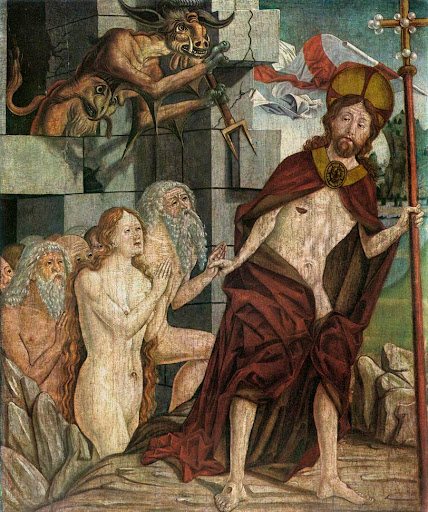
The ramification of Christ's journey through this World - His World - and into Death, through Hell's mischief and then into Resurrection, the Life that has followed on from this course now committed to, is full of great change and happy prospect.

On this day we encourage all good folk to be prepared to know intensely the life around them. So often we flinch away from this knowing, as if we can just get by on a gossamer presentation and veil all aspects of our life. 

Just as our own death does treat us on a daily basis [sleep] with a lack of continuity, each day upon waking, can enforce a stronger faith of sorts, but at the same time be very disconcerting. Until that day arrives when ordinary men can perceive the spiritual worlds most naturally, it is vital that they begin to see themselves as they are moment to moment. Your only true reference is within, and it takes an honest effort on a continual basis to refer to the private self and declare the cares and concerns that exact your very being. Know your own heart and mind and do not be dissuaded, with no apology or compromise - stand firm in your Love, in Christ, and in our Father.

We give thanks for the times to come, and the wonders then known to all. And we pray until then, that men find themselves, amidst the external calamity. Christ is with you constantly. Never doubt or fear it otherwise, for this fear itself will distract you away from His Purpose and His Care.


My Blog List

Followers

Esoteric Christianity Archive