Translate

A CLUB OF SUPERNAL INTERESTS Christian Esotericism, Spiritual Science, Esoteric Christianity - All Authored by a Lodge of Christian Teachers (unless otherwise stated.) (All writings copyright) ©

Sunday, November 29, 2009

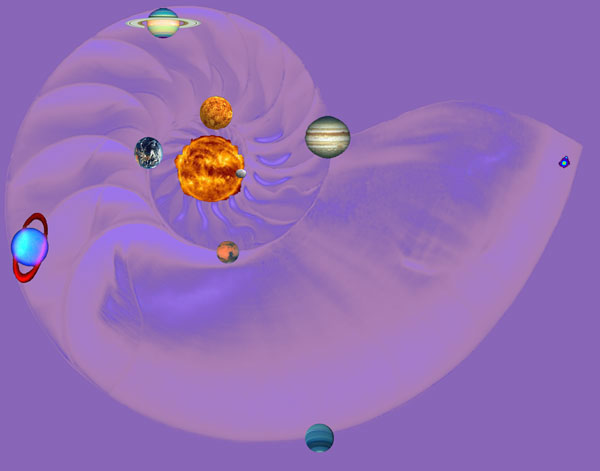
Conch Shells & Paper Nautilus- 1992


THE principles of rotation are such that all points on any outer circumference comply with that gentle central pivot, advancing in predetermined sequence. So it is that there is an arc to any motion, to any question, to any activity. When we arrive at a certain concept it is through a progression of thought so entailed which is ever curved: leaning inwards on a slight tilt, as it were. We do not conceptualize, form thought or phrase laterally, or else such channels of thought would stream out indefinitely, destined for some place in the infinite. Hence, “pearls of wisdom”, have a literal meaning in the spherical graduation. 

Remarkably there are interconnecting magnetisms which may be viewed as threads, or rather more correctly, pathways gathering collectives of similar impulse and frequency. But in general terms, all individual concepts are spherical, and the thoughts that travel the circumference, do travel with that ilk.

For one who is logically minded, who has precise reference to compilation and exactness, they are strong in the talent of 'turning the wheels around' (or spheres more correctly), and have the ability to motivate the relative inertia to speedy rotation, with equal ability to call stop when once aligned, and progressively command the vitalities required for such motivation, swiftly and accurately. For the talent for logical and precise conjecture comes of this control, in setting certain points of the circumference of a concept and aligning them so- the control necessary to the inner motivation, outer calculation, and then the commensurate and exacting halt whereupon concentration is fixed upon a particular point of the said circumference.

Inert concepts are what they are, but are not illumined and set to activity until activated by a man's attention and vitality. Once activated they begin to rotate. When a man refers to his 'head spinning', it is in fact the concepts themselves rotating, without a particular fix being exacted. By this is meant a conscious hold on any given point on the circumference of that concept: a particular thought.

Once a concept has been entered into and a thought focused, one may fleetingly experience the thought and withdraw from any further activity, or remain, and with desire born from curiosity, drive and command the rotation, in examining the concept further, in certain sequence of a set order of further thoughts.

As spoken of earlier, the nature of the sphere is introverted, and that point being central is a gateway to a higher realm. Thus in terms of a concept this also is true: that within each concept is a gateway to a principle which holds keys to ever higher thought and divine conceptualization, and so forth. But in order to perceptibly enter into the higher aspects of any given concept, one must experience the concept in total, and have consciously traveled the circumference in entirety.

"I must think around this subject" is a good phrase indeed. Also there are many points of view, points which are fixed on the circumference of a concept.

All concepts are around us to be experienced at all times, for they make up the substance of that life which we perceive. Whether personally activated by us or not, they are there to be had. 

This was the divine principle of Plato; here was the introduction to a set order of logical progression and progressive departure from conceptual perception. The primitive man may experience concepts largely, in their entirety. A man who has downcast his faculties of logical inquiry - through persuasions of certain intoxications or intoxicating acts - may return to this condition and find unusual satisfaction in instant but unattainable knowledge; made clear, but indefinable in conceptualizing, rather than experiencing ordered and progressive thought.

Clarity with concentration requires practiced skills of directing one's vitalities, as they are the commander of such; yet also with the element of inquiry necessary to illumine anew, and reactivate new concepts rather than traveling the old ones continually. Much vitality is spent through reviewing our favorites and relaying back and forth to positions held in the memory. Much time is given to sorting out such memories, which do hearken us back to particular spots, so fixed that one may find it difficult to move on from there.

We have true memory as part of our finer, subtle constitution. We also have concepts pertaining to those memories which are colored largely by attitude and personal perception. They need not confer with the reality of the past, but rather the personal aspects attributed to the details so remembered, and impressed. We are subtly bound to re-experience those stimulations with magnetic reference. It is almost as if one illumines a concept, but has not the will to move and propel it accordingly and cannot take the thought so fixed from its position pertaining to the memory, and work it through progressively. However, true learning requires experience to call forth the concept in the first place; therefore memory may also be entirely relevant to this learning.


In some the thinking processes are almost entirely fixed: when an individual who has lost the will for inquiry and cannot motivate his concepts internally and travel their circumference through, but rather clings to that which is stationary. Those individuals unpracticed in this, have difficulty at times when impulses begin to set motion amongst the fixed concepts, and have little flex or control in the stop/start motions - which may result in madness or breakdown; although this need not be the only cause of such malady. For one who is expert at such control of the logical processes, but gleans no particular impressions from such, and experiences for the sake of the practice rather than the value of the thinking, can too be set eventually for the path of disorder and disarray; for the discernment required, the discernment for particulars, has been lost. Again, one can have all sorts of 'spinning' out of control, through lack of control.

A soul who is deemed mentally handicapped can conceptualize. This he certainly experiences, and can be subject largely to the concepts brought forth by the company of the individuals who are around him. He may not be able to experience definitive regions of thought and their aspects, nor regulate those fixed points of focus in sustained concentration, but he can however, experience concepts in a way denied to the ordinary man.

Thus it is that a man denied of human company for a large part of his life, may have extraordinary talents when (in the relatively short-term) fixing his memories at particular points, and retaining them in new concepts. Such it is with children also; however in their case the unfolding faculties are acquired with gentle acquisition.



In the case of hypnosis and hypnotic suggestion, we have individuals who incorporate that of their own fixed perspectives, adhering them artificially to another. Animal magnetism was the process of sympathetic adherence of stationary concepts. In this, the individual being worked upon has frozen the aspect and ability of motivating the concept for himself. With fixed point of thought dictated, the concept is highlighted and imparted to him and imposed. This is why it can be conducted through the eyes, from man to man (if the scurrilous hypnotist is well practiced enough), and needs not words to be passed or conscious acknowledgment on behalf of the victim. Victim they are, for it is curious enough to say, that when one has certain concepts imposed in this way, and thus inspired with a point of reference, they are essentially characterized and motivated by their owner and creator, even though imparted and implanted in another. There can be little or no control on behalf of the adoptee to shift the said concept or work through it with governing motivation. There is no personal correspondence, because if there were, we should all interfere directly with each other's thought so continually that there should be no thought.

Concepts hold unique keys of signature. Therefore total expulsion: exorcism of the implanted and imposed concept is required; which is no easy matter, for the individual having thus received it has not the directive power to move it on, having the weakness to receive it in the first place. Alien concepts can group and congregate, and the susceptibility to receive and endure them may grow intensely also. Also there is little power to identify them, for the individual did not create them and cannot move from that fix on the circumference. This is why hypnotic suggestion can be so effective, and also so perilous to the thinking man. It is not so easy to go to another to remove such concepts, as the very act and submission is granting more of the same.

We should never desire to do another man's thinking for him. This would be depriving and corrupt- even though we do desire in daily life to meet with and communicate in the world of ideas and enjoy similar resonances with similar fixations in attitudes and attentions. We must forever remind ourselves that the progressive pathways of thought are entirely personal- objective or not. There can be no teacher or teaching which can dramatically realign or readjust another's thoughts without there being equally dramatic consequences to the detriment of the pupil. For self-control is, as ever, the key to self-freedom.

Inspiration can awaken a man to a concept and a series of thoughts, which was before unrecognised. Whether or not the man has the strength and vitality to pursue the movements required, in the rotation of those concepts and the progression of thoughts that will follow, is entirely governed by him.

One may practice exploring new realms of thought and gradually one will adopt abilities that hitherto were incognitable. Largely one is dependent on the quality of concepts which are highlighted, and therefore attracted to oneself, as one leads to similar. With alert and keen interest, we can acquire the skills of discovering much knowledge- patient perseverance and application, and an open mind. (Self-governed open mind.)

Too many folk cringe from inquiry, discovery and self-control. They equate self-control with fixed ideas, and when the fixed ideas become burdensome, they try to loosen their thinking so totally, as to repel all thinking altogether. When we come to know of the many aspects to a concept, we have the satisfaction in terms of understanding how many perspectives many individuals may hold: each being correctly situated and relevant to them and their truth. The supreme paradox of such knowledge is that particularizing aspects of it is the key to the discovery of the whole, once experienced. Aspects are no less valid because of this.

In reference to the clairvoyant as opposed to the telepathic: one might note that telepathy, as in conversation, has no interference in regards to one's personal concepts; and such thoughts relayed are soon forgotten, having not been adopted personally by the receiver, unless through conscious choice of such discovery. But these concepts are essentially consciously translated, with responses according to the decisions and directives of the second party.


In the case of the medium where consciousness is negated and put aside to rest, as it were, the faculties of logical determination are rendered useless in this process, and thereby weakened. Furthermore, depending upon the individual and his strengths or weaknesses, certain alien concepts may be implanted or imposed, for it is this hypnotic reception upon which he relies on for the receiving of such thoughts and impressions. Thus mediums do not usually have a great capacity for logical thought and abhor with distaste, learning with logical inquiry.

To be balanced in any form of development is to be content with slow and proper progression. Rapid change brings commensurate results. Although it can be said that whenever one enters into a practice of self-improvement and conducts themselves patiently but practically, the results almost immediately are so satisfying and encouraging, that one needs not grandiose results to appreciate the subtle differences between the before and after conditions.


Therefore it is recommended that one be courageous and curious enough to re-learn that which is inquiry. To become interested and experience thought with live questions and motivation. In this, life's learning, all questions do truly hold their answers. . . when one travels the circumference of a concept, working from first thought to last and home again.


Friday, November 27, 2009

The Absolution of Man- 28th February 1992

Concrete laws, fixed in sand,
- thus the shifting sands of time;
and with the sand-slide,
shall be the laws revealed!

THE tenor of gravity is 'likeness'. Without 'sameness', without 'likeness', there should be either propulsion or equilibrium (distanced), but not gravitational compounds. If I adhere to the Earth it is for the same reason that the Earth cleaves to me: 'likeness' in those qualities particular and determining, of this moment.

It is precisely those qualities which are bonded in such a manner which shall not be made separate - however distinct other qualities might be. Reformation therefore, is essential. 

Although man comprises so many increments in his 'beingness', he may not disassociate one part from the whole for periods longer than 'a rest'. He is compelled to return to pick up that which he himself has cast down, and work with his might in order that certain changes be effected. It is as lost treasure which from incarnation to incarnation he is bound to begin to retrieve. And Karma is binding to that material, which he has temporarily deposited for determined return.

Self-consciousness within this worldly arena may contrast a shadow-land of perceptions. Men differ in their perceptions, even though there is equality as far as reality's offerings. The fact that the notions of men are so disparagingly alterable and considerably 'at odds', gives over to that fact that all men bring with them a wealth of experience from various differing backgrounds and color their perceptions thereby. Men are not stimulated in exactly the same way. They share that which they share, whilst there are numerous realms of activity in which invisibly, they are manifest actively or quiescent within. 


Man and his relationship to the Cosmos is ongoing and not unfamiliar. The perception may be temporarily narrowed but his interaction with all realms open to his activity is continually a font from which he may draw- depositories for other, most hidden treasure. We are given such substance as is required for pass into cosmic realms and spheres and modes of being. We may ignite such mass and infire such rapports or make focus upon the immediate boundaries which are now in place. Whatever, they are all commanded and determined by each and every individual, regardless of his performance as representative of he the being, in this the present moment of the here and now.

The pantomime illusion of characters, of age, of personality, are not to be disregarded however, as mere puppetry. Every deed and thought which emanates out from a man is significant. The fact that the man is far more than he may seem is not contrary to this, but rather stipulates an important need: that the spirit of man needs be reconciled along with the frame (the body) and cohesion in the world.


Laws tend to be immutable. Occasionally though, higher aspects above lower laws may 'put off' or hold back, or foresee and pre-empt that which a law shall manifest. 
Regardless of this, a law is a law, a defined consequence of a preceding motivation. One's inability to bring to one's acceptance the inarguable reality of such laws, stems from the superconscious perspective which defines the laws as interpreted in the present world, as being by contrast of lesser significance. 

The path of those who would defy all law, comes from an over sensitivity as to the intangible alliances which remain between those of the lesser and those of the higher. Would that such could be clearly gauged with cohesiveness, the matter would be settled and restraint would become compliance.


Here we come to the overall interesting factors: that laws do not require acknowledgment in order that they be complied with. Moreover, a man is required to adopt a consciousness which may be as a directory to the Stars, with complete compendium and reference as to each and every stipulation, each determination. Fortunately they are nowhere near as difficult to interpret as those laws of local government! They may be difficult to comply with, with full graduation, however! 

What use to the universe would there be for a convolution of reckless souls? Let them go to those places where reckless souls best inhabit, that their injuries thereby, are contained. If we are to respect the law of a given household and oblige the host as he requires, then we may enter and take leave as we please. But we do not turn the home over! (Lest we never be invited to return again, of course!) 

The laws of men have given rise to the thought, that laws in general are improperly and unfairly decided. Protests come from those who do not hold perspective of the machinations required, and furthermore what lies above those very machinations: Divine impulse and Divine Reason - with an overview to both necessity and creation, in which the New is always harvested from the Old: Divine succession, Divine progression. 

Laws are neither entangled nor separate, but are as a returning chorus.

We often judge according to our own findings - a man may believe laws serve no higher purpose, and be unacceptable because he may find them to be nonsensical; purely because the effort or the understanding is, at that time, unavailable to him. The word 'obedience' sticks in the craw, for he may not perceive obedience to be managed with knowledge, joy- even laughter.

The immature consciousness seeks defiance, as does the concept of 'self reliance', 'self importance' and so forth, in order that they may assert their own junior significance in a scheme of preponderances maintaining overwhelming configurations. Such an immature consciousness moves to 'draw in' towards themselves attributes and belongings, and that which may be seen to enhance their being - to be 'empowered'. However, in the course of his self-tuition he shall find that it is the study of laws, both lesser and great, which will be of the greatest assistance to him in his plea for self-development. 

The path of logic and the path of the heart both lead to but the same door. But the dynamic approach, from the path of the heart, shall quicken such gravity of those the higher inclinations. One may reason as why one should seek out the 'doing of the Good' or one may actually do it. 

And here the laws are not only cited, but in being put to use are traveled and followed through into yet higher circumstance. The causal link between the law and imbuing the law, is that we come to said law, identify its purpose and make more wonderful the world hand in hand with such law. For the law serves us with the rudiments of possibility, that we might acknowledge and serve, and be so replied.
And from whence did all laws come?: Spilling out from the vision of that which is to be! It is as though we unravel backwards - that we have begun with an ending, and from this we pick out the detail. The eggbeater came about because the physics which entailed the usefulness of an eggbeater was put in place in, nigh! the very bosom of that first vision! No more, no less. Isn't that wonderful?!


Law is as language - and we may choose to shift in and out of its universal definitions. Law is as music, which returns with lofty and inspiring repetition. Law is as Angels, who with overseeing concern do tend and nurture the consistent and cohesive correlations - the Guardians of the larger world, whose dominion and care and responsibility serve all. Law is impartial and shows no preference for King, Master or demigod. Law is the grandest servant of all, in obeisance and humility it untiringly, unfalteringly, reliably serves all with constancy. 

The absolution of Man is to be exacted within such comprehension of Divine Law and the love between.

Thursday, November 26, 2009

Migraine- 25th February 1992

IT is important to realize that all physical disorder pertains to causes which usually lie superficially dormant within the physio/psyche connections. There are of course physical maladies which arise purely from physical aggravants, and on such a level may be treated as such. However in the main a constitution which is proven to a given weakness (weakness by definition, being either: sickness or pain, dysfunction or disturbance) may be treated in many ways, on many levels. Also added to this of course, one's physical condition may greatly aggravate the individual's capacity in ways pertaining directly to their psyche and mental wellbeing. So diagnosis of a given problem is imperative to initial instructions.

When speaking generally about the problems of migraine, one is usually struck with the characteristic symptoms to which a man is prone, vis-a-vis extreme pain in: cortex, nape of neck, upper lumbar, occipital, bifocal or behind left eye, or prominent in right. All of these issues are significant when one is to consider the conjunctions which are affecting the relative sights of aggravation.
There are three stages of migraine:
1. Being the sensation of dull ache.
2. Being an acute, sharp and overcoming pain.
3. Becoming the sensation of throbbing which has spread out from the second most localized point.

From the second to the third the constitution has markedly become consumed by this condition and reversal is certainly more difficult, and yet requires more speedy remediation.

The individual who suffers migraine may take notice that there are days in which he is inwardly pronouncing, "No, no, no". Perhaps he should like to be satisfactorily pronouncing this out loud, or perhaps he is at lengths trying to maintain himself in a situation where he should rather not be applying himself. Whatever the case, there is a specific shaking of the head (within the head) of this "No!" - as in a stutter or a stammer, whereupon he cannot resolve his daily activity in happy compliance. 

Now some might have it that this is the normal route as referred to commonly today, as 'stress'. And perhaps it describes a stressful condition to say at least, but is not of itself because of a general stress but rather says something of the condition of: the surroundings, the activities and the people, in relation to what is to be drawn from that individual. It may speak of that which he, with inner conflict, feels that he is called upon to do and yet feels that he cannot; and it may not even relate to the immediate at all. Regardless, there is this conflict in which the man continually answers himself and does shake his head in distress, causing many a shockwave resounding through an otherwise peaceable system.

The head and the heart come to disagreement, and the heart may often 'win' over the logic of the mind, and the head as such, is turmoiled, upset and disagreeable. Should the situation become transversed, the individual would dominate and drive the physical system to the extreme; for the heart always obliges, as it is wont to do… to a point. The stomach however, may manifest symptoms of the heart, for it is so closely related with the 'goings on' that it shall be sympathetic to all pleas unheard.

When the migraine sufferer has settled themselves into the darkened room, the inner battle becomes more determined by the fact that the man cannot resolve immediately the conflict, as dictated by the head. As he resists, and for the most part despises, the condition worsens and the battle rages, and the consciousness submits to delirious interludes. 

Now this may occur with a man who is usually of cheery disposition. In point of fact, this would be more than likely, for his natural tendencies when confronting the world at large would be compliant, (rather than resilient), complacent (rather than aggressive), confined (rather than communicative), complimentary (rather than critical), and so forth. By the main, he would (if left alone), be rather happy and peaceful, as his 'higher man' would have it. He is confused by all lower tendencies, both within himself and displayed by others, and unsettled because the extremes within are unreckoned. 

The pressure which 'builds up' within the frontal lobe, is usually an indication that he has been presented with something that he finds he cannot consider, but the nature of that which is troubling him resurfaces itself again and again, and begins to wear at him, regardless of his instinct to push it away to the back of his consciousness. The conscience is overworked, for the man cannot successfully expel the confrontation from his mind, and is reasserting the values and the presentation, with an inclination to pronounce 'no'. But this is ineffectual and this will result in a pain in the head. 

If the pain has begun at the top of the spine in the nape of the neck, then it is more than likely that the burden upon his shoulders does weigh too great - literally. Here the individual would tell you that not half of his work is completed, and he is forever in conflict as to how he may effect the impossible. His struggles need not be because he is actually overburdened by responsibility, but that it is enough for him to perceive it so - usually because, once again, he is conscientious enough to always strive to do more. 

The pain which begins in the region behind the eyes (apart from the factor of bright light, and iris dilation becoming inadequate), is related to a condition of memory or a condition of concentration. One will often assist the concentration by closing their eyes; also too, in attempting recall. The eyes do fervently move away from the perspective of the immediate, and though the gaze shall become inverted for a time - and pain within this region tells of an effort to suppress a past conflict, of which one is reminded. For here the conscientious individual may have well been reminded of a time in which he was scolded or reprimanded, and the conflict so exhumed in recall, is presenting and making effort to be put aright within the perspective of the present.

Now in all of these instances as characterized, the individual has difficulty in withstanding certain dilemmas in a way in which they may be put to resolve speedily. None of this examination is to say that he does in fact act mistakenly or badly, but rather that it pertains to his interpretation and perception of himself and the world.

At the first onset of pain it is essential for a man to identify the source of his disturbance. Usually there will be clarity enough to begin to sight the demon which afflicts him. If the individual persists with whatever he is doing and tries to ignore his impending condition, then it shall probably continue and worsen until he has no longer the ability for clarification. And so where possible, it is best that he remove himself from the environment (the room, or the company), and begins to digress thoughtfully over the hours or moments just past. 

Now one's conscience may be delightfully and rightfully fulfilling when adhered to. One must always try to align one's conduct according to the dictates of conscience. But there is a distinction between one who observes their higher self and the conscience, and the condition or state of being 'conscientious'. The individual who suffers from migraine attacks is a veritable zealot when it comes to being conscientious. There can become a point however, when this condition (as with many others) may turn back upon itself, and produce an imbalance of itself, being not particularly symptomatic of significance. It may become a generality of condition, rather than specifically called upon.

For the man of high ideals, he in his own mind, shall never be able to achieve enough, become as much, as he should prefer to be. At times his self-criticism and self-dismay may or may not be warranted, but regardless shall stand as a ghost beside him ever cocking the finger with persecution and with reprimand; whilst the workhorse of the personality, who is obliging also, may well listen to the stern positioning which comes from an ennobled character, and be subject to protests which arise, commanding and calling upon the inner man - from the past as well as the present.

When the vessels constrict and dilate, compress and impinge on nerve fiber, and vacillation becomes irregular, the vitalities have been spun into flux, and with chaotic hiccups, wave in and out in response to the condition of dilemma. 

The purpose of regaining the rhythm, in which it was formerly functioning in cooperation without this intermittent flux, relates to the fluidic process of free-flowing discharge, as opposed to vitalities encaptured and embanked within a closed-circuit conflict. Expelling, rather than shrinking. Making release, rather than introversion. Making decision, rather than non-commitment. Not succumbing to argument, or for that matter objectivity at the expense of one's own higher dictates.

The vitalities may be deposited elsewhere, either within the constitution or within a suitable receptacle without. The discharge is common within a vomit, or subsides according to the endurance of the individual's own rhythms exhausting the conjunctions as described above. 

There is however, one way in which one may settle an argument peaceably:-

MEDITATION

Imagine that you are standing at the foot of a throne, a throne which is so large that you cannot see the Face of He who does sit upon that throne - and that the Hand of He you stand before, is verily as large as yourself and is there before you, held down to greet you.
And you stand in judgment, and you stand there in humility, and you bring your predicament, all you have with you to offer before He who shall give all of his attention to your being.
And you refer that which troubles you to Him. And you make apology, for all your shortcomings - each and every one. And you designate what strength you require, in order that you may persevere, with each and every toil, and labor. And you feel His blessing, and you acknowledge His loving concern, and you know that you are immediately relieved from the guilt of your wrongdoings, for you are as bare in the sight of God. . .
And you take this meditation of forgiveness, and resign all strife to He who knows best what to do with it.

When the pressure begins, withdraw and reflect. Try not to sigh excessively, or reprimand oneself for the very withdrawal. For it is more productive to take 'time out' at the outset, than be obliged to do so if the battle takes hold.
It will help to use the hairbrush (natural bristles) and the water, as so described before.* And replenish the water constantly, throwing it out, and replacing it with a bowl of fresh.

It is important to give over to those things which invoke pleasure in both heart and mind. If the disagreement cannot be located, if the upset cannot be identified, then it is best to call upon a distraction which will impel both to be harmonious: Music, scent, non-restrictive clothing - nothing which is disagreeable.


If there is something which the individual feels that he wishes to respond to, with a 'no', then it will most definitely assist in making this audibly definite. It need not be in answer to a particular. By pronouncing vocally a 'No!' then one is practicing a decisive repulsion, which will help assist in resolving the troublesome irritation.

Feet placed in a bath of water, hot water, may be helpful also - but again - replenish the water; and mind not to place it upon one's favorite plant!

*Brush hair twenty times, or so. Rose or rosemary water can be used.

Wednesday, November 25, 2009

Why we do not remember: Our Past Lives- 22nd February 1992

IT is difficult when asking others for their opinions or interpretations, as truth does not depend upon consensus - thankfully.

The memory-recall which one develops throughout a lifetime does not readily (usually) make available to the man one tenth of the detail which has passed during his waking hours- particularly if the actions of a man are neither impressed with conscious determination or sufficient impact, rendering conditions to be most memorable. A man has difficulty recalling in full the minutes of the day which was yesterday, even though he knows and understands quite fully that the day prior to this one was lived and spent with minute detail. The man is not troubled by this as he looks towards the future and the new day's prospects ahead of him with concentration spent in this the consciousness of the present, and he rarely practices the exercise of reflection, of recall, depicting the days or the weeks which have past.

Sometimes too, one may be in error when trying to examine events which were of the years prior. Usually one's memory is given to specific instances, specific impressions, but even when these are called upon, there is a great limitation to carry them further and expand upon those particular recalls, further into that very day or thereafter.

Added to this one has extreme difficulty in recalling those experiences which occurred during dreaming when the consciousness has been so expanded beyond the particular that the mind is used to define within the waking hours. Translation here is again quite different, almost to the point of becoming undiscernible.

So one may say that memory recall within the immediate rests upon factors pertaining to both the present consciousness, and the exertion of consciousness at the time of that which we endeavour to recall. Quite rightly one would find that if we had opportunity to 'live out' all of the detailed impressions that we have gathered, then we should be so taken up with those living memories that all future receptions would be incapacitated by such. For at present the consciousness of Man cannot lend itself to both and function concurrently.

However and nonetheless, even though a man may begin to understand his inadequacy of detailed recall, he does not doubt his existence and the days spent from birth until this moment. For he 'knows' that his existence has been prior to this day, and he holds sufficient - though few by comparison - memories to sustain this supposition.

There are times when direct memory impressions are to be necessarily few- such as those times of infant consciousness whereupon the ability to remember the founding days is entirely non-specific, and may not be accessible to the mind through ordinary means of interpretation and memory. Such as it is, the consciousness which was of the infant, is so completely made separate to that of the now adult that connections are not taken up and impressions received are now separated also- and you know what they say about first impressions! How very true with the babe, whose experience of experiences is all consuming and multileveled! 

The child and its interpretation of the world has by far, an extraordinary encounter with the new and unfamiliar. Whilst added to this, they have direct perceptions of not only this world and its attributes, but also they take impressions knowingly of the ethereal worlds and the emanations within - and have dream-recall. For, so to speak, they have just crossed the border. The incarnating ego has not settled within the frame of a certain reality, and is not comfortable with such. There is an 'easing in' over many years, before the consciousness is: complete and receptive, coherent and concentrated upon the specific interactions; with a specific realm and grasp of 'reality'. 

With many forces employed here, the development from child to man would lend itself to volumes of material in the whys and wherefores of such incarnation. But suffice to agree, that one's present day powers of memory-recall are very steadily reliant upon present day consciousness and its abilities to translate or decipher and reckon with, the consciousness held in the past. 

Added to this, a man may well have expended much vitality within a situation which markedly impresses him so, above the usual. Therefore, if he has worked or exerted the consciousness with such vitality, his powers of recalling these events and impressions at a later day will be better equipped to draw forth these outstanding and worked-upon events.

The scholar who strives to do this is a perfect example of a consciousness that may exert such vitality into that which holds great interest for him. But similarly, that same scholar may misplace his keys or his hat, or be without recall as to what was for breakfast the day before. For such details do not concern him and he has not expended consciousness in these semi-conscious performances of activity.


In the instance of a man who after many years does suffer short-term memory loss, there may be a few explanations as to why this is effected. However, one particular reason may be that, as with all functions within the constitution of man, he may have ceased to utilize those vitalities within the conscious activity and withdrawn either by choice or by habit; and in such has forfeited the ability.

If a man has chosen to withdraw his vitalities from certain interactive sequences of activity - i.e. he has forced his consciousness lower by means of intoxication - then he will certainly find the exercise in later years most difficult, as he has practiced the very opposite of such exertion.

Similarly, if a man has concentrated all of his vitalities into specifics and yet has separated himself entirely from the habitual activities in which he carries out - doing the shopping, making the tea, etc. - then it is precisely the lack of interest and the lack of connection, which then means the lack of vitality and actuality of consciousness exerted, which will finalize in, not in his performing the tasks as second nature (as he has done), but through lack of real involvement, becoming incapable of ever remembering those things (above described) that he has done.


A musician may play music and the fingers may be so practised that by habit they strike the key. But with the case of the musician, he has a definite 'love' or 'passion' for that which he plays and so enhances the activity with vitality thus imbued. 

It can also be said here that there are definite physiological disturbances also, which may be taken into account in the case of those who suffer from this short-term memory loss, however usually the physiological system is reflecting the man and not vice versa.

Finally we come to the question of reincarnation as seen in the light of the above-described phases of memory and memory recall. It may also be said here, that even though a man may not remember the details of his day or his life with great or mediocre clarity, it has nonetheless been effected and lived by him. Also, even though a man may not find that the details as such are accessible to his everyday consciousness, they are nonetheless carried within his ego and exist minute by minute, in actuality, in record.

Furthermore and extending past those impressions which are rightly his, there is also record (explicit and defined) of impressions which he has effected, and impressions which rest upon a multileveled, many sphered base. In other words, there are significant interactions which the consciousness of the individual may not realize at the time or personally choose to realize. There are also ramifications which extend into the future and result in further consequence.

Added to this there are impressions left which are concurrent with the immediate reality, but have been effected within realms beyond, which the immediate consciousness cannot decipher - all of this and more, a man does carry with him. But alike to general memory impressions, these may not be extracted from the physical substance that some assume a man is only made of.

Given that the present day consciousness of Man has difficulty with recall, it is not surprising that he has such difficulty with the assessment of reincarnation. All of the abovementioned details relate similarly to one trying to recall, with definition, one's past life.


Consciousness at present is enhanced when applied to the present, and then onwards into the future. The 'inadequacy' of memory is for a time, a blessed reprieve whereupon a man is given to concentrating more upon that which he is to do and become. Also with this, one will find that the more one is conscious, fully conscious about that which they do, the more it shall become memorable in this and in future lives.

Some folk most certainly have glimpses and glimmers of lives previous whereupon particular impressions have incited like impressions that have been so outstanding for whatever reason. The fact that most have so little to go by is not a deterrent to their abilities to date. It is neither, a testimony as to reincarnation. However, today we have discussed the individual's memory impressions, rather than the actuality of a law and a system in which we are very much a part of.

There may be short-term explanations given as to cyclic re-embodiment, however also the long term view as regards these episodes, leads to much philosophical speculation. For as with all cosmic laws, one advances into a region of either: a) explanation or b) questioning the system itself. And 'b' is by far the harder.


We are not certain that one can ever come to spiritual laws by reasoning alone, for the grand whys and wherefores are dictated come what may and have been put into place, along with everything else in the system. Folk may enjoy questioning the processes, and certainly must test each truth personally before coming to the 'peaceful round'. But however, it is a little like asking "But why do we have grasshoppers?" We may choose to learn about grasshoppers, we may choose to not learn of grasshoppers. We may speculate as to why they have been brought into existence. We may speculate as to their mission in the world, we may even try to emulate them. But the 'b' approach to grasshoppers shall not be resolved by the nature of the questioning. 


My Blog List

Followers

Esoteric Christianity Archive