Translate

A CLUB OF SUPERNAL INTERESTS Christian Esotericism, Spiritual Science, Esoteric Christianity - All Authored by a Lodge of Christian Teachers (unless otherwise stated.) (All writings copyright) ©

Wednesday, September 9, 2009

The Ties of Men- Black Ties & Spotted- 24th August 1991

AS was the grandmother's rule: "There is a time and place for everything" - which apart from citing appropriate behavior at appropriate times, also means to say that all things have their time and place especial to them.

One maybe put at ease when one truly takes this thought into themselves and considers all desires as being thoroughly achievable. All longings committed with patience come to fruition at the correct time.

Even the wealthiest of men may not spend all of their money at once and therefore cannot realize the amount so written in their name. And would that they did, it being gone, should then amount to nothing in their name - and so goes the law of abundance and requirement.

There are two things that may stand before a man and his desires, namely: impatience and lack of hopeful perseverance. One must always fix their mind on their goals without compromising hope, and set their heart with diligent, purposeful, long-lasting perseverance. For the optimist dwells ever with possibility and enjoys the succulent products which come with ideals. The pessimist thwarts all designs from the outset and is self-fulfilling in attitude, but no more satisfied from the meager rewards.

All mistakes hold promise of rectification. There are specific remedies for all ills, as there are reasonable - quite real - answers to unanswerable questions. For all of the knowledge to be had, there is nothing out of place. One must observe thoughtfully that there are reasons for absolutely everything, even if one hundred mysteries unfold out from an answer first comprehended.

Regardless of our comprehension there is a perfect sequence of notation, with perfect reasoning and Divine wisdom accompanying every detail in daily life. One may come to be secure in this realization. Although we do not move consciously to motivate all functions of our physical constitution, it regardless does take care of us and sacrifices itself to our use, whilst we may choose or choose not to realize it.

So too will the new day arrive, and although the man of deluded ego may attribute the day to his being and not give thankfulness, the workings of Nature in her purity and innocence ignores the vanity of Man and continues the task of replenishment and manifestation.


As cells divide, multiply, graft and circulate, many a motorist and many a cyclist make their way one by one, throughout the land, traveling hither and thither. If one has ever seen those time-lapse sped up films taken with unusual time perspectives, they will have noticed the rush of individuals, who remarkably do not knock each other down in the confusing frames of frenzied specks - each going somewhere. It is this that one may feel instinctively: that the surrounding activity is somewhat overwhelming - and let it be said that in reality it can be!

It is fascinating that each individual who makes up that whole, that crowd, is almost oblivious to the tide of men that move within the city. With fixed consciousness they appear unconcerned and move about, in and out, bent on purpose regardless of the flurry and movement that they are contained in and a part of. To the agoraphobic it is all too apparent.

Similarly, we are unaware of other activities which underlie our existence and affect us so, without. For it is necessary to an individual consciousness to hold the rightful ability to be selective and function thereby. However, so saying there is much which does impinge upon us undeniably, and unless realized one may not afford the necessary changes which may be required based on an informed judgment. The necessity for Spiritual Science may well be received on this basis. The argument being that many a reason which was not formerly recognized and one lived well without, might provide in the knowledge further understandings which offer a good sense of a sound reality, upon which we may provide for changes and newly marked ways.

From the early years a young life becomes self-conscious in the sense of identity and self-conscious in the aspect of apologizing to the world for shortcomings and mishaps. Men and women are by nature suited to embarrassment, continually making comparisons which usually are valueless. However, as children we ever try to please.

Later in life, whether it be to a god, to a demon or another, we make effort to please; and are also much inhibited by self-conscious assessments, be they correctly founded or in fact irrelevant. There is difficulty in discerning which judgments are worthy and which are too harsh and irrelevant. Gratefulness and appreciation rarely counterbalances the uncomfortable man who does not have the means or the know-how to effect the possible changes, or the patience and humility to be content with those changes, which in a lifetime are impossible.

Bravado is empty-shelled. The attitude of conceit is false conceit and denotes nothing but weakness. One may not fall into conceit when truly grateful. We are incapacitated by our aspects of attitude which falsely equate the outer world with the measure of our self. One may never reconcile the two comfortably. Sympathies lead men to men, labor binds them and mutual celebration of soul enlightens them.


If one comes across a system which provokes harsh judgment and yet offers little reason or reasons, be wary. Delight and joy, inspiration and happiness, laughter and beauty, are all attributed to Divine impulses which we are endowed with, all in all. The path of pain is promulgated by many an unhappy and discontent soul, but has no bearing on actuality or truth. Fear based doctrines, conceit-orientated societies,lack the virility of the truth/humor/compassionate path. And whilst the latter can tolerate the former, the former cannot tolerate the latter. The path of pain, with all of its stern and difficult judgments makes no allowance for the humanity of man. Whilst in reality we are frail and yet born of the very greatest, our pride is the pride of all and our failings are committed to future perfection.

One may offer another a good meal, a wholesome discourse, an encouragement, share enlightenment, and make peace with the self-conscious considerations. If a society of men is chosen, it is best to keep with the company of generous souls, generous in heart and kind to all men. It is the seemingly small considerations which are of the first importance.

Any imposition on a man or woman is a disgrace. One may sternly holdfast and decide for themselves, and learn to be comfortable with all of those who would impose. Judgments are an imposition. One may reason and observe, but one may never dictate, for there is much too much of this already; so much that it continues to be habitual from man to man, century to century and god to man. Good judgments refer inwardly, only.

One need not criticize even criticism. All men and women seek betterment in one form or another and hold to criticisms because of a weakness in constancy and self-perspective. Those who are inwardly firm of a truthful opinion are carefree and not concerned with the contrasts before them. Criticism of itself is as a beginning to the formation of discernment, however opinions which are self-indulgent turn upon themselves offering little truth. Criticism pains the heart and works like a worm at the core, but as being mistaken for good discernment is adopted in attitude by even the most loving. However, it can be dispelled when the truth of any matter is made apparent. For in knowledge is true love and compassion, rather than fearful rebuke.

May we come to know ourselves truly and rejoice that we might come also to know our brother and sister, and embrace.

*****
Rudolf Steiner:
That is what you need — enthusiasm in the experience of truth. This enthusiasm is an absolute sine qua non: you cannot get on without it. For years it has been so terribly painful to me, the way the members of the anthroposophical movement stand there as if they were rooted to the spot — and the young too, almost as much as the old. But now consider what it means, That they can stand there so impassively. Look at Nietzsche! What a different sort of fellow he was — even if he did get ill from it! He made his Zarathustra become a dancer. Can't you become dancers — in the sense Nietzsche meant it? Why, you should be leading lives of joy — deep inner joy in the truth! There is nothing in the world more delightful, nothing more fascinating, than the experience of truth. There you have an esotericism that is far more genuine, far more significant than the esotericism that goes about with a long face. Before everything else — and long before you begin to talk about having a “mission” — there must be this living inner experience of truth.
-RS

Tuesday, September 8, 2009

The LAUGHING Warrior- 22nd August 1991


WARRIORS were admired for agility, precision, skill, flex and reflex. If a combatant was put to task (man to man) he was required to answer the blows by deflecting them for the sake of his own protection: deflection violent or deflection protective. Over the ages much has been made symbolically of the warrior - not particularly that we should dwell on the gross nature of violence however - in aspects characteristic of courage and the abovementioned qualities. 

There are individuals who constantly deflect concepts, similar to a man who is caught in physical conflict. For many, one may perceive that they are extremely pronounced in a flurry of such activity even when no direct challenges or challengers are about them. If one could see their reactions as they muddle through the day, one might come to learn of the ceaseless fury that surrounds such individuals. Much energy is spent by them - uncalled-for primarily - as they frantically battle with those concepts which impinge on their peace of mind. It becomes very like a muscular spasm, an automated movement without will or design. With no particular prompting, the individuals fall into patterns of deflecting, agitated and unsettled with nervousness and physical falterings.

Throughout one's life there are circumstances which provoke the individual so intensely that they may cause panic within the man and many changes following in lifestyle and in subsequent thought. These challenges are somewhat necessary to a man, necessary to living and no one is without these challenges. In the majority of instances the reactions to extreme change may be welcomed by the soul and dealt with, bringing new and fresh perspectives to the man. There will always be a measure of pain with extreme change, however as a man resettles into new modes and new ways adapting to circumstance, he eventually recovers his composure.


It may be said here also, that in speaking of extreme change, we do not refer solely to changes perceived which denote certain loss within a life. The spiral falls of depression, the challenges of yet unfathomable waters, may be grandly anticipated, wished for and thought to be of great benefit. However, the situations themselves do require adjustment and the balance of that individual being disturbed by either loss or gain, must be set aright and perspectives reconciled.

It is one matter to be ever ready for a challenge - to exercise and be 'on the alert', so to speak. But with many individuals who have met with former circumstances that knocked the wind out of them, quaked the ground beneath them, invoked impressions which are still lasting and painful, these individuals are often responsive after the fact- a delayed reaction with much regret, which causes the man to inwardly hold the attitude of all life being a perpetual fight. Of course there may be unseen challenges in thought generally, but usually there are fearful persuasions and imaginings which obsess the individual, who reacts and responds in ways uncalled-for.

Such overreaction and excessive stimulation, inhibits the abilities which draw from the well of a quiet mind. The heart is closed to the stimulation of giving and receiving, the will is misdirected and pulse quickened, the muscles so tense, the intellect locked, the man ever defensive and very much frightened.

One has to look back at that episode which began the challenge that becomes a daily reality, whereupon there was so much difficulty for that man to accept into himself, whatever the change effected/demanded. That which is necessary to survival but is perverted by lacking the cause in the moment, is aggression. Aggression is an over-responsive impulse which is rooted in fear. If the cause of the fear can be eradicated or transformed by the individual, the aggression will cease.


Fears need never be tangibly based. It is complicated to find those particular episodes and subsequent needs which initially prompted an individual into the quirks and habits still carrying on into the present. The act of aggressive repulsion is an act also of non-acceptance. Therefore an individual is self-inhibiting the very vitality which could work its way through to the process of readjustment and healing, and re-balance thereby.

However, just as there are times when physical rest is called for, so too are there explicit episodes when the characteristics and patterns which make up a man, rest for a while. This is within the bounds of consciousness. One will find with oneself, if observant enough, that key moods and ways of behavior are more relaxed at some times and more active at others. There are many factors (from within and without), which assist in determining those exact times for expression and expression's rest. 

Here is much wisdom and is not to be regarded lightly. Imagine for one minute that if there were not such times within the complexities of a man, times whereby he was pardoned from certain tendencies and self-endorsed inclinations, he should never have opportunity for change and re-learning, for adjustment and growth. A man would build on a character in one direction set from first waking. There should be no provision for release. There should be no opportunity for change.


In this one can explain much as to why we have so many changes in outlook and behavior from day to day. One can become content in this knowledge and also know that there are right times for change and yet times when all seems impossible. An immoral man will not be immoral twenty-four hours a day, for all of the days of the week or year. Similarly, a goodly man need not heed his conscience or be of cheerful persuasion 'full on' without interruption.

Were that a man sought the expertise of a psychiatrist, the doctor would do well in identifying those episodes where those aspects were quiescent and taking their rest. This is interesting speculation, because that being the case, on the 'good days' so to speak, the doctor could not determine and diagnose the problem and perhaps believe that recovery was effected. Therefore it is useful to observe both and await the opportunities for application- although stimulation of the problems may depend on the specific promptings and fears keyed into the accompanying concepts and attitudes of behavior, which can at times awaken them.

All of this is well and good from the perspective of daily life and the quirks of the personality. Fortunately it does not have to relate entirely to the soul-life of an individual who has license over the personality at all times. A soul may seek consolation in prayer in times of great change and great need for re-balance. The soul's equilibrium is steady and maintained, and even when unrecognized sustains the individual throughout. 

One may reach the soul of an individual and bypass the personality; especially so when the desire is within for self-help and self-improvement, but the means are not easily found within the mechanics of the personality. By this we do not mean to say that the lower passions (who too have their commensurate rest-periods) are to be considered here, but rather that stimulation which provokes a man to inquire again and show interest in that which formerly was but a darkened window.

It is common for students who set foot upon the threshold of inner inquiry to wonder as to why their development may not be hurried or even instantaneous. One must remember in this at all times that the essential point is that one calls for Divine Guidance, to live by Divine Law and know Divine Blessing in giving and receiving and then commit the lot to Divine Patience; for it is the urge for betterment, which as the right seed sown is all-important. The rest will follow in time and the matter refers solely to time. Therefore one must not be over-eager, but patient - considering that time itself is not a concern unless one is impatient. If there is anything which we do hold an abundance of, it is time.
During the course of self-betterment one may take in the privileges of studying quite closely all aspects pertaining to one's brothers, sisters and the world.

There are marvellous rhythms which breathe throughout the patterns in the scheme of Creation. One may come to know those rhythms which are so set within our personal realm of understanding and attitude, our thinking, our grappling with concepts and response.

Laughter is the beanpole opposite to aggression and is no less deflective. Of course one does not suggest that it is appropriate to laugh at all times - the laughter of the self-enclosed madman is not desirous - but rather, moderate laughter in response to those daily trials. If one is moved to anger or contempt towards a matter or a man, or perhaps a situation, move into laughter to combat those irksome concepts and then try to kindly understand the whys and wherefores, giving consideration which is proper after the reaction. For the issue of being too reactive is disruptive to the strivings toward self-betterment and creates a vortex self-perpetuating which may not dispel the aggression, but create more of the same.

There are many things which are undesirous to hold in our contemplation and therefore necessarily abandoned or rebuked. However, the act of revulsion concentrates much vitality into that very line of thought or consideration of behavior. The deeply rooted responses may fall from a man if at the correct time he is given to review and acceptance. We all need to be assured that we are cared for and that harm is not upon us. We all suffer misgivings and scars from the past, but are also rewarded if we have but the patience to wait. For we may take comfort in the knowledge of the soul that dictates according to Divine Grace, that all prayers in time are answered.

Monday, September 7, 2009

A Short Discussion on Keeping with a Good CONSCIENCE- 21st August 1991


MANY classify one's own conscience to be a distinctly separate and wholesome part, which is not entangled or embroiled in dilemma or the concerns of sin. Whether viewed as separate, of angelic or inner voice, the conscience when rarely focused upon, appears as a powerless authority that we may or may not consult should we choose to ignore its jibings and pleas.

That which is a conscience in a man, is that which is most bruised and battered by many a former err and misgiving. Separate be it to the personality, yes, but closer to that individuality which is most properly the man- far closer than the personality will ever be. The forming of the conscience within a man's consciousness and without (held in the auric metabolic memory so impressed) is paramount in retaining those experiences which identify a man with a man, and determine his humanity towards all.

One might suggest that the sum total of a man's progressive evolution is not in faculty enhancement but rather in fulfilling the realization of a high and according conscience.
In this respect when a man finds it most difficult to reach the concept of karma and perceive its instantaneous workings from the outset, one could say that this is extremely beneficial from the perspective of the nurturing of his conscience. That man does not feel duty-bound to acknowledge the law, divine and natural, but instead begins to discriminate out from those experiences and relies upon judgment which is not defined by fear of retribution to his acts. However, it is often the case that when a man's conscience has begun to be realized and is actively in place before all actions and concerns, one will find that the nature of karma is readily accepted and does not irk the individual at all. There is harmony in both viewpoints.

All judgments - and all living requires calls for endless responses namely: judgment - are turned inwards. All sympathies and antipathies return to a man. If a man is far removed from his proper sympathies and determines to dwell in the outer limits of a personality which denies those sympathies, then it is to the detriment of his suffering conscience. It is essential to reach the attitude of spirit whereby all that is connecting with a man may be interpreted and known inwardly. This is conscience. 

Therefore, when any one man steps beyond the bounds of concern, and in invasive act (or thought, for that matter) causes injury or imposition, he is in time made keenly aware of his liberties, so out of line. This is the path of true equality, that one soul may not push another soul out from his universe, his home or his happiness. In divine terms, there must be consideration and also a wonderful empathy so inspired, that through the multitude of kingdoms and divisions we come to find our true selves. This is conscience.

The conscience suffers pain much like physical pain, excepting that the pain is so profound and does not dissolve and is not made better. For in order for man to learn of the outward conditions which he inflicts himself upon, the conscience must suffer repeatedly and endure those sins of the past. One's Recording Angel is one's own conscience, and one's own conscience is in reality one's self. For it does release the soul from the pain which it should carry, and in this sense is separate to the personality. The personality is a refuge, and has privy as to choice of acknowledging or disassociating, according to the lower ego.

If one is to feel sympathy for one's own conscience, then feel also too, that for all others. Yet through this inner sacrifice we come to know of the worlds above and below. And there is much sweetness to endure such intimacy.
It does well to satisfy the cries of the conscience that we hear. Were one to practice listening, it becomes more and more apparent; remembering also, that in pleasing the bruised and beaten conscience we do in fact save ourselves.

After the passing from death to higher worlds, the personality is sheared away and we are what we are. We have full allowance given to us, we must consciously reunite with our higher faculties, and experience is had retrospectively through the recollections that they carry. So within us today we carry our own personal hell and purgatory, which is so saved for the appropriate time of reflection when gathered up and met with in death. 

We must absorb and assimilate those burdens (as well as those graces) which we carried lifelong. This too is a blessing of course, for one is given the opportunity for advanced insight with profound clarity to gauge the impressions one has effected in the world. Were we to be overwhelmed by such and dwelt consciously in the higher aspects of sympathy in daily life, we would probably take to bed and stay there- at least in this way of greeting the sum total of a life all at once. We have contrasts, contrasts which would not have been achieved and viewed if we had not erred at all.

From life to life we absorb this experience accordingly and carry with us the remainder - our conscience, our selves which have passed through the trials of our sins, our complete treasury of sympathies and subsequent intimacies which allow further communion without and within. The lower aspects within the constitution of man would have it that the conscience be suppressed and disregarded. There are many modes of conduct and practices in life which are very effective in temporarily abandoning the conscious acknowledgment of our selves: of our conscience. This is the component of sacrifice: the true martyr, one of our highest aspects and yet cast within a jail of vice; remembering that all sins divide a man from his humanity and injure himself accordingly.

When it is preached that morality is essential to development, there are many good reasons why this is so. Apart from the fact that the substance of Virtue is Cosmic and is life-giving in itself; apart from the fact that Virtues speak to us of the manifold aspects of the Father and His design; apart from the fact that the Virtues are demigods who will not be denied, and as such are imperially important to our understanding of the spiritual realities ... it is also so, that the cultivation of virtue is a wonderful healer to the conscience, that which is indeed ourself. All sins cause necessary, whilst unnecessary pain and confusion.

One could say, "Why wait?" Yes there is learning to be done and many mistakes still ahead - but why add one more or one thousand more, if it can be avoided by good clean living.

There are those who at this point, would query with haughty voice, as to the nature of morality and contest that no one really knows. They speculate that the wrongs and the rights of this world are without substance and so created by the moralists, having no direct bearing on reality. There is an answer to this: that they should begin to listen to their conscience if it is difficult for them to come to the realization: an awareness of 'good' defined and 'evil' so defined. If they cannot reconcile morality with immorality, then they must consult their own conscience.

It is possible that they have not yet the capacity for knowing of the intricate sympathies, that they have gleaned next to nothing in way of experience. Excepting, that we would suggest that if their behavior reflects their sorry attitude, then subsequently there would already be much suffering within their conscience - enough to come to know it, would that they could divorce the babblings of their lower self from the stifled inner voice.
Enough said of that.


A man is not easily defined. The conscience is but one of the higher aspects of an individual. Just as we have fingers and toes, and are yet still a whole person, we do have higher graces with divine implications that extend throughout our experiences. For there is much within Heaven that we may take into ourselves, and in order to do this progressively we must have the attracting constituents in the first place. Our ticket into other worlds, so to speak, is already part of our substance; that we might come to know them.

Did you know that every virtue has its own world and one may pay homage when death ensues? If the visit is to be enjoyed with some measure of consciousness, one must practice the acceptance into one's constitution of those vitalities which are peculiar to that virtue. 

From this hint one may gauge the service of the conscience, not only as protector from one becoming a creator of destruction, not only in acting as recorder and reminder, not only as entering into divine and objective sympathies, but also as a leader into gateways of realms and spheres at present unimagined. For those who enjoy travel and relish the experiences of wonder at those unknown landscapes with such colorful peoples therein, they might guess something of the joy that lies ahead in the heavenly trek.
So we must be mindful and respectful of our beloved conscience. With acceptance of ourselves, our higher selves, we can go forth in a new light of understanding, easing burdens within and without, setting courses of which the itinerary was long before planned.
So be it.


Sunday, September 6, 2009

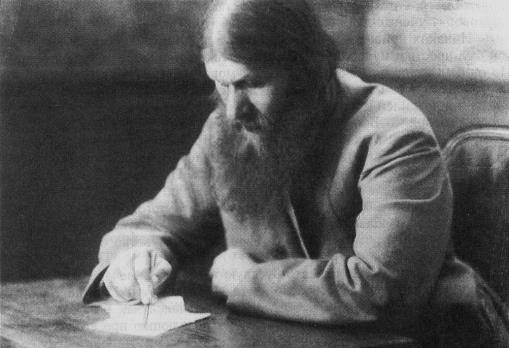
Rasputin- 20th August 1991

GREGORY EFIMOVITCH RASPUTIN was a man (half man, half wizard), who was a representative of the former ways of his people. Warmly sensual, sincerely sober in aspect, mesmerizingly commanding, he charmed and cajoled with a sophisticated will, with impenetrable eye and deceiving smile.

The European people may be defiant and stubborn, and firm of opinion at times; but they had also held an innocence, a childlike receptivity which embraced life and rejoiced in living; being primarily well intentioned, and where possible, exceedingly well-informed, with interests and curiosities akin firstly to artistic adaptations rather than abstract cunning.

One would expect a bear hug from a Russian man with a bulk that could crush you in an 'overbearing' manner. (Excuse the pun.) However, the point being, that these folk are tender lovers, with a vast capacity for passion. They are neither swift, but compelling, neither greedy, but hungry; neither naturally aggressive, but capable of unleashing a fiery rage if need be.


Had Rasputin travelled the Western worlds today, he should have been very popular indeed. For the cunning and contriving, for the best part, belonged mostly to those regions where men aspire to nobility; if not through blood, by personal conquests.

With centuries of old traditions and mystic doctrines which encompassed the richly embroidered magic of the religious and spiritual interpretations, Rasputin took into himself the essence as it were, and then turned such concoction into living vitalities put to the present. As if he might conjure all the ghosts from the past and bind them to his blood and his being, and pervert them, he was as a robber who came and stripped all that was mystically desirous, and defiled that which he left remaining.* Great injury was the consequence, great deformation, which left the core of the Russian racial soul stripped of its spiritual treasures and degraded.

One might ask how one man can affect a people so. And exactly what was it that he did take and convert? Imagine a holy object, say for example a cup of pure gold, which is a vestment to a church, and in deep ritual has been the bearer of the sacrament over many years, throughout many generations. This cup has significance, yet the robber sees only the value of the gold and does melt it down - perhaps it might turn out to make a chain to adorn the neck, or perhaps with coin to barter a meal. It was this type of betrayal which Rasputin brought upon his people; which dealt in not only the gold of shining ore, but also that of precepts, traditions, of teachings formerly kept locked within every man, woman and child: especial to them.

It is with no surprise that one finds that magicians are usually shunned and never trusted. And magician he was, for it was from the old laws and mystic devices that he practiced so as to take for himself, and put to bad purpose. If there was an overall view in the mind of Rasputin, it was never fully realized. But like a bull set loose in the street, there was so much carnage and mishap from that which he contrived.

When a people's pride has been whisked away and ransomed so, they are forlorn and disheveled. For it is more than difficult to replace in a single century that which has been worked upon for many a century.

However, with this qualification they may begin again, and now set course for an entirely different future. Nurtured in time, many flames will grow from the inward flicker and the challenges of re-embodying with an entirely different ego-awareness, shall be rekindled.

The painful service of Rasputin, has allowed for new opportunities, opportunities that the Eastern world have not. And so Mother Russia will peculiarly be progressively leading in an effort to re-find a spiritual denominator.

The archaic essences are now contained and hidden. Shelved. Much was distributed and lost . . . But much was captured and retained- only no longer held in Russia.

* Rudolf Steiner told Asya Turgeniev in 1916:
Rasputin worked directly on the will. That should not be. But people want that. He really is an unrestrained man, the ‘Rasputin’ (Russian: one without a path). Everything said about him is true, but he is nevertheless a God-Seer, that is an occult term for a grade of initiation. It is only thru him that the spiritual world, the Russian Folk-Spirit, can now take effect in Russia, thru nobody else.”

~Rudolf Steiner, according to Assya Turgeneva in the early years of WW1, recorded in her book Erinnerugen an Rudolf Steiner.

"Thus with the death of Grigory Rasputin Russia was finally 'prepared' for its cross-like destiny."

-Quoted from The Spiritual Origins of Eastern Europe and the Future Mysteries of the Holy Grail by Sergei O. Prokofieff page 213. There is more on Rasputin in this book.

My Blog List

Followers

Esoteric Christianity Archive