Translate

A CLUB OF SUPERNAL INTERESTS Christian Esotericism, Spiritual Science, Esoteric Christianity - All Authored by a Lodge of Christian Teachers (unless otherwise stated.) (All writings copyright) ©

Friday, November 13, 2009

Newness- 22nd January 1992

WE carry on, but not with tedious repetition. There are ever-new occurrences in every world and every plane, and activity is always exciting. For the essence of Creation is such creative force, which does not linger, does not stay and stagnate but ever moves on, with or without those who choose to experience the new life swells, the movements deep and inclines steep.

We, all of us within this scheme, are not merely the old, rehashed and reshaped becoming new. Folk tend to perceive life with repetition, and grand that might be - certainly when it comes to one's progressive evolution and expansion therein. But it is not the case of an old tune to an unfamiliar beat. It becomes much more than that. A symphony is so much more than the original tinkle of notes: the notes are the mainstay, the notes are essential and the symphony incorporates and enhances with melodic deviation and much new creation to the original tune.


If we look to the changes which occur within our own physiology, we find that they are related, but also quite different, and clearly not more of the same. An adult form is not directly that which the child appeared to be; and before that - somewhat derivative and some parts altered, and both quite separate in unique ways.
• Child to adult: a relationship in which the child is transformed beyond recognition of ever being a child.
• Bud to bloom: we know that the bloom was a bud, but at what point may we identify the bloom to sprout, bloom to seed?

Comparing the forms, they are exceedingly different - quite so with the future in its entirety. Nature is full of surprises. When seen for the first time, and quite unexpected, so much that may appear unrelated and changed, begins anew; and every living item is new.
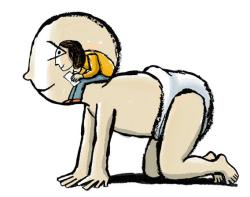
Newness is a concept which the 'oldness' within ourselves finds difficult to identify; the 'oldness' being that which has past been incorporated but not strengthened by exercise; concepts upon which we rely in order to perceive the given world, and thus go by. But the 'oldness' may become infirm when not given latitude enough to enable new concepts to become incorporated. 

Our picture ideas become weary and so hardened by expectations of the familiar. The question then is, "How do I begin to perceive the world in its true 'newness' without forsaking my very necessary aspects of conceiving and relying upon the familiar?" And the balance is paramount, for on the one hand one is too defined and is self-enclosed in a time that will not allow for grand change; on the other we have insanity.

Tan the leather that it remain supple and pliant! We cannot disregard or forsake that which we have come to know and cherish. This of course is not in question, for what use is one set of principles and concepts replaced by a completely new set, for the sake of newness? One should never keep up! Rather then, the task is more for steady and progressive, constant incorporation - incorporating ideas, with one end closed and one end open - ever mindful of the surprises; and surprises there will be, without anxiety or confusion or a desperate need to remain as is.

Accepting change within ourselves, within those conditions which impinge outwardly, is not easy. One can see how quickly we may become 'threatened' by the mere prospect of change, and frightened of 'newness', even though in truth every new day brings with it a future which comprises of: new breath, new word, new movement, new interaction, and new opportunities.

There must be comfort in the thought that we have dealt exceedingly well up to this point, with all of the confrontations which newness has brought. We still remain throughout. The winds may blow with turbulence but we are safe within. This we must know and do recognize as truth, even though at times we may feel tired of ever more newness. 

That which feels awkward in the presence of the future, that which feels tired and baulks like a donkey, are only those aspects within us which are tired and reluctant - quite reticent to change. This may sound obvious, but we shall return to that thought. 

One simply cannot hold back the tide of Creation - one cannot try to with great merit - but we do. We seldom welcome the newness that greets us daily. We seek rather to ignore that fact absolutely. Where is the pocket of fear deep within us that clings to the spirit of excited anticipation? The soul craves experience, the soul is social and the soul celebrates all wonders. Why then, even with our necessary bank of familiarity, are we in daily life, often the antithesis?

As we have discussed, there is nothing at present which conforms distinctly to previous ways, and one such nothing is our perception as regards the spiritual worlds. At present we are verily 'far from home' caught in an age of darkness enshrouding the Globe, which does not permit the conscious individual born into this world, to gaze out further, further than his immediate sensory perceptions.

The only roads leading out into the starry Cosmos, are in fact those primarily which are come to by extraordinary means; or more importantly, those which are reached directly by the heart and the perceptions of the heart. By the development of certain virtues, by the development of attaining a true morality, one can receive echoes of the spiritual activity that flows into them and permeates their very life substance. Though impressions may be deep, they are not clearly perceptible. Man is ever in doubt and divorced from much that he cares for. 

The conditions of this time are difficult, and it is this difficulty which provokes uncertainty. It is not so much the 'new spiritual day' which man is apprehensive of, it is rather whether or not that day will come. It is in these times, that hands need be held and much guidance is required. It is this which provokes a man to be so uncertain that he would rather cling to familiarity than welcome the wonder which comes with great change.

In times past, the threshold of death from this world into others was not closed to the worldly-perception. Those whom we love were not so detached and divorced, and realities were intermixed, intermingled as it were. Now we find that we are caught with a feeling almost of 'aloneness'. "Why, Father, has thou forsaken me?" That we are so separated from our heavenly homes, as the dust of a heavy materialism clouds our view and chokes our breath and fills our eyes which burn tearless and sting.

Brother to brother in this adversity, have yet separated off. Rather than come in unity as one great strength against this darkness, they have gone a'wandering in different ways - pilgrims who walk the earth, some the ranges, some the caves, all unsettled, orphaned by the conditions of this time. 

All periods have their corresponding joys, and also that which could perhaps have been otherwise. This particular time is one which is perhaps more frightening than else could be. For when one is denied the view, they surely feel helpless in meeting the future. But as with other episodes, this too will end. In the long and in the short, this blinded comprehension will cease. 

It is not for punishment, that the way it is, is the way it is. It is no great sword that strikes the sin of mankind which provokes a wrath uncharitable and unforgiving. This period shall be short-lived, even though it does span many lives and lifetimes - it shall end. Regained will be that heavenly identity and the consciousness which lives assured that it is definitely a part of, rather than apart from the glorious bonds of the embracing Higher Kingdoms of Divinity.
But for now in this present time, there is much turmoil from those who have difficulty in gauging much at all. Much sympathy is expended to humanity for suffering this separation. Invisible hands hold up the weary, invisible eyes shall see for the wary, and new days will follow on from days past, once new.

We must forgive our brothers if they cannot see glimpses of higher realities. We know how it is that often we work from recall or from intimations from soul, or from a heart enriched with vital fluids of inspiration and piety. If we have these ways then we must be grateful and give sympathy to those who are caught in this ineffable darkness, and so confused that the wondering ceases and gives over to a sleeping consciousness.

Welcome Creation and all her manifestations of newness, for it is by her that we shall come to that day when the bridges of consciousness may become renewed and divinity made plain. We must seek out divinity within our reality, for it is surely there even though so difficult to readily perceive.

Thursday, November 12, 2009

Measurement without numbers - qualify, not quantify: 22nd January 1992

TRY not to gauge the work, this work, by numbers: numbers of books, numbers of people, numbers of days, for this would be (to the numerist) ever unsatisfying and unrelated. In the worldly scheme folk usually measure success in exactly these terms of relevance, but value is value, e.g. buckets of money are useless if the currency is worthless.

Folk who become of public notice often seek to overcome the world by their presence or their company's presence, and determine that much is gained if they may verily 'outstrip' their 'opponents' by gathering more attention unto themselves. It is an easy mistake, but not warranted by those who should know better.

When a new species of flower breaks ground and is exhumed from the ethers, it has much glory in first popping its head joyfully and courageously into the light of this world's day. This work shall do many things beside that which is readily apparent - one of which, and not the least of which, shall be the bringing forth of another such new species, assisting its formation and creation. And that bloom shall continue as great medicine to the world - prolific or not, it will endure and continue. For it has been introduced into the world and will signify the hopes and strivings, the beginnings of this work. (Small and purple, delicate and four-petaled.)

Wednesday, November 11, 2009

Yes & No- 17th January 1992

THE tail of a dog wags back and forth; the finger of the old man cocks and shakes with all-knowing instruction. The head bows, the head lifts, the head shakes backward and forth, up and down: dissent, assent, agreement.

One movement is defined; wavering movements which are not of singular intent, are equally, undecided, as the wavering shows. If one examines the habits of this exploratory shaking they can begin to 'feel out' their partner’s searching, even though they appear to be decisive in interpretation. 

Here and there, from this and that, side to side, backwards up and frontwards down - this explains to us the true makeover of most decisions answered. If we nod in agreement we are tending towards that line of decision, but not overly committed unwaveringly. Equally a nod of disapproval - 'no, no, no' - is a tendency favouring such, but going from this to that in examination. 

It is moreover an informed answer, for the information is causing the constant reflex. Something like this: "No, I reject, but, what if?" "I understand" and so forth. Examination - return to first opinion - drawing conclusions - no; and so on. The head shaking side to side or up and down, the inner gauging, the outer affirmation of decided opinion. 


There are grades of sound which accompany the verbal equivalents, ranging from the most definite and exuberant, to those which are weak and noncommittal. If I should ask you if you would like to be given a treasure, your reply 'yes' should be stated far differently to your being offered a biscuit, a dry biscuit, for example. 

Yet the two words, both yes and no, are the most strongly driven words of any language. The individual who imparts either of these words may choose to do so quite forcefully, quite actively, and throw their whole being behind them and their meaning of the moment.

Of course there needs be both will and desire coupled with a true and proper reference, understanding that which is to be accepted or rejected by the individual. However, 'yes' and 'no' still stand as the most powerful issues, regardless of how quickly we tend to offer both, regardless of considerations.

These two words separate man from beast, as within the use common and decided, they are representative of choice - choice being paramount to man. They are in answer to all consideration. 


Tuesday, November 10, 2009

The Masters of Morn- 12th January 1992


THE Masters of Morn are the guardians of future travails; they are as the scout, who with mingled excitement, apprehension and courage, do run a little way into the future and return with what has been seen there. Messengers are sent who carry the word of these future events, who go from one to one into the world. 

One may divine the spiritual world and see who passes by, seeing also forthcoming eventualities, for the physical rendition is but echo to that which is in place. In this one can see the combination of destiny pre-told and an open future which is quite malleable to decision and intent. It is alike to oranges coming down on a conveyer-belt in groups: now one, now two, now none - and we may communicate with those who have seen how many were placed at the start, and we may sort through the quantities as they arrive. Plop, plop, into the packing case! Sorting through the bruised and the rotten: discarding and arranging, arranging and discarding. 


Events are a little like Plato: perfect in essence, but once active, compromising that perfect design. Life is fast indeed. Focus alters, situations breed other situations, focus adjusts accordingly and patterns are thrown and deviate. But the big waves still come crashing in with regular precision, whilst the small ripples flounder and tow. The heave and swell, the rise and peak of increments within the one body of water: these may be foreseen - the tendencies and magnitude, offshore from afar. 


We now go from oranges and tidal waves to specifics: If we were to compare men from the former centuries, streaming back into history known and beyond, we should find that the overall characteristics of each and every century-individual are so markedly different, one might be excused in believing them to be each a differing species. The constitution and metabolic system may appear derivative when in reality is not, and there are contradictions that the scientific world refuses to highlight when examining the 'unexplainable' jumps, deviations and patterns from era to era.


In livestock the interrupting inexplicable genesis characteristics are referred to as 'throwbacks'; whereas this system of explanation is not correct when one speaks of the present or future formations of any biological constitution. However, simple to say that there is truth that there must be seeds of given possibilities within a constitution for one characteristic to predominate and flourish. But we maintain that the preponderance is there all the time before becoming physically apparent and determined presently, and not by chance or ancestral 'throwback'. For the 'pool' theory is as good as it goes, however it rests on shaky doctrine which essentially rests on principles of chance mutations rather than will and design. One can see the devil at work in the thinking of the scientific world when such idiocy reigns and is accepted unquestioningly. 

However, returning to the first statement: that when comparing the century-men there are changes which are unrelated within that totality, within their overall makeup - in that which comprises not only their biological status, but also too their psyche, their comprehension, their perceptions, their powers of intellectual fraternization, their coordination (how they physically relate to the earth, how they stand, how they move, dances they prefer etc.), and so forth. And there are remnants of former centuries still here as representative of such, in physical form etc. But such are short-lived examples of centuries not exceeding two hundred or possibly a little more. In terms of the higher worlds and time, this is very few. Therefore one can immediately say that the century-men contrast greatly in such small periods, and even more so when viewed back four to five hundred centuries and before. It is important to acknowledge this, for from this perspective we can ascertain that the men of the future will be also quite markedly different. It is precisely in what way that concerns the Masters of Morn and their folk.


At the forefront of thinking in this century it appears we have struck upon an age of implants and mechanical function. From this, the 'modern thinkers' tend to work towards more of the same when viewing the future receptacle which will carry the soul of man. This is interesting because it is untrue and vain to believe that we may purely be motivated or 'mutated' into forms which are mechanically reliant, and therefore unresponsive to spiritual or higher dictates. 

The scientists work with modern picks and tongs, of lasers and extractors, delving minutely and dissecting the small worlds; and they fiddle the genes they can find, and they persuade the public that this is respectable intervention. They have forgotten however, that anything which is physically apparent, apparent enough to be at a level where they may intervene or interfere, is already the offspring of a previous design. This is fact. The 'beginnings of life' are not discernible physically. They are, later on, corruptible, as all physical manifestation is, but they are not begun or determined within the physical realm.

So the consequences of meddling at an early stage of preexistent gestation are dangerous and unlawful. Now there must be a certain sense of morality in place here, and one must come to understand a few definite principles before proceeding. When men try to pre-empt nature and presume to know better and interfere with destinies of growth, then they are responsible for the outcome, and yet do not act with full knowledge of such outcome. Let a scientist experiment first upon himself to judge an outcome. This of course they are not apt to do, but are quick to take foetus and dissect, with no such prick of conscience or sickening apprehension.

Men will change and men will alter, and whilst it is true to say that generations look to their forefathers for completing those conditions which make their constitutions conceivable, one can also say specifically that they are not wholly dependent, and can if need be determine much.


For example: there have been many kinds of atrocities as result of human calamity four to five hundred centuries ago - similar to what we might imagine to be the result of the entire planet become nuclear-bound with excessive radiation . . . and from this there were unalterable features and characteristic distortions, weaknesses, and a chain of inhuman (for that time) men. At the end of this period the animal kingdom took on the burden of many of the deformities; some were incorporated, some were absolved and dissolved; some were enhanced, and some were retained for future change (held back as it were). Then in a wave, a completely new generation arose, who basically were not responsible or accountable for the regretted chain of calamities, and who were pure in design - and actually born so - defying what should have been the succession of physical deformities, because they were operating out from the original plans as were laid in the spiritual worlds prior to their incarnating. They were marginally unaffected. However, those who partook in the crisis events which were prior: they were the ones who would suffer the physical implications in forthcoming incarnations. 

So this tells us that as regards the physicality of the constitution and the whole of humanity, certain generations may be at risk if it ever came to chemical or radioactive disturbances. But it would be temporarily interruptive only, and not determine the pattern of incarnating individuals forever and a day.


Having said that, what does precisely determine the constitution of man, of humanity in future generations to come? It is that which we take with us into the spiritual realms, and receive there also, which will be of paramount significance. And so, alike to the generations who still carry the problems which occurred in sudden and destructive transformation and effect today in those corresponding parts of their constitution, we also suffer the defects and trials of our spiritual deficiencies - but more so.

Happily there is more to be gleaned which enhances a man than does destroy him; so this is good for the principle. Man is ever improving as it were, gaining much strength and self-determination. The incarnating ego is brimful of great and marvelous experience. All individuals receive more than they lack. But conditions and opportunities are carved and structured always in the present. The actions, the thoughts and deeds of a man, predetermine his future destiny. One cannot divorce a man from his future. The time lapse may be confusing, but is rather a blessing to most. And fortunately also, we are given respite from inevitable consequences, where we may gather much in order to deal better with those circumstances we have made for ourselves.
The genetic engineer would be better discerning a soul inhabitant from a sea of living cells. If he might find that quite truly it is the responsiveness of the inner qualities of man which determine the future man (body as well), then he should go from the laboratory and out into the streets, and practice applied morality.

What use is it to try and lengthen the days if we are rob ourselves of a much needed sleep? Without the rest, without the slumber, we exhaust ever quicker and shorten our total of days. For the man is of the cosmos and requires the nutrition that only proper rest will bring. It is so with all other areas whereupon the enthusiastic scientist would state temporary preferences which take from the overall plan. 

One might try to cheat death, when the reality is that death is but ever more life, and the very thing that they say they seek, they already have. Men would be better to understand the first reality, rather than deny it and chase secondary notions.

My Blog List

Followers

Esoteric Christianity Archive