Translate

A CLUB OF SUPERNAL INTERESTS Christian Esotericism, Spiritual Science, Esoteric Christianity - All Authored by a Lodge of Christian Teachers (unless otherwise stated.) (All writings copyright) ©

Thursday, November 12, 2009

Measurement without numbers - qualify, not quantify: 22nd January 1992

TRY not to gauge the work, this work, by numbers: numbers of books, numbers of people, numbers of days, for this would be (to the numerist) ever unsatisfying and unrelated. In the worldly scheme folk usually measure success in exactly these terms of relevance, but value is value, e.g. buckets of money are useless if the currency is worthless.

Folk who become of public notice often seek to overcome the world by their presence or their company's presence, and determine that much is gained if they may verily 'outstrip' their 'opponents' by gathering more attention unto themselves. It is an easy mistake, but not warranted by those who should know better.

When a new species of flower breaks ground and is exhumed from the ethers, it has much glory in first popping its head joyfully and courageously into the light of this world's day. This work shall do many things beside that which is readily apparent - one of which, and not the least of which, shall be the bringing forth of another such new species, assisting its formation and creation. And that bloom shall continue as great medicine to the world - prolific or not, it will endure and continue. For it has been introduced into the world and will signify the hopes and strivings, the beginnings of this work. (Small and purple, delicate and four-petaled.)

Wednesday, November 11, 2009

Yes & No- 17th January 1992

THE tail of a dog wags back and forth; the finger of the old man cocks and shakes with all-knowing instruction. The head bows, the head lifts, the head shakes backward and forth, up and down: dissent, assent, agreement.

One movement is defined; wavering movements which are not of singular intent, are equally, undecided, as the wavering shows. If one examines the habits of this exploratory shaking they can begin to 'feel out' their partner’s searching, even though they appear to be decisive in interpretation. 

Here and there, from this and that, side to side, backwards up and frontwards down - this explains to us the true makeover of most decisions answered. If we nod in agreement we are tending towards that line of decision, but not overly committed unwaveringly. Equally a nod of disapproval - 'no, no, no' - is a tendency favouring such, but going from this to that in examination. 

It is moreover an informed answer, for the information is causing the constant reflex. Something like this: "No, I reject, but, what if?" "I understand" and so forth. Examination - return to first opinion - drawing conclusions - no; and so on. The head shaking side to side or up and down, the inner gauging, the outer affirmation of decided opinion. 


There are grades of sound which accompany the verbal equivalents, ranging from the most definite and exuberant, to those which are weak and noncommittal. If I should ask you if you would like to be given a treasure, your reply 'yes' should be stated far differently to your being offered a biscuit, a dry biscuit, for example. 

Yet the two words, both yes and no, are the most strongly driven words of any language. The individual who imparts either of these words may choose to do so quite forcefully, quite actively, and throw their whole being behind them and their meaning of the moment.

Of course there needs be both will and desire coupled with a true and proper reference, understanding that which is to be accepted or rejected by the individual. However, 'yes' and 'no' still stand as the most powerful issues, regardless of how quickly we tend to offer both, regardless of considerations.

These two words separate man from beast, as within the use common and decided, they are representative of choice - choice being paramount to man. They are in answer to all consideration. 


Tuesday, November 10, 2009

The Masters of Morn- 12th January 1992


THE Masters of Morn are the guardians of future travails; they are as the scout, who with mingled excitement, apprehension and courage, do run a little way into the future and return with what has been seen there. Messengers are sent who carry the word of these future events, who go from one to one into the world. 

One may divine the spiritual world and see who passes by, seeing also forthcoming eventualities, for the physical rendition is but echo to that which is in place. In this one can see the combination of destiny pre-told and an open future which is quite malleable to decision and intent. It is alike to oranges coming down on a conveyer-belt in groups: now one, now two, now none - and we may communicate with those who have seen how many were placed at the start, and we may sort through the quantities as they arrive. Plop, plop, into the packing case! Sorting through the bruised and the rotten: discarding and arranging, arranging and discarding. 


Events are a little like Plato: perfect in essence, but once active, compromising that perfect design. Life is fast indeed. Focus alters, situations breed other situations, focus adjusts accordingly and patterns are thrown and deviate. But the big waves still come crashing in with regular precision, whilst the small ripples flounder and tow. The heave and swell, the rise and peak of increments within the one body of water: these may be foreseen - the tendencies and magnitude, offshore from afar. 


We now go from oranges and tidal waves to specifics: If we were to compare men from the former centuries, streaming back into history known and beyond, we should find that the overall characteristics of each and every century-individual are so markedly different, one might be excused in believing them to be each a differing species. The constitution and metabolic system may appear derivative when in reality is not, and there are contradictions that the scientific world refuses to highlight when examining the 'unexplainable' jumps, deviations and patterns from era to era.


In livestock the interrupting inexplicable genesis characteristics are referred to as 'throwbacks'; whereas this system of explanation is not correct when one speaks of the present or future formations of any biological constitution. However, simple to say that there is truth that there must be seeds of given possibilities within a constitution for one characteristic to predominate and flourish. But we maintain that the preponderance is there all the time before becoming physically apparent and determined presently, and not by chance or ancestral 'throwback'. For the 'pool' theory is as good as it goes, however it rests on shaky doctrine which essentially rests on principles of chance mutations rather than will and design. One can see the devil at work in the thinking of the scientific world when such idiocy reigns and is accepted unquestioningly. 

However, returning to the first statement: that when comparing the century-men there are changes which are unrelated within that totality, within their overall makeup - in that which comprises not only their biological status, but also too their psyche, their comprehension, their perceptions, their powers of intellectual fraternization, their coordination (how they physically relate to the earth, how they stand, how they move, dances they prefer etc.), and so forth. And there are remnants of former centuries still here as representative of such, in physical form etc. But such are short-lived examples of centuries not exceeding two hundred or possibly a little more. In terms of the higher worlds and time, this is very few. Therefore one can immediately say that the century-men contrast greatly in such small periods, and even more so when viewed back four to five hundred centuries and before. It is important to acknowledge this, for from this perspective we can ascertain that the men of the future will be also quite markedly different. It is precisely in what way that concerns the Masters of Morn and their folk.


At the forefront of thinking in this century it appears we have struck upon an age of implants and mechanical function. From this, the 'modern thinkers' tend to work towards more of the same when viewing the future receptacle which will carry the soul of man. This is interesting because it is untrue and vain to believe that we may purely be motivated or 'mutated' into forms which are mechanically reliant, and therefore unresponsive to spiritual or higher dictates. 

The scientists work with modern picks and tongs, of lasers and extractors, delving minutely and dissecting the small worlds; and they fiddle the genes they can find, and they persuade the public that this is respectable intervention. They have forgotten however, that anything which is physically apparent, apparent enough to be at a level where they may intervene or interfere, is already the offspring of a previous design. This is fact. The 'beginnings of life' are not discernible physically. They are, later on, corruptible, as all physical manifestation is, but they are not begun or determined within the physical realm.

So the consequences of meddling at an early stage of preexistent gestation are dangerous and unlawful. Now there must be a certain sense of morality in place here, and one must come to understand a few definite principles before proceeding. When men try to pre-empt nature and presume to know better and interfere with destinies of growth, then they are responsible for the outcome, and yet do not act with full knowledge of such outcome. Let a scientist experiment first upon himself to judge an outcome. This of course they are not apt to do, but are quick to take foetus and dissect, with no such prick of conscience or sickening apprehension.

Men will change and men will alter, and whilst it is true to say that generations look to their forefathers for completing those conditions which make their constitutions conceivable, one can also say specifically that they are not wholly dependent, and can if need be determine much.


For example: there have been many kinds of atrocities as result of human calamity four to five hundred centuries ago - similar to what we might imagine to be the result of the entire planet become nuclear-bound with excessive radiation . . . and from this there were unalterable features and characteristic distortions, weaknesses, and a chain of inhuman (for that time) men. At the end of this period the animal kingdom took on the burden of many of the deformities; some were incorporated, some were absolved and dissolved; some were enhanced, and some were retained for future change (held back as it were). Then in a wave, a completely new generation arose, who basically were not responsible or accountable for the regretted chain of calamities, and who were pure in design - and actually born so - defying what should have been the succession of physical deformities, because they were operating out from the original plans as were laid in the spiritual worlds prior to their incarnating. They were marginally unaffected. However, those who partook in the crisis events which were prior: they were the ones who would suffer the physical implications in forthcoming incarnations. 

So this tells us that as regards the physicality of the constitution and the whole of humanity, certain generations may be at risk if it ever came to chemical or radioactive disturbances. But it would be temporarily interruptive only, and not determine the pattern of incarnating individuals forever and a day.


Having said that, what does precisely determine the constitution of man, of humanity in future generations to come? It is that which we take with us into the spiritual realms, and receive there also, which will be of paramount significance. And so, alike to the generations who still carry the problems which occurred in sudden and destructive transformation and effect today in those corresponding parts of their constitution, we also suffer the defects and trials of our spiritual deficiencies - but more so.

Happily there is more to be gleaned which enhances a man than does destroy him; so this is good for the principle. Man is ever improving as it were, gaining much strength and self-determination. The incarnating ego is brimful of great and marvelous experience. All individuals receive more than they lack. But conditions and opportunities are carved and structured always in the present. The actions, the thoughts and deeds of a man, predetermine his future destiny. One cannot divorce a man from his future. The time lapse may be confusing, but is rather a blessing to most. And fortunately also, we are given respite from inevitable consequences, where we may gather much in order to deal better with those circumstances we have made for ourselves.
The genetic engineer would be better discerning a soul inhabitant from a sea of living cells. If he might find that quite truly it is the responsiveness of the inner qualities of man which determine the future man (body as well), then he should go from the laboratory and out into the streets, and practice applied morality.

What use is it to try and lengthen the days if we are rob ourselves of a much needed sleep? Without the rest, without the slumber, we exhaust ever quicker and shorten our total of days. For the man is of the cosmos and requires the nutrition that only proper rest will bring. It is so with all other areas whereupon the enthusiastic scientist would state temporary preferences which take from the overall plan. 

One might try to cheat death, when the reality is that death is but ever more life, and the very thing that they say they seek, they already have. Men would be better to understand the first reality, rather than deny it and chase secondary notions.

Monday, November 9, 2009

The Denial of Life- 1992

FIRST Steersman Pucker drove the buoyant seas like one gigantic slippery-dip. So reckless was he that the scruffy crew of Her Lady Magnifico Splendouralous, happened upon his talents one day, whilst he, on the pier, chewed the hind legs of a Caesar crab. The crab was still alive at the time.

He had traveled far in search of the land of the Bon-Bon tree, but had failed to reach destiny, as his previous charge had unwittingly been swallowed by storm and sea. The crew's captain had retired into a madness which only the ocean-bound did at times, become inflicted. It came, thought they, when drinking seawater, and this rumor was upheld by many. 


Steersman Pucker was qualified, for he held papers in which marvelous testimonies did tell of exotic freights and passages; which none other had heard of. They presumed that he must have already traveled far, for the stories so told were bewildering and fascinating, and bore no known relationship to local waters.

The cargo was hauled and fixed on deck, bound thrice over and attached as thought sufficient - one mammoth statue engraved and worked upon; a most cumbersome figure wrapped and concealed; destined for the garden of a holy man who had set the commission. A few other trifles and truffles, beverages and salt-meats, kegs of sour, kegs of sweet, and the usual animal passengers: a variety, from monkey to rat. 

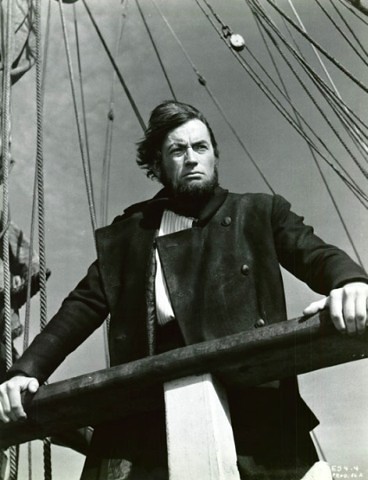
The waters were alarmingly calm, and the crew - with now, new captain (whom one might imagine as Gregory Peck) - were motivated to resume their voyage. For to the seaman life itself is a continual voyage, with every seaport considered an interruption to their watery land. But also too, every new consignment promised its reward; and eagerly they chortled off with grand expectation of special payments for this one.

On the seventh night, still flouncing on an ever quiet sea, Captain Pucker divorced himself from the main company and sought seclusion down by the ornament, which groaned with the ship's movement, tensing and straining at the bondages wrapped and bound. There was much superstition and a tingling apprehension regards this form lying heavy on the deck. The men had begun to speak jovial remarks when passing, but feigned to touch it; and did joke of what lay so concealed and so wrapped. Until three days later; weird imaginings had seized every man on board, and they stopped their remarks for many had begun to hear replies. Of course, not one did intimate this to another, but the frenzy was plain.

Pucker was amused and made point of resting himself on the head of this form. He was assured of gathering his thoughts uninterrupted, and was not caring or curious about this reliquary of import.


On this night, of the seventh, a snake did happen out from the garments, which though constrained well, did have many a fold in which the serpent might have made home back on land. The Captain notified the shiphands, calling for instant removal; and the glistening whip snake was duly flung over. The men, now caught with ever more suspicion, suggested that the snake was an omen of this illegal cargo.

Three nights later Captain Pucker was disturbed from his nightly contemplations, yet again in similar fashion. Another snake did slither out, and became erect, looking eye to eye, beside the Captain. Somewhat startled and complaining, the Captain did beckon his mates and rebuked them for not attending to the matter when first asked. For he did presume that this was the first snake, and considered not that there were two.


"It's enchanted, that's what it is!" they exclaimed with alarm; and all the while the snake, poised on statue, stared motionless. Pucker threw a net, and so covering the reptile, took a great iron chain, and smashed it over and over, with dramatic movements and curses, well satisfied with his trembling audience. Overzealous he became, and when casting the net over, found to his upset, white crumbles at his feet- one quite large. Shrewdly he shuffled the marble fragments under the tarp, and began to make bold of his achievements of the night. The men returned to sleep, and the Captain was again alone, alone with the now defiled and desecrated artwork.

"Bloody nuisance cargo!" was all that sprang to mind.

The wind had become icy colder, his stomach churned, he had never been partial to snakes, or regret. He comforted himself that perhaps with chisel and brazing-stones, he might make aright the craftsmanship gone wrong. And he so retired for the night, looking forward to the next, when he planned to unrobe the cold marble figure and confront the job ahead.

It was a moonless night as the sky was cloud-filled, and Captain Pucker required a little lamp for assistance with his restoration. The men were subdued and kept to themselves. The opportunity had come for him to strip bare this secret figure discreetly. With ropes untied, and further cords cut, Pucker pulled away one sheath of calico to find another underneath. Seven in all enrobed the marble figure, six he removed away from the head, until he came to the seventh, when he despondently leapt back, dismayed with disgust. For upon stripping back the final cloth, a defiling sticky paste caught his hand; viewed in the light of the flickering lamp . . . it resembled blood!

The Captain was rarely at a loss for immediate action when required, and prided himself so in daring and in confidence. It flashed through his fevered mind that he too might be drinking seawater, come morning. Unnerved and reluctant, he reviewed his good intentions, and with loathsome hand, rewrapped and rebound the solemn figure, deciding it better remain concealed; for he could not bring himself to view the face.


Never before had he encountered a magic unexplained. Many a story is told and received, and of course, he had known practically all the stories passed on. He was brought up on them. He had met with strangers who were curious, lecherous, exotically garbed and heavenly inspired; and disregarded all such individuals as one of the same.

Had the figure been a man so enshrouded, who had met with a common death, he should not fain glance into the face. But he was bewildered with the prospect of confronting that which he did not know- so foreign to experience and expectation.

Captain Pucker could not appease his tiredness with fresh, sweet sleep that night. He lay in blankets, all in an itch. His legs took to a trembling as he wrestled with the demons of imaginings. He tried many a consoling thought, with the promise of morning ahead.


A storm had been brewing however, with veritable force. The night was challenged by cracks and crazes of light, in thunderous episodes. The boat, truly tiny in respect now to the mountainous tumultuous waves, was seized and taunted perilously. After weeks of complaining that the waters were almost too quiet, it often happens that one is given such grace of certain pleas in overwhelming abundance.

"How so?" thought Captain Pucker, as it was not the season for storms.

However, he was glad for distraction and leapt from his bed to attend. It was a sad peculiarity that Pucker was remiss ever slightly, that when he had retied the ropes on his cargo he had hurriedly done so, too loosely to hold. The weight of the figure was shifted this way and that; and the bonds became weaker until finally they snapped.

The men were busy bailing and restraining ropes and rudders; their concentration spent on keeping certain balance. The Captain sung his favourite ballad, which was especial to inhospitable weather. The crew from this, worked well, with one mind, managing the elements, each with his own duty duly performed.


Finally the winds abated, the swirls ceased and a rosy glow streamed over the horizon. The ship creaked slightly as it gently glided into the port. The men were looking forward to their due nourishment and were glad that they might peruse the new town. Captain Pucker had given notice that he should not be making the voyage back, but rather chose to investigate the prospects of a merchandising franchise and apply his talents to market trade.

But before disembarking each man did have to wait. For their main commission had to be claimed and paid accordingly for, as the charge was their much-needed salary. The recompense was to last them three months or more.

But no one came. A full seven days passed, with word sent and waited for. But still no one came for the marble model.


Restless and weary of their charge, the men one by one, would make short daily departures, returning at night. What was unknown to the crew was that the rightful owner of this peculiar cargo had deceased shortly after making the arrangements for the statue to be transited. Having paid one quarter of the fee outstanding, it was small comfort to the men to be left the legacy of the unclaimed reliquary.

The Captain had desisted their attempts to view this marvel, as he feared the repercussions of their finding its demise. But after days had turned to weeks and weeks past the length of the month, the crew had decided it time to cut losses and depart. Having seen all there was to see locally, they became as irritable tourists, homesick.

The funds from the remainder of the cargo were sold, gained and now spent, the decks refilled with menagerie and curio, cloth and spice and luxurious intricacies so called for. But still remaining with position taken on deck was the mighty marble statue awaiting removal.

Carved from a frozen Tear of God, the name of this art-piece had spread throughout the local (and distant) communities of the holy. They had awaited its presence, but had not known the details of which ship to port- as many did come and go. The traffic was by the hundreds.

The search for the commission was extensive. So it took a small company of monks many months before reaching the correct vessel, in good time. They had ventured into that region a matter of days before its arrival, and departed to other parts before returning with perseverance and hope of finding this acquisition.

Pucker, who was still resident upon the ship, eyed the hooded, plain-garbed troop who gathered at the walkway entrance. They had been murmuring to one of the crew, deliberating with restrained excitement of their finding, implying that they had come to collect.

This did satisfy the men to make suitable arrangements, as only that day they had assumed total readiness for departure. There was no argument as to payment. The monks had brought much gold, and did not hesitate when asked to pay twice over the initial price agreed upon.

With hoist and lever, a push and a pull, the clumsy strained efforts of twenty men did heave the marble piece from the side of the ship onto rodded ladders of iron bands, and suitable attachments to hoist such a bulk.

The men, much satisfied, bid goodbyes to Captain Pucker. Their transit was coast-bound, and they left, content to manage without him.

The Captain inquired as to the monk's destination. Perhaps he might follow them, and view the piece naked - as he had spent many months a'wondering and could not bring himself to depart this mystical work. The monks consented to his company and in goodwill Captain Pucker brought many provisions for their travel. His guessing had got the better of him, and he provoked haste with hurried promptings. But one may never hurry a monk, and his efforts were unrewarded.

The passage through to the holy community was lengthy, tedious, and mostly (it seemed) uphill. They would venture forth in two or three hour treks, stopping at intervals for prayer and privileged feasts. At night they would camp, and he did slumber amongst the chants that drove into the darkness to greet the morning. His ways of worldly assertion and mean outlook were educated by the presence of these twelve strangers- not a sigh or a grumble, in the great treasured haul.

Through ranges and down uncut pathways, from town to town and into ever more countryside, they travelled on for the best part of a year; until one fateful day when a mighty illness struck each and every one. Greatly fatigued and depleted of life, the entire company took camp, lay down and had not the strength to rise.

Pucker was delirious and quite helpless, as he watched the monks so quickly weaken. One by one their last prayers, on last breath, were murmured. One by one, they did abandon him, passing on to Heaven.

Had he the strength to laugh at his folly, with this affection for the unseen statue? Might he beseech the Father, to grant him more essence of life? Where could he go to if his legs could but more carry him? Was this figure so wrapped, accursed to him and his for his failings?

He knew not what to do with the twelve bodies that listlessly slumped before him. With respectful prayers, he clasped each hand in farewell and performed rites he felt most suitable. For in the time that he had spent journeying so, he had come to love these twelve.


He then went to the marble form and knelt beside. Throwing himself over the figure, he wept for the injury he had caused it, so long ago. For now he knew that this piece was surely special, if it had been treasured by these monks in a way that offers life itself for beauty.

Dare he behold the form for what it truly was? So many configurements he had speculated and presumed. With knife attending he drew each layer of shroud back from the form, until he came to the seventh and last.

Just then, as with a vision more vivid than life, there came and stood an Angel who beckoned him to come.

"But I must first take away this veil, and then I shall follow you wherever you will."


But the Angel intimated that his time had all been spent and that he must heed now, not later, not even one minute later. Without anxiety, without despair, Pucker did go, as he was asked to.

For the Angel's presence was well known to him, and he did recognize what he had come to love. For he needed not a statue to behold her Holy Face. And this burden of his life was surely redeemed in happy death.

My Blog List

Followers

Esoteric Christianity Archive