 Question: Could you please explain the line in our Lord's Prayer which says "And if put to the challenge, may we walk in the shadow of Your example"?- I find the word 'shadow' a bit off-putting.
A SHADOW is that which falls out from someone (or something) when there is light strong enough to make such discernible. The 'shadow of an example' means the example's projections which naturally fall this way or that; depending upon their relation to what is before them.
Although the word 'shadow' implies a gloominess distinct from its contrast of light, it is a product of a light-focus, of there being that place to where the rays have issued and met. Darkness, as often signified, is that which is without light, i.e. no thing which the light present can efface.
Light itself is ever-present, called into being by the need of a lowly existence; for all light (all, as in all) is a reality from a higher world presenting in pure form. It contains an essential fluidity, and an amalgamation of qualities and higher forces, including myriads of beings respective to times and places from higher realms also; and it enters into the spheres beneath, presenting to illumine and make known that which is in existence there.
We come to recognize and know all that is of this World by the provisions of that from a far higher impetus. Thus all knowledge, even the blatant materialistic comprehension, is inspired from 'on high'.
One cannot light a candle and bring the fires out from Hell to produce an illuminating flame. Any flame, of necessity, is from an adjoining region which is higher to the condition from which it is seen in, and from that perspective the fires of Hell themselves are indeed what is needed and a godsend so to speak, rather than an object of evil. They are purging to the sinner to whom they are abhorrent, because they are from a higher sphere. Those who are temporarily (yes, temporarily) committed within the lowly confines, are enshrouded with a darkness all of their own. Their spirit is truly divorced from the joy of any great illumination; and as a plant without light they either recoil back from life or adapt with an astrality which feeds them the milk of the light as cast from others; and as a creature of the depths of darkness, their characteristics mutate into spurious, inhuman design.
It is a higher world which calls us into being. We are drawn up towards it, but only brought as far as the perimeters of this in our consciousness; whilst all the while we live too in quality and in perspective, in some of that which is to be our spiritual future, belonging further on ahead.
The miracle of Medjugorje is a circumstance of discovering this truth. The Sun becomes the very portal that it is, with the cascade of angels multifariously tumbling into our place of being, with too the grandest of Loves, in pure spirit form, who may meet in the light and are seen in this light, and interpreted in countless languages because their true and first language is direct and spoken in presence, rather than projection.
The earth in which the kernel rests, cradled and nourished, protected before maturation, this earth is penetrated by the sunlight daily; and although our eyes would not take in the difference between morning and night, all growth beneath the ground does. The etheric sight belonging to all things which live beneath the soil is keen to the Sun, which actually radiates all the way through the larger Earth, saturating it entirely. We are never without some of its influence - and even in those portions where the darkness of night is apparent, there is still much of the Sun that is with us even so.
Heat and light are two totally different commodities. Heat is activity whereas light is our immediate Heaven, the 'one' above us, the element so combined of our higher resources. Heat is an activity which is not necessarily partial to the relative higher aspects in its manifestation. It is active because of higher possibility, but may come from a lower source. Heat expires soul forces, whereas light infills them.
Heat is natural to the activity of soul, but requires containment and direction. Light is of the soul and knows no containment but is satisfied and lives through all things lower than itself - it finds itself (transversely) by its subjection into the grosser imprints.
The Future finds its way into the Present and thus recognizes itself, by that which it makes apparent. The Present may only come to recognize itself by those powers as sacrificed to it from the incoming Future.
Actuality, of a higher and firstborn reality, inspires activity, where the forces of the Future impound and tussle with the forces of the Present. Warmth is such an activity, whereupon the Future makes wrestle with the Present; and accounted for, may expire some of the Present whilst making way for the new.
Question: Is there anything that one can ever really be 'certain' of?
Yes indeed! Whilst we may never be certain about our own perspectives being completely and utterly adherent to an actuality, we may, for one, be certain that there are those more able than us who are reliable. This is not a trite put-down, but offered as a comfort. For although it is paramount for each to learn for himself all things, there can be much too much self-importance placed in this by the individual student, who may overestimate his wisdom into the bargain. There are those times in which it is appropriate for all of us to acknowledge our relative infancy on this path to higher Wisdom, and look forward to many adjustments in understanding, in comprehension.
Having said that, we may examine the meaning of certainty, and hope that we may come to it! Certainty is to Light as Knowledge is to the Heat's activity. The experience of certainty within a man is, of itself, a higher quality given expression; for the time that he has called it forth and lives with it in true affirmation within, this 'living' certainty (irrespective of its connections), is expressive of his higher nature, positioning him in relation to the present.
It is assumed that this is relative to the ego-activity of a man, but it is not. Many creatures that know certainty have not the egos to know that they know. Many self-realized beings are brimful of certainty, but reflective solely of the Cosmos, and have no marked individuality which distinguishes them from their brothers (apart from their histories). So we may say that certainty is not bound to self, with all of the implications of possible mistakenness.
Certainty lives in our experiencing that which is really outside of ourselves, rather than some false imagination. In other words, one cannot consider it properly in a negative context - of 'it' having gone wrong - particularly in this case, the subject being what it is; if you get the point.
The clearest and strongest of experiences of pure certainty comes to a man during prayer - this is true. When we endeavor to combine with our Christ or Father God, or appeal to the Angels also, we effectively do so. As immediately as the hope goes out it is answered. There is an enormous eagerness to meet with us, and quite often, although a man may almost experience a solitude during prayer, he is at the same time amassed with a loving attentiveness that obliges his soul.
Many times we may come to share in the greater strengths which are about us. We may come to a certainty of Christ's wherein we know:
He is unshakably, undeterably, incorrigibly, unrelentlessly, completely and emphatically, unreservedly and undeniably, totally, most utterly, fully, and happily:
- CERTAIN of His Love for us - for all of us.
- CERTAIN of His unswerving commitment to us.
- CERTAIN of our being, (in existence) and our right to be.
- CERTAIN of His being, (in existence) and His right to be.
- CERTAIN of the Future (because He is the Future).
- CERTAIN of Love (it being the one Key to Creation).
- CERTAIN of Purpose - with a definite direction known to Him.
By just such contemplation of this earnest certainty we begin to adhere to its reality, and thus experience it. There is no doubt about it! That is the very experience of certainty - its gift to us is the pleasure of a godly conformity, where we do not battle our wills with the greater Will, but we may yet do battle with those aspects of the World which we need to effect change.
Should we ever really discuss the correctness of a man to ponder his correctness of certainty? You see, as implied before, the nature of certainty is what it is. The experience of it, in one sense, no matter how it is attached to what or what for, is still a heavenly inspired gift working within a man. What he knows in certainty may not even translate and correlate in thought. He may be mistaken in opinion, but in those times of certainty he is close to the big truth; and so one is separate to another and not dependent upon another.
How a man manifests day to day in blithering logic and movement does not depict his full reality. What he says he knows and what he truly knows is an extraordinary comparison of itself. We may cite countless instances of him knowing so much more in the richness of his soul experience, having been gleaned over ages now beyond memory (but not beyond recall), that for the time he may be fixed with acquiring a technique of this age, or a sophistication in his thinking; but he is a grand being with vast associations.
Therefore he is able to be certain of a good many things without even having to qualify why. And he is entitled because the spirit-soul is far wiser than the all-connecting intellect regardless. And he is accountable to his own spirit-soul before answering to the intellects of others.
But what of delusion? Delusion is another matter. In certainty he is never wrong, even though his reasoning may be.
Just as light comes to us from the higher spiritual realities, so does the light of certainty infill us with its higher spiritual knowing. From this, when the future is brought into our present thought, we have an activity arising, a combusting process within the inspiration of reasoning, of further surmising, of unrelated thoughts too, and vapors of emotion also. We begin then to expire some of our soul forces into that which we are considering. There becomes a warmth and a liveliness, which may consume our present selves, or maybe quick to extinguish, depending upon the episode.
Certainty is to Light, as the activity of Knowledge is to Heat. And if you can't stand the heat... you can still get into a Certainty.
 FOR the very reason that men do not glimpse outside of their own splendor for very long, or indeed effectively, there is that which does save them from the consideration of inertia and dullness also.
When men strike confidence within themselves, and by which are so self-bound as to refute the world before their own wisdoms, it is from a quality so endowed in ego which is lastingly good and godlike by nature and inclination. The certainty of one’s ego and one’s direction is born firstly from that same certainty of God; with there being lesser characteristics following to distinguish a false confidence in lesser activity.
A false confidence is one which is falsely based; i.e. wherein the individual is clearly wrong about something, the judgment has gone awry, and yet there is little or no perception of the fact, and little or no connection with the outer reality or inner truth.
However, if a man is to know something, then he must be given the right to know what he does know; and were one to forcibly shake just one certainty out from his gather, he should then be corrupted and lessened in regards to all. Disillusioned, he would become inept and without the compulsion to evermore learn – and inertia (a spiritual disease of soul-consciousness, which afflicts the mind - when there is one) (or forces thereof) would set upon the individual, who in lackluster treatise would become most ineffectual within the world.
Fortunately there is no simple way to unhinge a man in this way, and so the events of this happening are exceedingly rare. The point is though, that there is a responsibility of attitude by this that we can arrive at, and an understanding of one’s place unto another, and furthermore of Christ’s position in this as well.
In reference to there being a cloak of invisibility that one could don at will, we may take the consideration of Christ of the Gospels as He beseeched His beloved to make recognition, whilst time and time again was refused; even the belief in Him, let alone the vision of the obvious. As our first example of this cloak, now transversed, we may go to our Master and wonder why it was that He was not 'seen' or understood or comprehended with clarity to be He who He was. This is an important point.
The frustrations that are often experienced in one soul who is keen to share realities with another but cannot because the other individual stares back blankly as if there is no such thing brought before them, this basic frustration that one may experience from another is best to be understood and worked through, rather than aggravated with annoyance.
For there are two types of communication that can be shared between men: one is where there are 'toes dipped in water' wherein the consciousness flits in and out and to and fro, from self into logic then quasi-logic, with only a little rapport. In this instance the distance is marked, and each man is quite separate even though there is a consciousness-meet wherein they agree in kind. The separation is natural to the necessity of knowing who is who (that being that which distinguishes one from the other) which is elementary to individual life, whilst also perfunctionary to an underdeveloped consciousness also.
The second form of communication is empathetic, sympathetic and, in a higher sphere, sequelogistic to the soul comprehension. Here there has been a space given willingly by each participant, to which they go, away from their own definition’s restraints, and meet consciousness in communication, in experience, direct experience - which is not solely worked out within the one mind of one party, but is cohesive and accurate to the two.
In other words, in this mingle there becomes a temporary conjoining, which really thereby, has been a moment or so which was shared completely. By contrast to 'toe-dipping' we may liken this to full immersion; and so the communications shared between individuals do vary and differ markedly.
The space which is given over to where the two souls may meet, is a space made by the heart, which is the only true entrance into a man that he shall initially give his faith, to enable some other to be warranted worthy for communication. In this we find Christ asking of the men for them, to make a space in their hearts that they should believe in Him, so that He would then be made known to them, as they to He. Without this consent the men who sought evidence would find none, and the grand majesty of soul would go unrealized, as was proved.
One cannot come to the unknown by way of the mind or intellect, as this would be contrary to logic in the first instance. Either a man comes to what he does know, learning anew, or he must find a capability which would be outside of his mind to enable the addition. For mind alone cannot increase other than in parallels - it cannot add to itself complete contrasts from what substance it already has.
Intrinsic to our beings is our preoccupation with relevancy. That we may be specific to only a handful of realities at the one time is a gift which assists the consciousness and the soul to live in time, and experience wakefulness. If a man could not be particular, and was not insensitive to the many myriads of spiritual realities which breathe through him and accompany his immediate life, then he should have little or no knowledge of self or contrast of self, and therefore self consciousness. He would be and become all else firstly.
FOR the very reason that men do not glimpse outside of their own splendor for very long, or indeed effectively, there is that which does save them from the consideration of inertia and dullness also.
When men strike confidence within themselves, and by which are so self-bound as to refute the world before their own wisdoms, it is from a quality so endowed in ego which is lastingly good and godlike by nature and inclination. The certainty of one’s ego and one’s direction is born firstly from that same certainty of God; with there being lesser characteristics following to distinguish a false confidence in lesser activity.
A false confidence is one which is falsely based; i.e. wherein the individual is clearly wrong about something, the judgment has gone awry, and yet there is little or no perception of the fact, and little or no connection with the outer reality or inner truth.
However, if a man is to know something, then he must be given the right to know what he does know; and were one to forcibly shake just one certainty out from his gather, he should then be corrupted and lessened in regards to all. Disillusioned, he would become inept and without the compulsion to evermore learn – and inertia (a spiritual disease of soul-consciousness, which afflicts the mind - when there is one) (or forces thereof) would set upon the individual, who in lackluster treatise would become most ineffectual within the world.
Fortunately there is no simple way to unhinge a man in this way, and so the events of this happening are exceedingly rare. The point is though, that there is a responsibility of attitude by this that we can arrive at, and an understanding of one’s place unto another, and furthermore of Christ’s position in this as well.
In reference to there being a cloak of invisibility that one could don at will, we may take the consideration of Christ of the Gospels as He beseeched His beloved to make recognition, whilst time and time again was refused; even the belief in Him, let alone the vision of the obvious. As our first example of this cloak, now transversed, we may go to our Master and wonder why it was that He was not 'seen' or understood or comprehended with clarity to be He who He was. This is an important point.
The frustrations that are often experienced in one soul who is keen to share realities with another but cannot because the other individual stares back blankly as if there is no such thing brought before them, this basic frustration that one may experience from another is best to be understood and worked through, rather than aggravated with annoyance.
For there are two types of communication that can be shared between men: one is where there are 'toes dipped in water' wherein the consciousness flits in and out and to and fro, from self into logic then quasi-logic, with only a little rapport. In this instance the distance is marked, and each man is quite separate even though there is a consciousness-meet wherein they agree in kind. The separation is natural to the necessity of knowing who is who (that being that which distinguishes one from the other) which is elementary to individual life, whilst also perfunctionary to an underdeveloped consciousness also.
The second form of communication is empathetic, sympathetic and, in a higher sphere, sequelogistic to the soul comprehension. Here there has been a space given willingly by each participant, to which they go, away from their own definition’s restraints, and meet consciousness in communication, in experience, direct experience - which is not solely worked out within the one mind of one party, but is cohesive and accurate to the two.
In other words, in this mingle there becomes a temporary conjoining, which really thereby, has been a moment or so which was shared completely. By contrast to 'toe-dipping' we may liken this to full immersion; and so the communications shared between individuals do vary and differ markedly.
The space which is given over to where the two souls may meet, is a space made by the heart, which is the only true entrance into a man that he shall initially give his faith, to enable some other to be warranted worthy for communication. In this we find Christ asking of the men for them, to make a space in their hearts that they should believe in Him, so that He would then be made known to them, as they to He. Without this consent the men who sought evidence would find none, and the grand majesty of soul would go unrealized, as was proved.
One cannot come to the unknown by way of the mind or intellect, as this would be contrary to logic in the first instance. Either a man comes to what he does know, learning anew, or he must find a capability which would be outside of his mind to enable the addition. For mind alone cannot increase other than in parallels - it cannot add to itself complete contrasts from what substance it already has.
Intrinsic to our beings is our preoccupation with relevancy. That we may be specific to only a handful of realities at the one time is a gift which assists the consciousness and the soul to live in time, and experience wakefulness. If a man could not be particular, and was not insensitive to the many myriads of spiritual realities which breathe through him and accompany his immediate life, then he should have little or no knowledge of self or contrast of self, and therefore self consciousness. He would be and become all else firstly.

So the gift of self and of knowing self is valuable and to be respected. No matter how important it may appear to our selves that another individual come to our understandings as we have them, one can see that their station and aspect of self and the protection thereof, is of more gravity. One may not forcibly request a mutual meeting in thinking or in being; and further to this one can actually step back and become less persuasive in attitude, whilst more effective in soul experience.
Many men go to break the egg to find the chick, not waiting for the bird to manifest in its own time. They would will for another, rather than love for another – the approach is all or nothing and therefore ill-satisfying.
Later on, if a man lives in commonness, he shall only seek out the company of those in which there is a shared likeness, because he cannot stand the frustration of trying to bend others to him. His narrow hatreds will deepen because they are born from intolerance and weak mindedness, dismissing the value of all which is unknown.
This is yet another case for the exercise of heart logic. If we think with our hearts we may find another way to actually confer with a man; one in which he will be pleased and enhanced, as we too would hope to be.
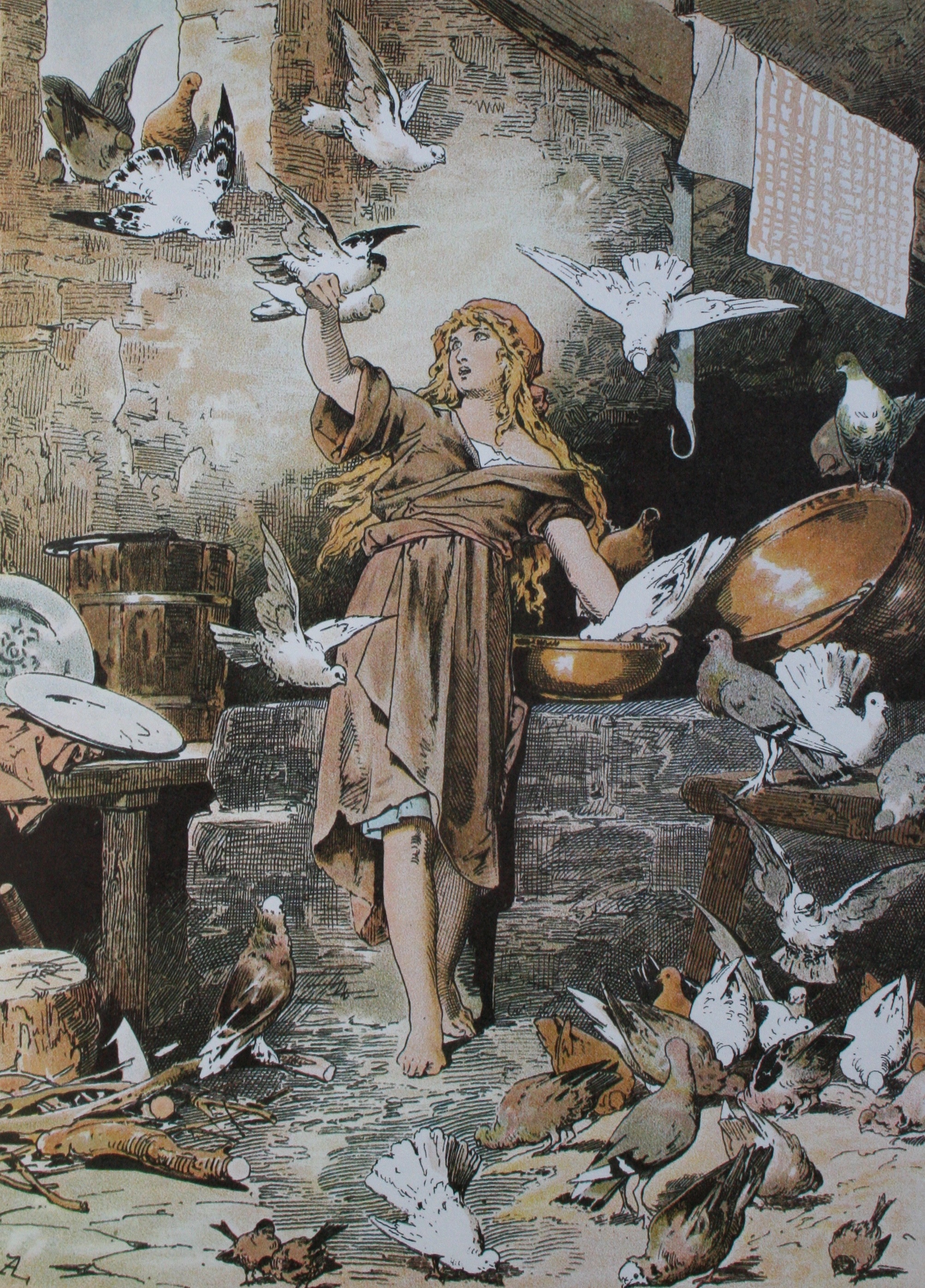
Let this be said furthermore - the story of Cinderella is just that; as we may find:
We begin with the picture of the hearth, as it was the sweet Cinders’ title to attend to the space in which the fires would burn heartily. Let this space be now her heart, which is given over to the household and to the world. She does clear away the ashes that she may prepare for the fires to burn again. In this there is truth that the soul’s love which inflames our inner spaces, graced by spirit and the life of the spirit, becomes choked with residue and the impulses subside, ever needing prompting back to life; for love and love’s passion, does ebb and flow in rhythmic obedience. There is the time in which we contain the fire, and the time in which we clean the hearth and prepare for its coming again.
Cinders had two sisters which dominated this story: Slovenliness and Wickedness. These sisters were unlike her in nature, bearing little or no resemblance to the child of the heart/hearth.
There was to be an occasion. A prince of the district was to hold a gala party that he may choose a wife to couple with. The sisters were eager to try their chances. The prince resembled all that a stately soul should be, in upright virtue, in strength and in capability. Therefore the acquaintance and subsequent mingling was desirable. For it can be said too, that when an individual truly meets in soul with another friend, then the qualities are shared. This is why we seek our Christ in combining, as best influence upon our humble natures.
Returning to the story: The haughty sisters mocked Cinders that she would wish to go to the Prince’s party. This party was the community host of all his invited confederates. This other soul has opened himself to the world at large, that he may seek out true commune in spirit, and so by inviting all of those who would accept the invitation (and others who would not) he has gone through the necessary obligations of being openhearted as well as openminded. For we must remember that all men are unknown to us, unless we truly know them. Should we really come to know them, then there is much love and affinity thereby. However, at the stage he was at, the Prince was seeking for his soul’s commune (that being the theme of this story) and so he was open to all, that he may find that which was especial.
The sisters are attributed to be quite ugly, but did do the best they could, dressing themselves in common finery, pretending that the outer appearance could conceal their sinful and lazy natures. In the outer world this does happen, that a man may feel uplifted, almost morally, by such clothes which are stately- however, it may be but a good guise and little more; particularly if the individual wears pride as well. And proud these two were, as they did strut with self admiration.
Here now, our picture of sweet Cinders is of rags, and she is overcome with the soot-black of ash upon her white skin. Why then should it be this way, that the pure of heart is portrayed so forlorn? This is because the soul is wanting and is not fulfilled. The closer to God that a soul does become, the more it suffers the world. It does also come to great happiness accordingly, however.
When the sisters had departed, Cinders fell into great upset at her self’s condition. If we are to review ourselves by comparison, we shall always find disparity; and so it is that the sadness came, but was answered in the appearance of an Angel. The Angel appeared to Cinders in beauty and in radiance, saying "You shall go to the party tonight, and I have come to help you."
That Cinders was to attend was ordained by her right to do so. The assistance that she was given is one that we all have. Although our angel’s presence goes unrecognized (for they are forbidden to make themselves known), in this special story our Cinders catches the vision of her intervening Angel and hears her speak.
Our physical presence which carries us through a lifetime in the world, is comprised of the service of both the animal and plant kingdoms. The transformation of pumpkin into coach was an example of this; as quite so, our physical bodies are just such an issue, wherein the dear contributory kingdoms serve to bear our souls by their constant reformation.
Cinders herself was clothed anew in the most beautiful of wraps, with also two crystal shoes upon her feet. In her case the outfit bore the resemblance of her inner nature, inasmuch as she was worthy to wear the finery. It was produced from the Angel herself, and of much better material than could be purchased within the world.
The crystal shoes are significant, for they are the connection she has within the world, and they represent the very clarity of being, true to the world in perceiving how it is for what it is. Shoes are our protection, and they may be of fashion as well as practical, however they are worn to soften our relationship with the world, and do cordon our selves from the immediate reality. By the wearing of crystal slippers, Cinders is still quite separate and protected from the tearing and scratching and skinning of coarse grounds, but is connected in the most refined way possible, as her perceptions of the world are nonetheless accurate – therefore she meets with the world in a consciousness of purity. Only she was entitled to wear them; and this was so because there was no selfishness to mark and mar the clarity.
The Angel made warning that there was but a definite time for which Cinders could make use of her equipment; that she must indeed return home before midnight, for then it should happen that all would return to how it was.
When Cinders made her entrance she appeared exquisite and quite obviously beautiful. The Prince immediately recognized this, and had come to see the quenching of his longings; for there was this other soul which was in likeness to his, and with space waiting there to fill; for she had gone in faith and with open expectation.
The love became a rapture and they danced together for the length of the night. But as the late hours did filter into the new morning’s day, Cinderella (Cinders now made beautiful), lost her strength in magic glamor as she remembered the Angel’s warning of returning back. She fled the court lest he catch her great indignity - leaving behind one of two crystal shoes.
That which the Prince had retained was rightfully now his to keep. For this is the way of soul commune, that there is always the remaining evidence and shared qualities; so one of the shoes became of his belonging. It is significant also because they both shared now a same connection with the world, and that he would come to know this to seek it further.
The Prince had no immediate way of finding his love directly. The powers of soul are illusive, and perhaps better understood to say that our comprehensions are many, with not one being so constant as to prevail over all. Continuance is always assured - that we pick up and return to this and that understanding, situation or soul. But change occurs in lively fashion, for without change, there becomes inertia leading to subsequent expiration; which necessitates a different change regardless. So he took charge to find his beloved, in whom he experienced a mutual knowing - but he knew not enough to simply recognize her by sight alone!
How often Christ has appeared to those who knew Him, but knew Him not! The way in which they could come to Him, once again, was not by this the visual appearance, and not by expectation born of themselves, but in being true to the spiritual reality, in meeting with crystal clear connection (the other half recollected), knowing that the love between you both verily made two sets of keys. You may go into the space of faith, into the heart, to find Him.
The noble search continued until the Prince happened upon the cottage in which Cinders took rest. Pushing their way before her, the sisters were determined to press their feet into the shoe - bleeding and crushing, bones cracked and toes looped off. But even so, there was no fit, and their false proof of soul-hood came to no real description. It was then that Cinderella was given the opportunity and so placed her foot in his half of the pair. Of course, the fit was perfect! It could not have been otherwise, and he knew her to be the one that he longed for.
Without the shoe he may have well bypassed this individual and kept up the lonely search. By appearance only we are ill-informed. Her costume given to her from the Angel, was one which showed only substance of soul; but it could not survive as visible within the outer world for long – it had to withdraw.
As it is said, the heart sees what the eyes do not; and contrariwise, the heart is a gentle informant. We can be peaceful in the proposition that others rarely see us as we are in truth. Although there most certainly will come the day when aspects are shared openly and obviously, for the time being there is a self protection for immature egos, that they develop a sense of self firstly; and then may go on to such sharing amongst selves in the greater outreach.
If we are aware of this, then we shall immediately lessen our penetrating influences upon others: those that impinge or dominate, or devastate the less developed individual. Once again it is a matter of understanding and attitude that people shall come to understandings with us and by us at the time when we cease to force ourselves upon them.
Our cloaks of humility are apparent when we are relaxed in our selves (and no, this does not mean inebriated or casual, or inconsiderate or sleepy). In spiritual definition it means that the inner tensions of want and will are divorced from our interest in another, and our love for their being prevails over personal desire. Our desire here of course, is that of being seen for who we are etc., and so we may forgo even that in order to meet them with love. This is not to say that we wear a cloak of falsehood or deception, for that kind brings sadness to both souls and no real convening.
Expressions of love from men, bring the gods their great happiness. We can only give love where it is chosen to be received; and if the space is not there for us to go into, there is no reality thus given it. And the space shall not be made if there is no faith there within that heart – as so cried Christ, for us to believe in Him.
The Prince did find his sweetheart and delivered her from the service of the sisters. The three were truly the one – our sweet souls are mocked thus by our own laziness and wickedness, which pretend to be beauteous and worthy of another soul’s consideration. When we have departed from these two undesirables, when we listen to our Angel’s counsel and pursue our heart’s destiny with clarity within the world, then it shall happen accordingly that we will find our destiny through faith, in believing of the greater love that shall one day come to reclaim us.

See the wild spill of plant and tree,
Blossom and berry,
As it rushes extravagantly into being;
With a ferocity advantageous,
The grasp and the grip of each moment realized;
Through vein with liquidity,
In resonant ambiguity;
Here is truth so complete and made evident,
Just by that being of expression –
Here in resource, in infiltration,
Whereupon the sunlight touches…
In argument the tresses strain,
In tangle, they altogether,
Each scene,
Each dream,
Each caught in frame;
Their angelic servitude lives true to our moment,
And reliable to objectivity.
Hush! Hush!
Hear the Wisdoms call for you,
Soft song in Man,
They here are tuning,
With valor,
Should he embrace their beauty,
And withstand the push out,
Into extremity's limits.
Relax! Relax the torsion's pull,
And stay awhile inside here,
In this quiet sanctum,
Close by, thereby,
There are the Spirit's secrets,
And here within,
Deep in agreement they confide,
Maintaining the Glories to be unrepentant,
As they sweep on and over into cascading joy.
Just as traveling froth,
Cheer sits atop the wave,
That heaves souls throughout Time's continuity.
The Spirit’s speak is hardly heard…
Yet seen as apparition;
By sign,
Or meaning so imposed,
To catch the comprehension.
And now be known,
My Christ,
My love,
In all that is so filled…
Your patient care,
And Might contained,
Implores my soul,
To come within your world…
That we know Love,
And it knows us -
There is no other better.
Our life is sensed,
And fully known,
In Love that is forever.
 THE materialist would tell you that the actions of one man are equal to that of another, that if a prescription was followed in the physical realm and imitated regardless of intent being a factor, then accordingly all that followed would be unremarkably the same.
This is not the case however, when one perceives the expirations which follow on from any one act. Everything a man projects out from himself is significant. A projection, for the sake of definition here, is outer activity which can be described as anything from 'being' and its natural consequences and impacts, to self-conscious definition, deliberation and decision accompanying an actual act. Such outer activity cannot help but be and become consequential.
The ways in which it significantly does become transfused with all other consequential factors which work and weave their way into the present, is dependent upon the spiritual foundations of their worth. There are those which are short lived because there is no sustaining virtue afforded them - as in the careless act of a man who is not invested with the necessary empowerment to further it into the future - not being worthy in itself and of itself, to remain as a remarkable event. Therefore, it shall be as dust.
One might question the events which have been noted as an outfall to many a 'careless' act which have inadvertently caused great consequence, crucial and pivotal to a circumstance. However in these instances, of which there are a great many, we find here that a man has been used instrumentally by an inoffensive angel (angel, as in warden of the presenting karma; it may be an 'acting' angel, i.e. another man). Because of the lack of intent, and being void of ego-involvement, there is an opportunity for his actions and his presence to be utilized to assist some purpose unknown to him.
THE materialist would tell you that the actions of one man are equal to that of another, that if a prescription was followed in the physical realm and imitated regardless of intent being a factor, then accordingly all that followed would be unremarkably the same.
This is not the case however, when one perceives the expirations which follow on from any one act. Everything a man projects out from himself is significant. A projection, for the sake of definition here, is outer activity which can be described as anything from 'being' and its natural consequences and impacts, to self-conscious definition, deliberation and decision accompanying an actual act. Such outer activity cannot help but be and become consequential.
The ways in which it significantly does become transfused with all other consequential factors which work and weave their way into the present, is dependent upon the spiritual foundations of their worth. There are those which are short lived because there is no sustaining virtue afforded them - as in the careless act of a man who is not invested with the necessary empowerment to further it into the future - not being worthy in itself and of itself, to remain as a remarkable event. Therefore, it shall be as dust.
One might question the events which have been noted as an outfall to many a 'careless' act which have inadvertently caused great consequence, crucial and pivotal to a circumstance. However in these instances, of which there are a great many, we find here that a man has been used instrumentally by an inoffensive angel (angel, as in warden of the presenting karma; it may be an 'acting' angel, i.e. another man). Because of the lack of intent, and being void of ego-involvement, there is an opportunity for his actions and his presence to be utilized to assist some purpose unknown to him.

In this instance the karma is a bonus, it is true; that he has been offered the opportunity to manifest some remarkable turn of events. However it may also unfortunately, happen the other way also. Sadly a man may be temporarily made much use of, when his self-conscious control is quite forfeit, and he may be lent to ill purpose by demons who know no better. So one may not prefer to walk around being solely instrumental to the invisible; it is dependent upon the moral makeover and condition of a man that he attract the right and proper influences accordingly. We may all be watchful and prayerful, that our actions are only placed as Christ would have them.
Now in returning to the opening suggestion: there is a world of difference (what a remarkable phrase that is) between the performance of any given act by one man and another - just as, as you may imagine, between individual beings also. For example, when Christ moved in one direction the whole world shifted. (This is speaking of His time in physical internment.) Everything He did in the physical world, in that physical condition, was miraculous - termed so because the natural laws were obedient to Him, and where His intention was incited the matter was plastic to His Will.
Upon his 'death' and after His resolving, there were and were not marks of those changes which He had effected. He withdrew the evidence, so to speak, of much of His Presence. The matter which was immediately affected by His being, by all that He physically touched and made altered, does contain the memory-imprint sufficient to one day be recalled. However, speaking in the obvious sense of the immediate memories as are akashic or consequential, He returned the natural law to its rightful domain, insofar as He could not risk an anarchy spirit, which otherwise would have been born by Him.
Now this is a little complicated, so see if you can stay with me as I lead you through this concept. Christ nor Father God, do not turn against themselves, ever. There is evidence to say that this is impossibility; and were it made so, that they became supremely contradictory, then the patterns so established by such higher conflict would be involutionary and unthinkable.
The very concept of nuclear war is based upon this fear of higher turmoil. And too the capabilities for the kind of change as is effectual, is related to just a few actions of Christ having been, as we describe, defiant of the laws as were. This is not the occasion to travel the thoughts about nuclear and other implications, but what can be said is that there are reasons and not just serial accidents, which have brought such forces into evidence.
However and more important to this issue: it is true that many poor individuals do undermine God and Christ in their contemplations, by way of doubting and fearing and believing them to be less than they are. This can happen in a variety of ways, and perhaps it comes from our own imperfections or perhaps and more than likely, from a bevy of suggestions which hang heavy in the astral domain. Many grumbles have been cast into the immediate astral. The souls from whom they did issue, are quite free of them and so unburdened; however they remain for some time and are convincingly bleak.

The question then is, if Christ altered back that which He made change, what did remain? This is the nice part: love became no less significant, it became moreso. Love in Man was given the power to immortalise that which it was invested into by any man. The physical laws were and were not altered in this - the everlasting spiritual projections and realities were. The material world could not be so impressionable as it had been in the past.
There was a time when one might 'wish' for another and it would be so - given that the design was placed well, immediate and apparent results would be consequential to the thought. Men could be physically perfect and materially wealthy, and the Sun would shine all day long as the clouds would be obliged to just rain where told. Yes indeed there was such a time in a former world; and many hearken back to it. Also there are many places within the spiritual worlds where this is the case, and so lived after death and in dreams besides.
However, in the physical world a man still does reflect much of his being; only there are the associated impurities from within which are now evident and needed to be sloughed. Our wonderful capabilities have deviated into more complex talents to be perfected, and at this time it is of much more soul importance to negotiate with struggle, rather than look for the easy mean.
It is not that we would not wish happiness to all individuals. Of course this wish is fine and noble and reflective of the joy of God Himself. But we look to true profit and real joy, and to that which shall be everlasting rather than temporal; which by the physical law itself, the physical world is changing, malleable to the future and therefore unstable and only ever temporary in what it has to offer.
So when Christ asked us to invest ourselves in Heavenly aspect, it is (and this is the important point) not because we should choose to artificiate a heaven here amongst the evolving futures subject to consequential law, but that by our own actions here in the physical world, we shall eventually make perfect the World by way of those very laws, worked with love. Every action (thoughts are inclusive in this too) which is given in love (i.e. true love requires selflessness), becomes consequential in the parent realms and indelible within a future.
Commerce, as in trading, is commerce, whether it be with money or with peanuts. Barters are still with self-interest; and whatever the system, it is a system nonetheless. These systems of agreement are rarely advantageous to both parties - this is just offered in observation. However and consequential to that, there is of course the karmic follow-on always, for which retribution shall be levied.

Money is indeed an artificial wisdom, and the student when contemplating its configurations will be astounded and perplexed, for there are some terrible beings associated with the mass. It is not entirely relevant to itself; and this is our saving conclusion. What does become relevant is what we may give completely and freely. This is revolutionary to the laws - always has been - and now more than ever. There are no restrictions given to each individual on just how much he can afford to do just this. There are no systems required, for opportunities arise most everywhere for effort to be made selflessly. And by living the reality the greater world is made. This is a great truth. Of course it is irksome to our 'selves'. The very term 'self-less' is threatening to self. So we must look to the way in which it is not so disturbing, and understand exactly, just what in the true and proper sense we may exercise.
When a man feels inspired by love, it is that his own concentration of self becomes dispelled and relieved of the pressure of being so tight-bound within the veneers of his own ego definition. His interest is captured by that which he has gone to in mind or in soul. For that time he has exceeded his own self with the joy that has brought him into places and stations and true commune without.
Love can be because of affinity, but in its working process upon a man it most definitely exceeds all affinities because it leads to greater ones, mutual ones that are thereafter established when experienced mutually. Therefore the release of a man out from himself, is the freedom he feels in love - free in spirit, because quite truly, this he has become.
Our own selves are to be cherished and prized, and regarded with especial interest and care. Our own selves are entrusted to our beings solely, and so we are mindful of the responsibility each has unto his own self, and the love of our being, that it thrives and that it continues. It is also the nature of our being to participate with other beings - not only that we may fit in with our own ecology or just to feed and fill ourselves to capacity, but rather delight and find God by our communion with others, alongside our own nature.

The notion of selflessness is only irksome where there is no love implied. The man may then look for the return for his efforts, and may or may not be satisfied with the outcome. The self-less lover is always satisfied with the outcome, for it is promised with the very love that he does offer. It need not be an action. It is not in truth a 'feeling' as such either; although there are a convoy of accompanying emotions which arise and circulate the immediate ethers when a man is inspired in this way.
Can you picture a very fast journey as the consciousness travels, the soul in the uptake? For love draws us up into the far reaches of our spirit, as close to God as we may become. Then we journey down, all the time having being freed from self, because we are distracted from self. We are marvelously and delightfully distracted. We go, in our soul, to that very adoption of consuming attention - unlike the forcible exit from bodily constraint which certain drugs and practices do incur (and this does mimic the 'feeling' of love in the release). Unlike that loosening, the individual has come to his Beloved in consciousness and met in spirit - taken to the lap of God every time, bringing back in residue, a voucher for continuation. For this is the promise of Christ, that where there is love there is life eternal.
So the practical man, the materialist, who enjoys an almost immediate recompense for his actions, is preparing himself for the greater lesson to adopt, but in actual effectiveness within the world he shall be limited, as his issues are not 'guaranteed' as it were, or offered permanence, for they are self-limited and therefore restricted.
There is little point in trying to be selfless purely for the sake of it - this is destructive to the individual in many respects, not the least being the associations of such it shall establish. However, there are so many credits one is not aware of (that too being 'part and parcel'); and there are simple loves and acts of love, which men project all during the day. These simple but not so obvious investments are the very great beginnings to a wholesome career of natural sainthood in the future.
There is no need for terrific pressure or heartache - far better to work towards the self-goals consistently and thoroughly, and fill the lifetime with as much true soul activity as possible. In this it is meant that the rest will follow. If a man is true to his heart, as they say, then his activities and meetings and consequential dues will be obliging with grace.
The vision which is dear to Miss I.S. [questioner] is worthy of holding close, and projecting into future economies. It is natural and sensible to feel the need for an 'ecologically sound' economy. It would be unnecessary for this to become a matter of sadness or depression in the frustration for immediate realisation, for the most productive way to address this concern is in personally taking the time to defy the superficial laws and just give what you can. Quite often, if an individual offers himself to Christ it will be made known what it is that they can give, if they so desire.
Do we seek only the glamorous employments? Be cautious as to attractions. However it is best to pursue that which is so exciting to your greatest joy - that there is no hesitation but to. The faith in such love will sustain you when you have exhausted yourself for a time.
And in the lesser marvel, employ a measure of charity at all times. Give time to the people who ask it of you. Give attention to what you consume. Give prayer for the needy, and know that the prayers when issued with love and compassion and empathy, are substantial to the overall remedy, and that such prayers are the necessary transfusers of law. Thereby the angelic influences have been invited to employ.
By prayer in love we release they who we may pray for. The action of the love is met on a soul level and works as it does within and verily without, our selves. The very nature of prayer is profound in this. This is explicit to high love for another, that we may take their cause or their pain or their protection, into our hearts and care for them. With the working of love we may carry them up into their highermost spirit-souls to be renewed, to be revivified and to be given then the substantiality of yet another measure of love's immortality.
Give effort, and when the rewards come, give them away too. It is a fine ideal to wish to divorce oneself from material belongings, however this gesture may be limiting to the overall effectualness within the world - perhaps best kept under the responsibility of yourself. In other words, if one is entrusted with monies within the world, then it is very much a responsibility and a personal concern to do the very best with such monies; to give them away completely is always done when dead, and even then there may be discretion as to where it is best gone to.
However and more importantly, it is always the man himself and his very attitude of being which determines the world.
- Man 1 grows corn to feed himself.
- Man 2 grows corn to feed the family.
- Man 3 grows surplus to sell for a profit.
- Man 4 grows corn to give to the neighbors.
- Man 5 grows corn and loves his corn.
He may be Man 1 through to 4, but he also loves his corn. He still tires at night, he may suffer the intemperate seasons, but he loves his purpose. He knows the germ and the marvel of its passage into sheath and then to Man - corn becomes in Man, as Man becomes enstrengthened by the corn.
He stands among the fields and sees the pulse of produce there before him, and feels the freedom of his spirit's release, there in that field of glowing golden corn. And he is elated.
Esoteric Christianity Archive